

Description
This Bundle for Utah SEEd 5th grade includes science resources for each strand and standard. Each unit addresses specific Utah SEEd standards for 5th grade. Students will love these engaging activities for Utah SEEd 5th Grade. You will love saving time by having someone creating resources who really understands Utah SEEd.
Utah Teachers Love This Bundle! ❤️❤️❤️
Vista ⭐️ ⭐️ ⭐️ ⭐️ ⭐️ Extremely Satisfied
This is awesome for Utah SEEd 5th grade! All the standards are addressed and this made transitioning to these new standards so easy. The author was my science methods teacher at the university and she really knows the Utah SEEd. My students and I are enjoying all of these great activities.
Janet ⭐️ ⭐️ ⭐️ ⭐️ ⭐️ Extremely Satisfied
I love this resource. It has been so useful! I love that there are a variety of activities to choose from. I really appreciate all the visual aids. I am excited to have assessments for our new science standards! Thanks
I have a great deal of experience teaching Utah SEEd standards and science methods courses in Utah. My resources include research-based practices such as using phenomena to engage students, crosscutting concepts, and science and engineering practices. Check out my website to find out more about my credentials. Lynda R. Williams
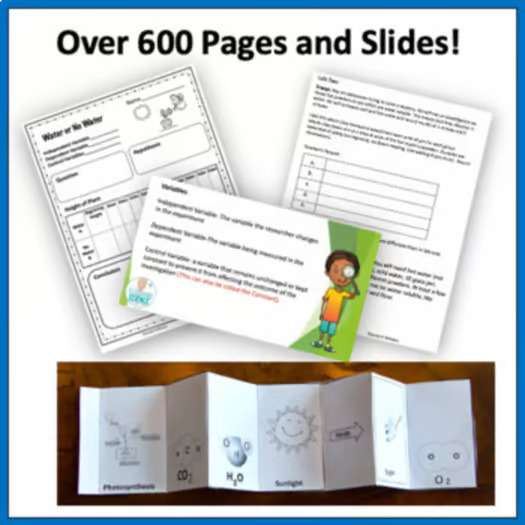
This bundle covers all the standards for Utah SEEd 5th grade with interesting units that include labs, hands-on activities, slide shows, reading passages, response pages, worksheets, and assessments. My Utah SEEd resources use phenomena and engage students in the science and engineering practices and the crosscutting concepts.
Strand 5.1: CHARACTERISTICS AND INTERACTIONS OF EARTH’S SYSTEMS
Utah SEEd Standard 5.1.1
Analyze and interpret data to describe patterns of Earth’s features. Emphasize most earthquakes and volcanoes occur in bands that are often along the boundaries between continents and oceans while major mountain chains may be found inside continents or near their edges. Examples of data could include maps showing locations of mountains on continents and the ocean floor or the locations of volcanoes and earthquakes. (ESS2.B)
Utah SEEd Standard 5.1.2
Use mathematics and computational thinking to compare the quantity of saltwater and freshwater in various reservoirs to provide evidence for the distribution of water on Earth. Emphasize reservoirs such as oceans, lakes, rivers, glaciers, groundwater, and polar ice caps. Examples of using mathematics and computational thinking could include measuring, estimating, graphing, or finding percentages of quantities. (ESS2.C)
Utah SEEd Standard 5.1.3
Ask questions to plan and carry out investigations that provide evidence for the effects of weathering and the rate of erosion on the geosphere. Emphasize weathering and erosion by water, ice, wind, gravity, or vegetation. Examples could include observing the effects of cycles of freezing and thawing of water on rock or changing the slope in the downhill movement of water. (ESS2.A, ESS2.E)
Utah SEEd Standard 5.1.4
Develop a model to describe interactions between Earth’s systems including the geosphere, biosphere, hydrosphere, and/or atmosphere. Emphasize interactions between only two systems at a time. Examples could include the influence of a rainstorm in a desert, waves on a shoreline, or mountains on clouds. (ESS2.A)
Utah SEEd Standard 5.1.5
Design solutions to reduce the effects of naturally occurring events that impact humans. Define the problem, identify criteria and constraints, develop possible solutions using models, analyze data from testing solutions, and propose modifications for optimizing a solution. Emphasize that humans cannot eliminate natural hazards, but they can take steps to reduce their impacts. Examples of events could include landslides, earthquakes, tsunamis, blizzards, or volcanic eruptions. (ESS3.B, ETS1.A, ETS1.B, ETS1.C)
Strand 5.2: PROPERTIES AND CHANGES OF MATTER
Utah SEEd Standard 5.2.1
Develop and use a model to describe that matter is made of particles on a scale that is too small to be seen. Emphasize making observations of changes supported by a particle model of matter. Examples could include adding air to expand a balloon, compressing air in a syringe, adding food coloring to water, or dissolving salt in water and evaporating the water. The use of the terms atoms and molecules will be taught in Grades 6 through 8. (PS1.A)
Utah SEEd Standard 5.2.2
Ask questions to plan and carry out investigations to identify substances based on patterns of their properties. Emphasize using properties to identify substances. Examples of properties could include color, hardness, conductivity, solubility, or a response to magnetic forces. Examples of substances could include powders, metals, minerals, or liquids. (PS1.A)
Strand 5.3: CYCLING OF MATTER IN ECOSYSTEMS
Utah SEEd Standard 5.2.3
Plan and carry out investigations to determine the effect of combining two or more substances. Emphasize whether a new substance is or is not created by the formation of a new substance with different properties. Examples could include combining vinegar and baking soda or rusting an iron nail in water. (PS1.B)
Utah SEEd Standard 5.2.4
Use mathematics and computational thinking to provide evidence that regardless of the type of change that occurs when heating, cooling, or combining substances, the total weight of matter is conserved. Examples could include melting an ice cube, dissolving salt in water, and combining baking soda and vinegar in a closed bag. (PS1.A, PS1.B)
Utah SEEd Standard 5.3.1
Construct an explanation that plants use air, water, and energy from sunlight to produce plant matter needed for growth. Emphasize photosynthesis at a conceptual level and that plant matter comes mostly from air and water, not from the soil. Photosynthesis at the cellular level will be taught in Grades 6 through 8. (LS1.C)
Utah SEEd Standard 5.3.2
Obtain, evaluate, and communicate information that animals obtain energy and matter from the food they eat for body repair, growth, and motion and to maintain body warmth. Emphasize that the energy used by animals was once energy from the Sun. Cellular respiration will be taught in Grades 6 through 8. (PS3.D, LS1.C)
Utah SEEd Standard 5.3.3
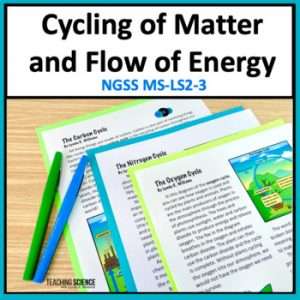
Develop and use a model to describe the movement of matter among plants, animals, decomposers, and the environment. Emphasize that matter cycles between the air and soil and among plants, animals, and microbes as these organisms live and die. Examples could include simple food chains from ecosystems such as deserts or oceans or diagrams of decomposers returning matter to the environment. Complex interactions in a food web will be taught in Grades 6 through 8. (LS2.A, LS2.B)
Utah SEEd Standard 5.3.4
Evaluate design solutions whose primary function is to conserve Earth’s environments and resources. Define the problem, identify criteria and constraints, analyze available data on proposed solutions, and determine an optimal solution. Emphasize how humans can balance everyday needs (agriculture, industry, and energy) while conserving Earth’s environments and resources. (ESS3.A, ESS3.C, ETS1.A, ETS1.B, ETS1.C)
The slideshows and pages in this bundle are not editable. My work is protected and secure for copyright reasons. All resources in this bundle are in PDF and PPT format. The assessments include Google forms as well as a pdf.