Claim, Evidence, and Reasoning writing can be one of the most powerful ways to help students think like scientists. CER evidence and reasoning help students support their claims with data and explain why that evidence matters.
But I see one problem again and again: students often understand the claim, and many can even find the evidence, but they struggle with the reasoning.
They may copy another piece of data.
They may restate the claim.
Or they may write something like, “This proves my answer is correct.”
The missing piece is helping students understand that evidence and reasoning have two different jobs.
Once students understand that difference, their CER responses become much stronger.
Read more about How to Teach Students to Write a CER
What Is CER in Science?
CER stands for:
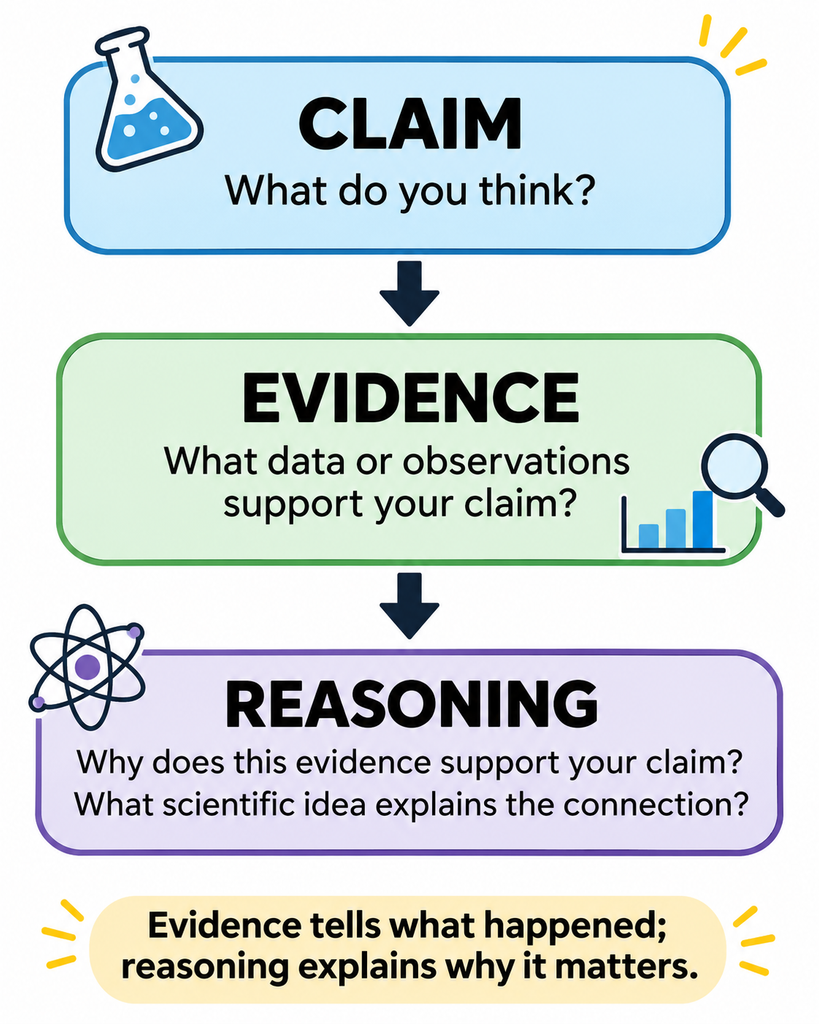
Claim: An answer to a scientific question.
Evidence: Data or observations that support the claim.
Reasoning: An explanation of why the evidence supports the claim using scientific ideas or principles.
A simple way to explain it to students is:
- Claim = What do you think?
- Evidence = What information supports it?
- Reasoning = Why does that evidence matter?
That last question—Why does that evidence matter?—is often the key to helping students finally understand reasoning.
What Is the Difference Between Evidence and Reasoning in CER?
Evidence comes from the investigation, graph, data table, model, reading, or observations students are analyzing.
Reasoning comes from the student’s scientific thinking.
For example, imagine students are studying whether a garden cover helps keep soil warmer overnight.
The data might show:
- Uncovered soil temperature: 8°C
- Covered soil temperature: 12°C
A student might write:
Claim: The garden cover helped keep the soil warmer.
Evidence: The covered soil was 12°C, while the uncovered soil was only 8°C.
So far, so good.
But then comes the reasoning.
A weak response might say:
Reasoning: This shows the garden cover worked.
That does not really explain anything.
A stronger response would be:
Reasoning: The covered soil stayed 4°C warmer than the uncovered soil. A cover can reduce heat loss from the soil to the surrounding air, so the warmer temperature supports the claim that the cover helped retain thermal energy.
The evidence tells us what happened.
The reasoning explains why that evidence supports the claim.
Why Do Students Struggle With CER Reasoning?
Students often struggle with reasoning because it requires them to make a connection that may not be directly stated in the data.
They need to connect:
Evidence → Scientific idea → Claim
That requires more thinking than simply locating a number on a graph.
Students may also believe that once they have provided the correct data, their work is finished. They do not always understand that readers need to know why the data matters.
That is why I spend time explicitly teaching evidence and reasoning as two separate skills.
| Evidence | Reasoning |
|---|---|
| Comes from the data, graph, observations, or text | Comes from scientific understanding |
| Tells what happened | Explains why it happened or why it matters |
| “The covered soil was 4°C warmer.” | “The cover reduced heat loss, helping the soil retain thermal energy.” |
How Can I Teach Students to Choose Strong Evidence?
Before students write a complete CER response, give them practice choosing evidence.
Ask questions such as:
Which piece of data best supports this claim?
Which observation is relevant to the question?
Which two data points should you compare?
What pattern in the graph supports your answer?
This helps students learn that good evidence isn’t just any number they can find.
Strong scientific evidence should be:
- Relevant to the question
- Connected to the claim
- Specific
- Taken from the available data or observations
- Accurate
Students also need to understand that more evidence is not always better.
Two strong pieces of evidence are often more convincing than five unrelated facts.
Teach Students to Ask: “How Does This Evidence Help Prove My Claim?”
One of the simplest CER strategies is to have students stop after writing their evidence and ask:
How does this evidence help support my claim?
That question forces students to move from reporting information to explaining it.
For example:
Evidence: Plants receiving eight hours of light grew an average of 15 cm, while plants receiving two hours of light grew only 6 cm.
Then ask:
Why does that evidence matter?
A student might explain:
Reasoning: The plants receiving more light grew more. Plants use light energy during photosynthesis to make sugars needed for growth, so the greater growth supports the claim that increased light helped the plants grow.
Now the student is connecting the evidence to scientific knowledge.
Use the “Because” Test for CER Reasoning
Another simple strategy is to have students imagine placing the word because after their evidence.
For example:
The covered soil remained warmer because…
The plant grew more because…
The population decreased because…
The sentence that follows should contain the scientific idea that connects the evidence to the claim.
This is not a formula students have to use forever. It is a scaffold that helps them recognize what reasoning sounds like.
Help Students Separate Data From Scientific Ideas
I also like to have students sort statements into two categories:
Evidence
or
Reasoning
For example:
Statement: The temperature increased from 20°C to 35°C.
That is evidence because it describes data.
Statement: Higher temperatures can increase particle motion.
That is reasoning because it uses a scientific concept to explain the evidence.
This simple sorting activity can be surprisingly helpful.
Students often need to see multiple examples before the distinction becomes clear.
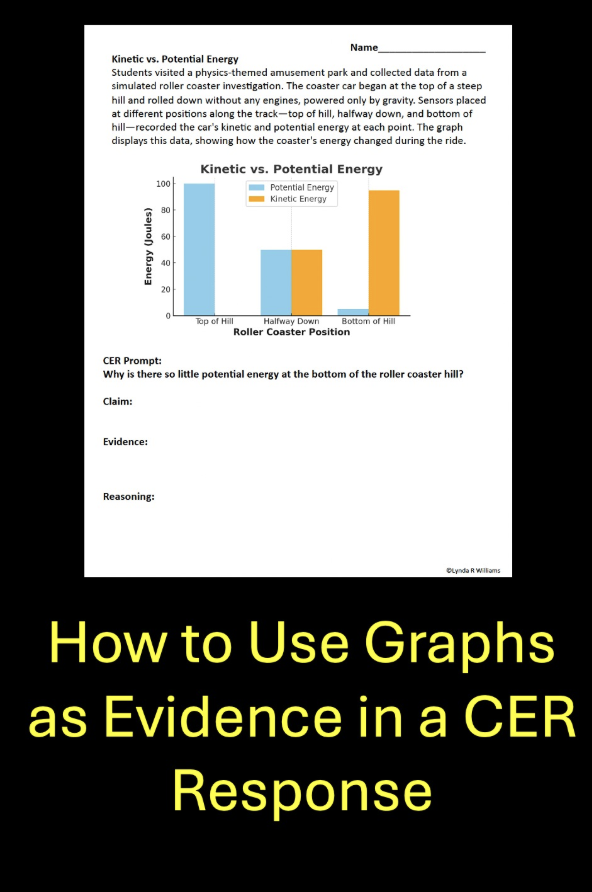
Use Graphs and Data Tables for CER Practice
Graphs are especially useful for teaching CER because they make it clear where the evidence comes from.
Give students a graph and ask them to:
- Identify the pattern.
- Make a claim.
- Choose one or two data points as evidence.
- Explain why those data support the claim.
For example, students might analyze a graph showing predator and prey populations over time.
A student could write:
Claim: Changes in the prey population affected the predator population.
Evidence: When the prey population increased, the predator population increased shortly afterward. When prey numbers dropped, predator numbers also decreased.
Reasoning: Predators depend on prey for food. When more prey is available, more predators can survive and reproduce. When prey becomes less available, the predator population may decrease.
This kind of practice helps students see that reasoning requires more than reading the graph. They must apply what they know about the science.
Start With Short CER Responses
Students do not always need to write a full-page response.
In fact, short CER activities can be one of the best ways to build the skill.
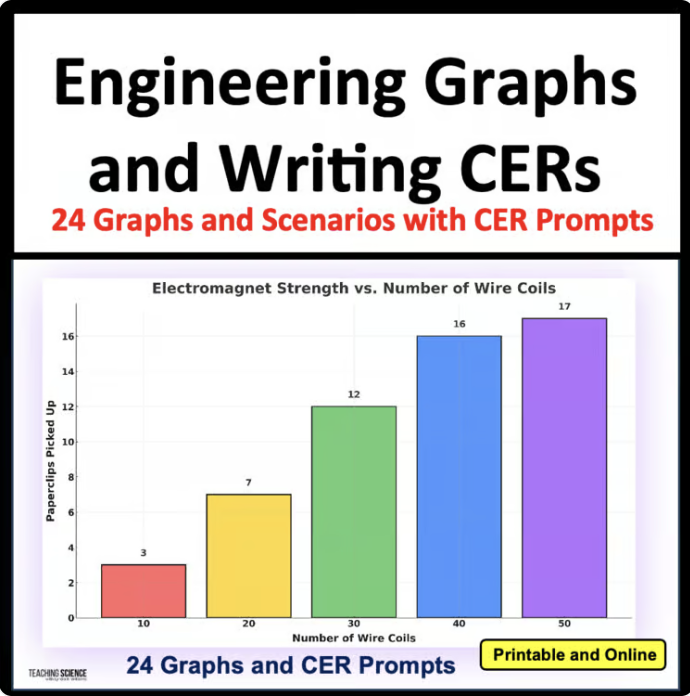
Give students a graph, photograph, short scenario, or set of data and ask for:
One claim
Two pieces of evidence
Two or three sentences of reasoning
This keeps the focus on scientific thinking rather than writing length.
Once students are comfortable with the structure, they can apply CER to labs, investigations, longer readings, and more complex scientific questions.
Get a FREE CER Writing Prompt Here
Model Both Weak and Strong CER Responses
One of the most effective ways to teach CER is to show students examples.
Instead of showing only a perfect response, give them two examples and ask:
Which response is stronger?
What evidence was used?
Does the reasoning explain why the evidence matters?
What could be improved?
For example:
Weak Reasoning
The data proves my claim because the plant grew more.
Stronger Reasoning
The plant receiving more light grew 9 cm more than the plant receiving less light. Because plants use light energy during photosynthesis to produce sugars used for growth, the greater growth supports the claim that light availability affected plant growth.
Students can usually recognize the difference before they can produce the stronger response themselves.
Analyzing examples gives them a model to follow.
Sentence Stems Can Help—But They Should Be Temporary
Sentence stems can be useful when students are first learning CER.
For evidence:
- The data show…
- One piece of evidence is…
- According to the graph…
- The results indicate…
For reasoning:
- This evidence supports the claim because…
- This matters because…
- Scientifically, this can be explained by…
- The relationship between the evidence and the claim is…
Sentence stems should support students while they are learning the structure.
As students become more confident, begin removing the stems so they learn to explain their thinking independently.

Ask Students to Highlight Their CER
A simple color-coding strategy can help students check their own work.
Have students identify:
- Claim
- Evidence
- Reasoning
They can underline or highlight each part using a different color.
Then ask:
Do I have all three parts?
Did I include actual evidence?
Does my reasoning explain why the evidence supports the claim?
This makes the structure visible and gives students a simple way to self-assess.
CER Is About Scientific Thinking, Not Just Writing
It is easy for CER to become another writing formula.
But the real goal is much bigger.
Students are learning to:
- Analyze information
- Choose relevant evidence
- Recognize patterns
- Apply scientific concepts
- Explain relationships
- Defend a conclusion
These are skills scientists use when they interpret results and communicate explanations.
CER gives students a structure for practicing that kind of thinking.
How Do I Know if a Student’s Reasoning Is Strong?
A helpful question to ask is:
Could the reasoning make sense without the evidence?
If the student simply says, “This proves my claim,” the reasoning is probably too weak.
Strong reasoning usually includes a scientific concept, principle, relationship, or explanation.
Another useful test is:
Does the student explain why the evidence matters?
If the answer is yes, the student is probably moving in the right direction.
Frequently Asked Questions About CER Writing
What does CER stand for in science?
CER stands for Claim, Evidence, and Reasoning. Students answer a scientific question with a claim, support it with evidence, and explain how that evidence supports the claim.
What is evidence in a CER response?
Evidence is specific scientific information that supports the claim. It may come from observations, measurements, graphs, data tables, models, experiments, or scientific texts.
What is reasoning in CER?
Reasoning explains why the evidence supports the claim. It connects the evidence to a scientific principle, concept, or relationship.
What is the most common CER mistake?
One common mistake is repeating the evidence instead of explaining it. Students may include accurate data but never explain why that data supports their conclusion.
How can I help students improve CER reasoning?
Ask students, “Why does this evidence matter?” and “What science idea explains this result?” Modeling strong and weak examples also helps students recognize what good reasoning looks like.
Should students use sentence stems for CER?
Sentence stems can be helpful while students are learning CER, especially for reasoning. They should gradually be removed as students become more independent.
Can CER be used with graphs?
Yes. Graphs are excellent for CER practice because students can identify patterns, choose specific data as evidence, and then use scientific concepts to explain those patterns.
Helping Students Become Better Scientific Thinkers
Students do not usually master evidence and reasoning after one CER assignment.
They improve through repeated, manageable practice.
Give them opportunities to analyze graphs, evaluate evidence, compare responses, explain patterns, and answer one important question:
Why does this evidence support my claim?
Once students learn to make that connection, CER becomes much more than a writing strategy.
It becomes a way for students to organize their scientific thinking, support their ideas with evidence, and explain the science behind their conclusions.
About Lynda R. Williams
Hi, I’m Lynda R. Williams. I’ve spent more than 34 years teaching science and 20 years helping prepare future teachers at the university level. I love creating practical science resources that help students analyze data, ask questions, use evidence, and explain their scientific reasoning. My goal is to make science engaging for students while giving teachers activities that are clear, useful, and easy to bring into the classroom.