Description
Teach the uneven distribution of natural resources with a complete middle school Earth science unit aligned to NGSS MS-ESS3-1.
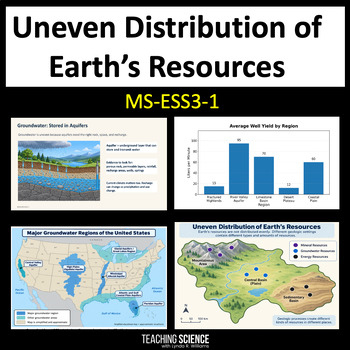
Students investigate why Earth’s mineral, energy, and groundwater resources are unevenly distributed and connect those patterns to past and present geoscience processes. Instead of simply memorizing where resources are found, students analyze maps, graphs, model data, and real-world patterns and use evidence to construct scientific explanations.
What Students Investigate
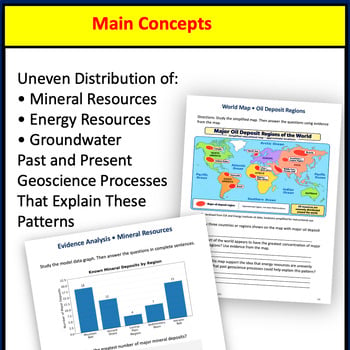
Students analyze the uneven distribution of natural resources, including:
- Mineral resources and rare earth mineral deposits
- Oil and other energy resources
- Groundwater and major aquifer regions
- Past geoscience processes that formed resources
- Present-day processes that affect resource availability
- Why certain resources are concentrated in some regions but scarce in others
Students connect resource patterns to geoscience processes such as magma movement, hydrothermal activity, mountain building, weathering, erosion, deposition, burial, heat and pressure, infiltration, and groundwater recharge.
What’s Included
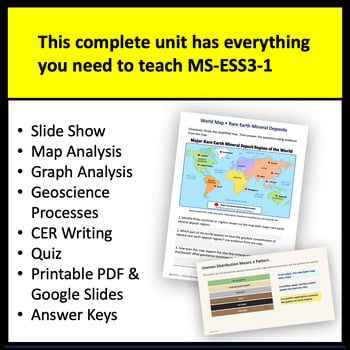
- 13-slide introductory teaching presentation
- 35 student and teacher pages
- Suggested 5-day lesson sequence
- 5E lesson plan
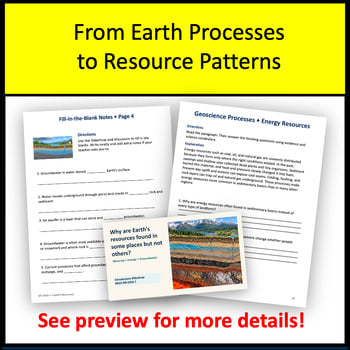
- Fill-in-the-blank guided notes
- Mineral resource graph analysis
- Energy resource graph analysis
- Groundwater graph analysis
- Rare earth mineral world map analysis
- World oil deposit map analysis
- U.S. groundwater aquifer map analysis
- Conceptual mineral deposit map
- Geoscience process readings
- Past and present process connection activity
- CER scientific explanation
- Multiple-choice and short-answer quiz
- Complete answer keys and sample responses
Digital and Printable Options
- Teaching slides in PowerPoint
- Teaching slides in Google Slides
- Student pages in printable PDF
- Student pages in typable Google Slides
Alignment to NGSS MS-ESS3-1
This resource is designed to address MS-ESS3-1: Construct a scientific explanation based on evidence for how the uneven distributions of Earth’s mineral, energy, and groundwater resources are the result of past and current geoscience processes.
Students do more than identify natural resources. They use evidence from maps, graphs, models, and data to explain how geoscience processes produced the uneven distribution of natural resources seen today.
Benefits for Students
- Builds confidence analyzing maps and graphs
- Strengthens evidence-based scientific reasoning
- Helps students connect Earth processes to resource patterns
- Provides scaffolded practice before the CER assessment
- Reinforces cause-and-effect relationships
- Gives students experience working with both model data and real-world patterns
Benefits for Teachers
This MS-ESS3-1 natural resources unit provides a complete instructional sequence instead of disconnected worksheets. The slideshow, guided notes, evidence-analysis pages, maps, graphs, CER, quiz, and answer keys are designed to work together, making planning easier and helping students move from introduction to independent explanation.
Perfect For
Middle school Earth science, natural resources, Earth resources, uneven distribution of natural resources, distribution of natural resources, geoscience processes, MS-ESS3-1, map analysis, graph analysis, and CER writing.