
Description
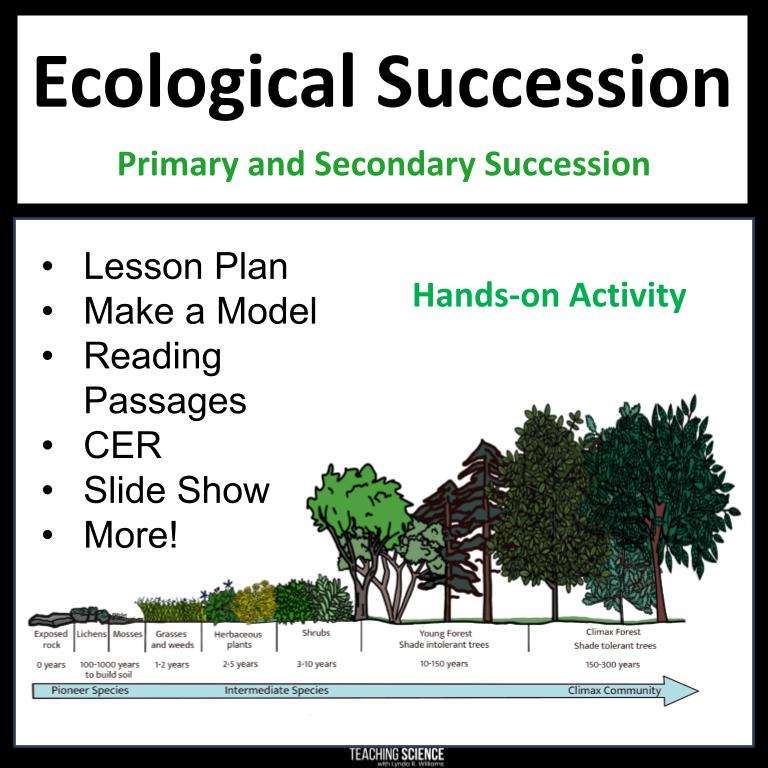
Bring ecosystems to life with this low-prep ecological succession unit that teaches students how environments recover and change over time.
Ideal for grades 6–9, this 4-day unit covers primary and secondary succession through real-world examples, hands-on activities, reading comprehension, and model-based learning. Aligned to NGSS, it combines literacy, science, and critical thinking in one complete, interactive experience.
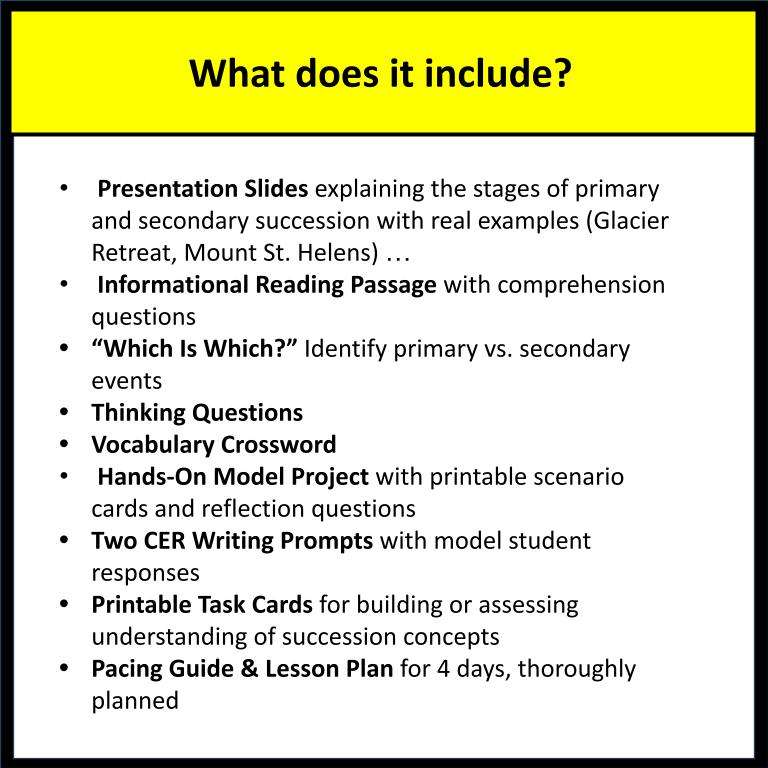
✅ What’s Included in this Ecological Succession Unit?
- Presentation Slides explaining the stages of primary and secondary succession with real examples (Glacier Retreat, Mount St. Helens) Editable!
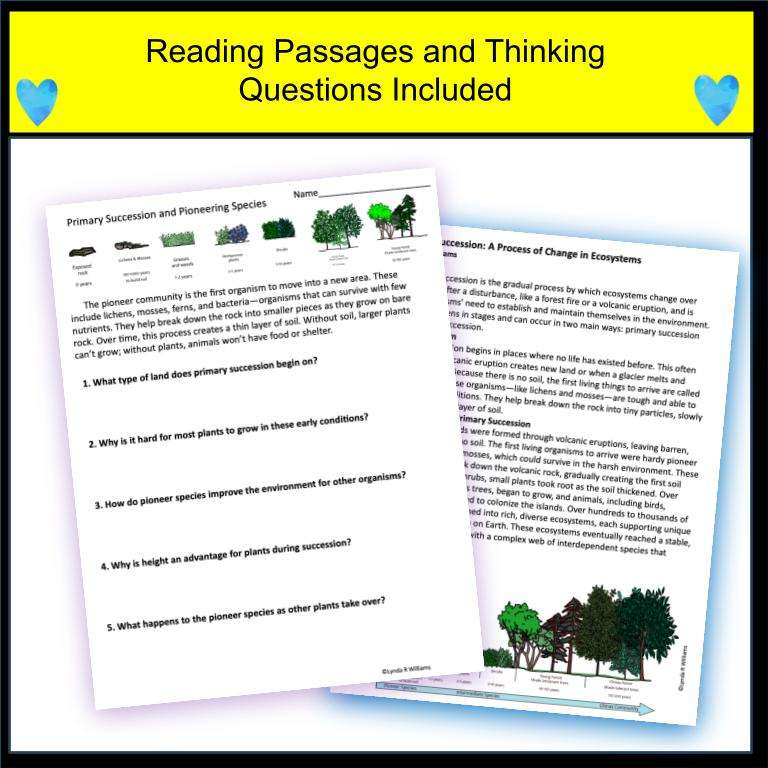
- Informational Reading Passage with comprehension
- “Which Is Which?” Identify primary vs. secondary events
- Vocabulary Crossword & Application Questions Worksheets
- Hands-On Model Project with printable scenario cards and reflection questions
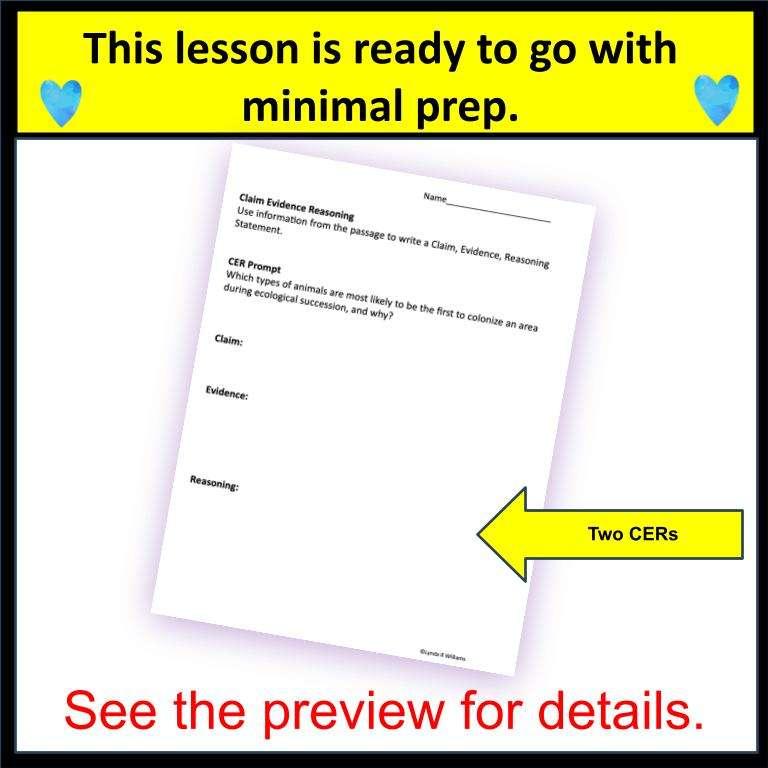
- Two CER Writing Prompts
- Printable Task Cards for building or assessing understanding of succession concepts
- Pacing Guide & Lesson Plan for 4 days, fully planned
- Answer Keys
Students Will:
- Explain the difference between primary and secondary succession
- Analyze examples of real-life ecological change
- Build and present models of ecosystem recovery
- Write CER (Claim-Evidence-Reasoning) responses using evidence
- Work collaboratively to demonstrate scientific thinking
Perfect For:
- NGSS MS-LS2-1 and MS-LS2-4
- Earth science and ecology units
- Environmental change and biodiversity discussions
- Sub plans, enrichment, or cooperative activity, science project
Also addresses these standards:
Florida – NGSSS (High School Biology)
- SC.912. L. 17.4: Describe changes in ecosystems resulting from seasonal variations, climate change, and succession.
Virginia – Standards of Learning (Biology)
- BIO.8(c): Ecological succession is a predictable change in the sequence of species that establish in an area over time.
Ohio
Grade 7 Life Science: Cycles of Matter and Flow of Energy
- In any particular biome, the number, growth, and survival of organisms and populations depend on biotic and abiotic factors. Ecosystems can change gradually or dramatically due to natural or human-made disturbances. These changes can lead to a succession of species over time.
South Carolina
Biology 1 – Standard B-6.3 Explain how an ecosystem’s succession process may result from a change in climate, human activity, introduction of non-native species, or changes in population size.
North Carolina
Biology – Bio.2.1.2 Analyze the impact of ecological succession on ecosystems.”
Indiana
Environmental Science – Env.1.6 Describe how ecosystems change over time through ecological succession and the impact of these changes on biodiversity.
Arizona
High School Biology – HS-LS2-6 Evaluate the claims, evidence, and reasoning that the complex interactions in ecosystems maintain relatively consistent numbers and types of organisms in stable conditions, but changing conditions may result in a new ecosystem.
California
High School Biology – HS-LS2-6 Evaluate the claims, evidence, and reasoning that the complex interactions in ecosystems maintain relatively consistent numbers and types of organisms in stable conditions, but changing conditions may result in a new ecosystem.
New York
Living Environment – Standard 6.3b Through ecological succession, ecosystems tend to change from simple to complex over time.