Description
TEACH NEW YORK MS-PS1-8 MIXTURES AND SEPARATING MIXTURES
5E Science Unit, Hands-On Labs, CER, Slideshow, and Assessments
Help your middle school students understand mixtures and physical separation methods with this engaging, ready-to-use science unit created specifically for New York Science Standard MS-PS1-8.
Students investigate how mixtures are combinations of substances and use physical properties to determine how the substances can be separated.
The unit focuses on filtration, evaporation, and magnetism, the three separation methods included in the New York assessment boundary.
Students observe real-world phenomena, conduct hands-on investigations, collect evidence, plan a separation procedure, and complete a CER response explaining how mixtures can be physically separated.
NEW YORK SCIENCE STANDARD ALIGNMENT
MS-PS1-8: Structure and Properties of Matter
Plan and conduct an investigation to demonstrate that mixtures are combinations of substances.
Students identify mixtures as physical combinations of substances, explain that substances in a mixture keep their own properties, compare homogeneous and heterogeneous mixtures, choose an appropriate separation method, plan and conduct investigations, collect evidence, and explain why separating a mixture is a physical change.
STUDENT-FACING SLIDESHOW
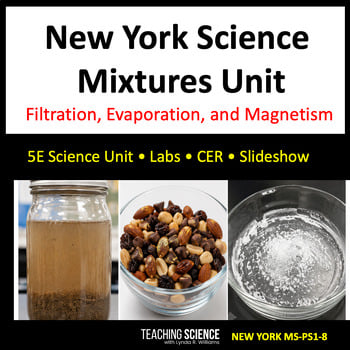
The slideshow begins with engaging phenomena involving muddy water, trail mix, and salt water.
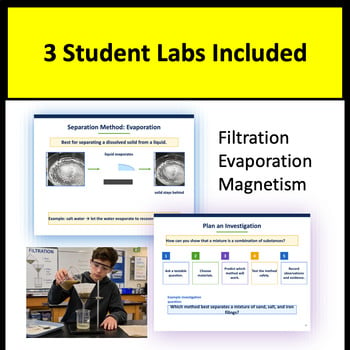
Students are introduced to mixtures, pure substances, homogeneous and heterogeneous mixtures, physical properties, filtration, evaporation, and magnetism.
The slideshow also guides students through planning an investigation, collecting evidence, and checking their understanding.
DETAILED 5E LESSON PLANS
The teacher pages include detailed directions for the Engage, Explore, Explain, Elaborate, and Evaluate phases of instruction.
Each phase includes its purpose, materials needed, teacher actions, student actions, questions to ask, main teaching points, and suggested pacing.
Teacher directions for presenting the student slideshow are also included.
HANDS-ON MIXTURE INVESTIGATIONS
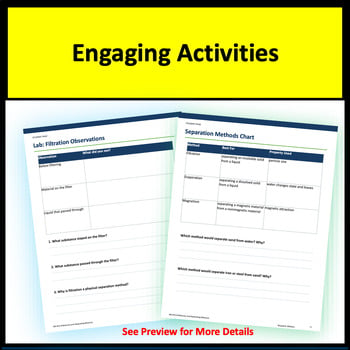
Students complete a filtration investigation using sand and water or muddy water.
Students observe evaporation using salt water and identify the solid material left behind.
Students use magnetism to separate magnetic and nonmagnetic materials.
Each investigation includes a question, materials, prediction, procedure, observations, analysis questions, and opportunities to explain the scientific evidence.
SEPARATION CHALLENGE
Students apply what they have learned by planning a method to separate a new mixture.
They identify the substances in the mixture, choose an appropriate separation method, connect their choice to a physical property, write a step-by-step procedure, record results, and evaluate whether the plan worked.
Materials Required:
Filtration Lab
- Sand and water or muddy water
- Clear cups or beakers
- Funnels
- Coffee filters
- Stir sticks
- Paper towels
Evaporation Investigation
- Salt water
- Shallow dishes or cups
- Labels
- A warm window or safe drying area
A hot plate is optional, but it should be used only as a teacher demonstration.
Magnetism Lab
- Sand
- Paper clips, small steel washers, or iron filings
- Magnets
- Plastic bags to cover the magnets
- Trays or paper plates
CER WRITING
Students respond to the question:
How does evidence from separation investigations show that mixtures are combinations of substances?
The unit includes a CER planning page, a final CER response page, sentence starters, a sample CER response, and teacher scoring guidance.
WHAT IS INCLUDED
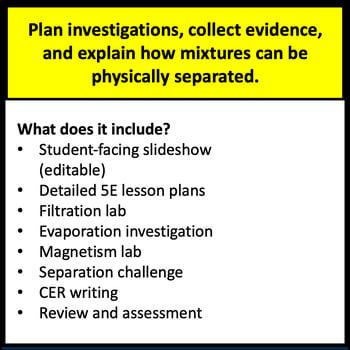
This resource includes a student-facing slideshow, detailed 5E lesson plans, teacher presentation directions, materials lists, safety information, suggested pacing, a phenomena observation page, student notes, mixture comparison pages, a separation methods chart, three investigations, a separation challenge, CER pages, a unit review, a quick quiz, answer keys, and a sample CER response.
PERFECT FOR NEW YORK MIDDLE SCHOOL SCIENCE
This unit was designed to help New York teachers confidently address MS-PS1-8 through meaningful investigations rather than isolated worksheets.
Students do more than memorize the names of separation methods. They make predictions, test methods, collect evidence, and explain how physical properties allow mixtures to be separated.
ALSO USEFUL FOR
This resource also works well for eighth-grade science, middle school physical science, introductory chemistry, NGSS-aligned classrooms, science intervention, review, test preparation, homeschool science, and hands-on science stations.
Give your students the investigations, vocabulary, evidence, and reasoning practice they need to understand mixtures and physical separation methods.