Description
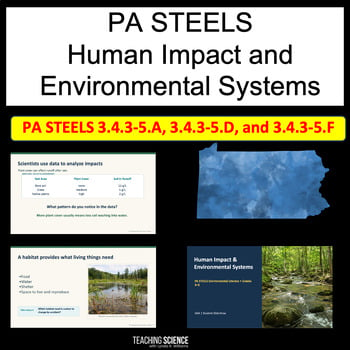
Teach PA STEELS Environmental Literacy with a complete grades 3–5 unit focused on human impact, natural resources, watersheds, habitats, agriculture, and environmental systems.
Students explore how people depend on the environment, how human activities change land and water, and how a local environmental issue can connect to a much larger system. The unit includes a student-friendly PowerPoint presentation, guided notes, standards-based student activities, data analysis, a Pennsylvania environmental case study, and answer keys.
PA STEELS Standards Addressed
✅ 3.4.3-5.A – Analyze how living organisms, including humans, affect the environment and how the environment affects them.
✅ 3.4.3-5.D – Develop a model to show how local environmental issues connect to larger environmental and human systems.
✅ 3.4.3-5.F – Critique ways people depend on and change the environment.
Students Explore
- How people depend on environmental resources
- Renewable and nonrenewable natural resources
- How people use and change land
- Human impacts on land, water, habitats, and wildlife
- Watersheds and runoff
- How pollution and runoff can move through connected water systems
- How habitat changes can affect living things and food webs
- Agriculture and its connections to soil, water, food, and wildlife
- Environmental choices that can reduce erosion and protect water quality
- How local environmental issues connect to larger systems
- How scientists use evidence and data to analyze environmental impacts
What’s Included
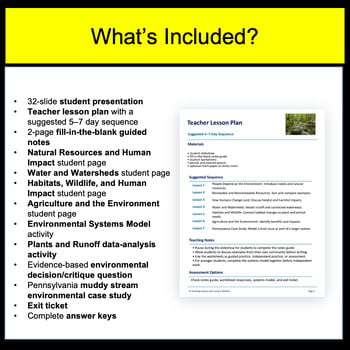
- 32-slide student PowerPoint presentation
- Teacher lesson plan with a suggested 5–7 day teaching sequence
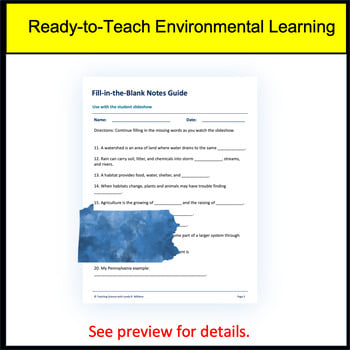
- 2-page fill-in-the-blank guided notes
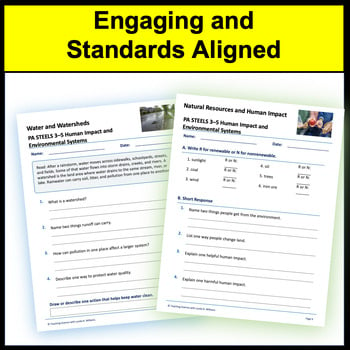
- Natural Resources and Human Impact student activity
- Water and Watersheds student activity
- Habitats, Wildlife, and Human Impact student activity
- Agriculture and the Environment student activity
- Environmental Systems Model
- Plants and Runoff data-analysis activity
- Evidence-based environmental decision and critique task
- Pennsylvania environmental systems case study
- Exit ticket
- Complete answer keys
Standards-Based Science Practices
Students do more than identify examples of human impact. They analyze data, explain cause-and-effect relationships, use evidence, evaluate environmental choices, and develop a systems model showing connections among human actions, land and water changes, habitats, living things, and larger environmental systems.
The included runoff investigation gives students practice analyzing model data and using evidence to explain how plant cover can affect how much soil is carried into water.
Pennsylvania Environmental Connection
Students apply their learning to a Pennsylvania stream case study in which they examine possible reasons a local stream becomes muddy after heavy rain. They consider evidence such as land use, bare soil, runoff paths, water clarity, plants, and organisms before developing a model of possible causes and effects.
Designed for Grades 3–5
The presentation uses clear, student-friendly language and large text, while the printable student pages provide ample space for writing, drawing, modeling, and explaining scientific thinking.
Use the activities for whole-group instruction, guided practice, independent work, environmental literacy lessons, science centers, review, or assessment.
This resource provides a practical way to teach PA STEELS Environmental Literacy and Sustainability standards while helping students understand the real-world connections between people and environmental systems.