Description
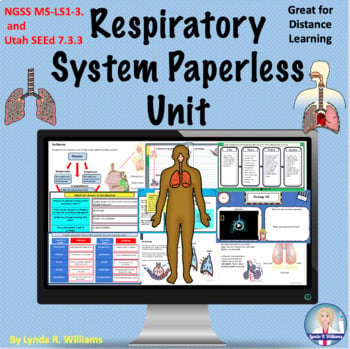
This resource is an online unit on the respiratory system. This Google product provides your students with informational text passages, interactive activities, videos, response pages, a lab, and a quiz. Students will make arguments from evidence and will learn about the organization of the human body: cell-tissue-organ-system. They will learn that the human body has systems and each system is a collection of subsystems comprised of specialized cells and tissue. This is an online unit in Google Slides. Perfect for Google Classroom. This resource is formatted horizontally to make it easier to use on a device. Students will be able to write and record ideas and drag and drop in the interactive features right on the slides in edit mode.
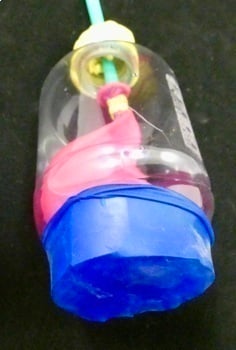
This unit includes a hands-on activity to make a model of a working lung out of inexpensive materials. All you will need for this is a straw, plastic bottle, rubber band, two balloons, and some modeling clay. I believe students can make this simple model at home as long as they have the materials, but if they do not have materials, I have included a video of the working model so that you can at least show it to students.
This resource also includes a guided relaxation exercise using diaphragmatic breathing. Students can learn to use breathing to calm anxiety and fear. This is video was created for this product by a licensed psychotherapist,
In order to access this resource TPT must put a copy in your Google Drive. Some school districts have restrictions on this. Be sure to check with your district and make sure you are allowed to use Google products in your classroom. You may add it to a personal drive if that is easier for you.
This resource is aligned with
NGSS MS-LS1-3.
Use argument supported by evidence for how the body is a system of interacting subsystems composed of groups of cells. [Clarification Statement: Emphasis is on the conceptual understanding that cells form tissues and tissues form organs specialized for particular body functions. Examples could include the interaction of subsystems within a system and the normal functioning of those systems.] [Assessment Boundary: Assessment does not include the mechanism of one body system independent of others. Assessment is limited to the circulatory, excretory, digestive, respiratory, muscular, and nervous systems.]
And
Utah SEEd 7.3.3 Construct an explanation using evidence to explain how body systems have various levels of organization. Emphasize that cells form tissues, tissues form organs, and organs form systems specialized for particular body functions. Examples could include relationships between the circulatory, excretory, digestive, respiratory, muscular, skeletal, or nervous systems. Specific organ functions will be taught at the high school level. (LS1.A)
Students will love the interactive online activities in this respiratory system unit.
Please visit my blog
If you have questions about my resources please contact me at lywilliams1@gmail.com
This unit was created by Lynda Williams for the TPT store Lynda R Williams
You will enjoy other resources for online learning
Paperless Circulatory System Unit NGSS NGSS MS-LS1-3 and Utah SEEd 7.3.3
Distance Learning Plant and Animal Adaptations MS NGSS and Utah SEEd 7th Grade
Interactive Editable Google Slides for Commercial and Classroom Use