
Description
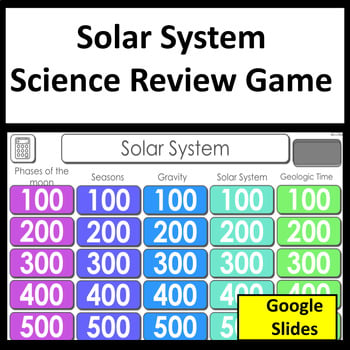
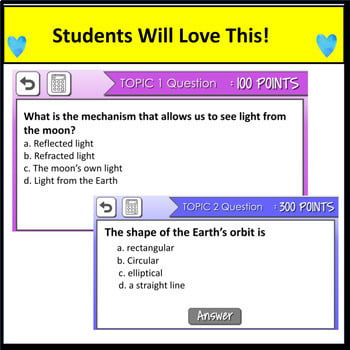
This Jeopardy-style game on the Solar System for middle school will engage your students. This Solar System Jeopardy-style Game will be the perfect fit! This game includes 25 questions and answers aligned with NGSS MS-ESS1-1-4 on theSolar System. You and your students will have a blast playing this game show-styled review! You can use these after teaching the standard for assessment practice and review at the end of the year. Answers are included.
Solar System Jeopardy-style game Includes:
- Editable Jeopardy-style game
- Answers
- Scorecard
- Instructions
This resource is aligned with the following standards for NGSS:
⭐️ MS-ESS1-1. Develop and use a model of the Earth-sun-moon system to describe the cyclic patterns of lunar phases, eclipses of the sun and moon, and seasons. [Clarification Statement: Examples of models can be physical, graphical, or conceptual.]
⭐️MS-ESS1-2. Develop and use a model to describe the role of gravity in the motions within galaxies and the solar system. [Clarification Statement: Emphasis for the model is on gravity as the force that holds together the solar system and Milky Way galaxy and controls orbital motions within them. Examples of models can be physical (such as the analogy of distance along a football field or computer visualizations of elliptical orbits) or conceptual (such as mathematical proportions relative to the size of familiar objects such as students’ school or state).] [Assessment Boundary: Assessment does not include Kepler’s Laws of orbital motion or the apparent retrograde motion of the planets as viewed from Earth.]
⭐️MS-ESS1-3. Analyze and interpret data to determine scale properties of objects in the solar system. [Clarification Statement: Emphasis is on the analysis of data from Earth-based instruments, space-based telescopes, and spacecraft to determine similarities and differences among solar system objects. Examples of scale properties include the sizes of an object’s layers (such as crust and atmosphere), surface features (such as volcanoes), and orbital radius. Examples of data include statistical information, drawings and photographs, and models.] [Assessment Boundary: Assessment does not include recalling facts about properties of the planets and other solar system bodies.]
⭐️MS-ESS1-4. Construct a scientific explanation based on evidence from rock strata for how the geologic time scale is used to organize Earth’s 4.6-billion-year-old history. [Clarification Statement: Emphasis is on how analyses of rock formations and the fossils they contain are used to establish relative ages of major events in Earth’s history. Examples of Earth’s major events could range from being very recent (such as the last Ice Age or the earliest fossils of homo sapiens) to very old (such as the formation of Earth or the earliest evidence of life). Examples can include the formation of mountain chains and ocean basins, the evolution or extinction of particular living organisms, or significant volcanic eruptions.] [Assessment Boundary: Assessment does not include recalling the names of specific periods or epochs and events within them)
** Please note this only includes the Jeopardy-style game with 25 questions & answers
**Check out my blog!
Please contact me if you have questions about my resources. info@teachingscience.us