Description
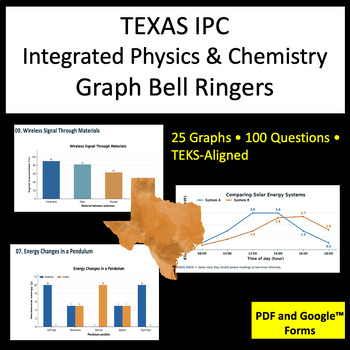
Looking for Texas IPC graph practice that aligns with your Integrated Physics and Chemistry standards? These Texas IPC Graph Bell Ringers provide 25 science graphs and 100 multiple-choice questions designed to help students develop graph-analysis skills while reviewing important physics and chemistry concepts.
Created specifically for Texas Integrated Physics and Chemistry teachers, this resource reinforces selected IPC TEKS through scientific data analysis, mathematical reasoning, and critical thinking. Students practice reading graphs, identifying patterns, comparing data, making calculations, and drawing conclusions supported by evidence.
No prep required! Simply project a graph or print a page for a quick 5–10 minute science warm-up.
What’s Included
- 25 science graph activities
- 100 multiple-choice questions (4 per graph)
- 12 physics graphs and 13 chemistry graphs
- 20 core graph-analysis activities
- 5 higher-level IPC Challenge Graphs
- Line graphs, bar graphs, grouped bar graphs, and scatterplots
- Texas IPC TEKS alignment guide
- Teacher directions and suggested classroom uses
- One-page answer key
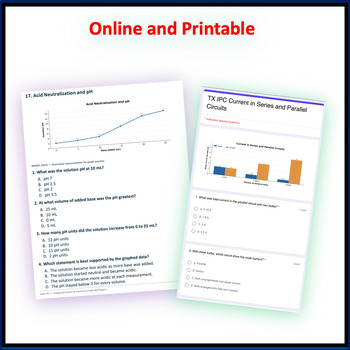
- Printable student pages
Five Higher-Level IPC Challenge Graphs
In addition to the 20 core activities, this resource includes five more challenging graphs designed to help students move beyond basic graph reading.
- Mass, Force, and Acceleration: Compare multiple data sets and analyze relationships between force, mass, and acceleration.
- Comparing Solar Energy Systems: Interpret multiple lines and evaluate energy production patterns.
- Temperature, Stirring, and Dissolving Time: Compare experimental conditions and identify relationships between variables.
- Concentration and Gas Production Rate: Analyze reaction-rate data, compare trends, and perform calculations.
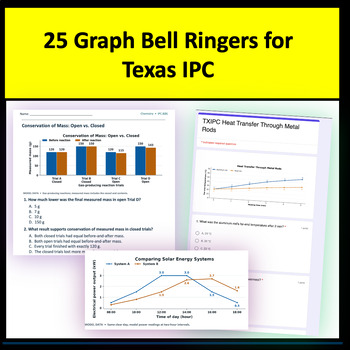
- Conservation of Mass in Open and Closed Systems: Evaluate experimental evidence and explain differences in measured mass.
These challenge graphs give students additional opportunities to apply scientific concepts, analyze experimental data, and support conclusions with evidence.
Texas IPC TEKS Alignment
Designed specifically for Texas IPC teachers, these activities reinforce selected
Texas Integrated Physics and Chemistry TEKS (§112.44), including:
- IPC.5: Motion, forces, acceleration, momentum, and gravity
- IPC.6: Electricity, energy transformations, thermal energy, waves, and energy resources
- IPC.7: Properties of matter, periodic trends, emission spectra, and reaction rates
- IPC.8: Chemical reactions, conservation of mass, nuclear applications, and environmental effects
Students also practice scientific and engineering skills involving data analysis, mathematical reasoning, and evidence-based explanations.
These activities reinforce selected TEKS concepts and skills rather than fully covering every IPC standard.
Easy to Use in Your Science Classroom
These graph activities fit into your existing lessons without extra planning. Each graph is a standalone activity, so you can use them in any order throughout the school year.
Perfect for:
- Daily science bell ringers and warm-ups
- Physics and chemistry review
- Graph interpretation and data-analysis practice
- Science stations and independent work
- Formative assessments and exit tickets
- Homework and test preparation
- Substitute plans
- Differentiation and enrichment
What Grade Levels Is This Resource For?
This resource is designed primarily for Texas high school Integrated Physics and Chemistry (IPC) classes, particularly introductory IPC courses in grades 9–10.
The core graph activities also work well for advanced Grade 8 physical science practice, while the five additional challenge graphs offer opportunities for more demanding analysis and reasoning.
Why You’ll Love These Texas IPC Graph Bell Ringers
Finding ready-to-use graph practice specifically designed for Texas IPC can be challenging. These activities help you incorporate consistent data-analysis practice into your physics and chemistry lessons without spending hours creating graphs and questions.
Your students will practice more than reading numbers from graphs. They’ll compare evidence, identify relationships, make predictions, and apply science concepts to real-world situations.
With 25 graphs and 100 questions, you’ll have flexible activities ready for a quick warm-up, review, or meaningful science practice.
Less planning for you. More scientific thinking for your students!