
Description
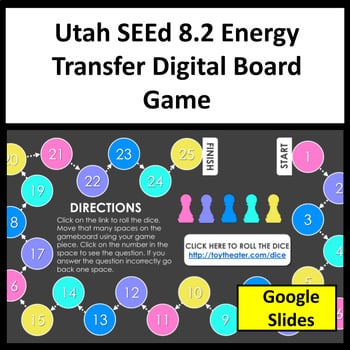
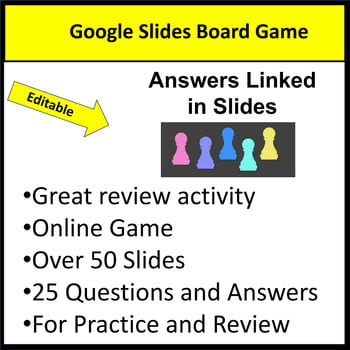
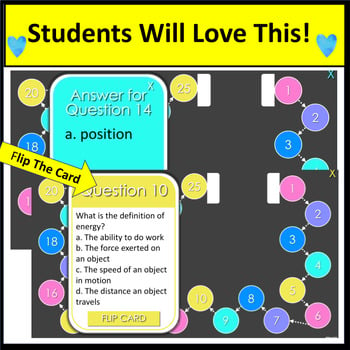
Bring energy to your review day! This Utah SEEd 8.2 Energy Transfer digital board game includes interactive questions, movable game pieces, and digital dice for fun, test-aligned practice that keeps students engaged and learning.
This energy is stored and transferred to physical systems. The Game Includes:
- 50 Google Slides
- 25 Questions and Answers
- Directions
Tips for Implementation
- This is a Google Resource. You will need access to Google Drive
- It can be used as a station or center for pairs or small groups (2-5 students)
- Whole group review with up to five teams
Why you will love this!
- No prep and easy to use!
- Writing is not required.
- No extra materials needed
Standards Addressed:
Strand 8.2: ENERGY IS STORED AND TRANSFERRED IN PHYSICAL SYSTEMS
Objects can store and transfer energy within systems. Energy can be transferred between objects, which involves changes in the object’s energy. There is a direct relationship between an object’s energy, mass, and velocity. Energy can travel in waves and may be harnessed to transmit information.
Standard 8.2.1
Use computational thinking to analyze data about the relationship between the mass and speed of objects to the relative amount of kinetic energy of the objects. Emphasis should be on the quantity of mass and relative speed to the observable effects of the kinetic energy. Examples could include a full cart vs. an empty cart or rolling spheres with different masses down a ramp to measure the effects on stationary masses. Calculations of kinetic and potential energy will be learned at the high school level. (PS3.A, PS3.C)
Standard 8.2.2
Ask questions about how the amount of potential energy varies as distance within the system changes. Plan and conduct an investigation to answer a question about potential energy. Emphasize comparing relative amounts of energy. Examples could include a cart at varying positions on a hill or an object being dropped from different heights. Calculations of kinetic and potential energy will be learned at the high school level. (PS3.A, PS3.B)
Standard 8.2.3
Engage in argument to identify the strongest evidence that supports the claim that the kinetic energy of an object changes as energy is transferred to or from the object. Examples could include observing temperature changes as a result of friction, applying force to an object, or releasing potential energy from an object. (PS4.A)
Standard 8.2.4
Use computational thinking to describe a simple model for waves that shows the pattern of wave amplitude being related to wave energy. Emphasize describing waves with both quantitative and qualitative thinking. Examples could include using graphs, charts, computer simulations, or physical models to demonstrate amplitude and energy correlation. (PS4.A)
Standard 8.2.5
Develop and use a model to describe the structure of waves and how they are reflected, absorbed, or transmitted through various materials. Emphasize both light and mechanical waves. Examples could include drawings, simulations, and written descriptions of light waves through a prism, mechanical waves through gas vs. liquids vs. solids, or sound waves through different mediums. (PS4.A, PS4.B)
Standard 8.2.6
Obtain and evaluate information to communicate the claim that the structure of digital signals are a more reliable way to store or transmit information than analog signals. Emphasize the basic understanding that waves can be used for communication purposes. Examples could include using vinyl record vs. digital song files, film cameras vs. digital cameras, or alcohol thermometers vs. digital thermometers. (PS4.C)
These resources are created by Lynda R. Williams at Teaching Science