
Description
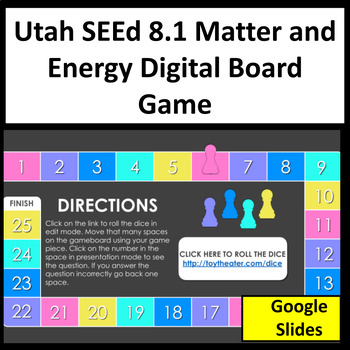
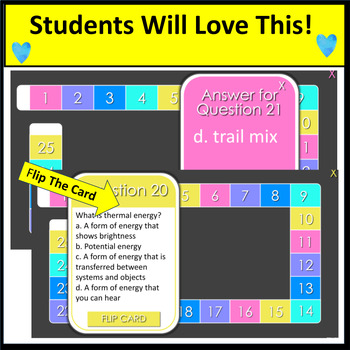
This digital Matter and Energy activity game for Utah SEEd 8.1 is an interactive review created in Google Slides. Great for Science Review and 8th Grade RISE Science Test Prep. It includes linked questions and answers, movable pieces, and even digital dice. Perfect for engaging students in reviewing science concepts related to Matter and Energy. Great for Science Review and 8th Grade Science Test Prep. This game will reinforce students’ understanding of Matter and Energy
This Matter and Energy Game Includes:
- 50 Google Slides
- 25 Questions and Answers
- Directions
Tips for Implementation
- This is a Google Resource. You will need access to Google Drive
- It can be used as a station or center for pairs or small groups (2-5 students)
- Whole group review with up to five teams
Why you will love this!
- No prep and easy to use!
- Writing is not required.
- No extra materials needed
Standards Addressed:
Strand 8.1: MATTER AND ENERGY INTERACT IN THE PHYSICAL WORLD
The physical world is made of atoms and molecules. Even large objects can be viewed as a combination of small particles. Energy causes particles to move and interact physically or chemically. Those interactions create a variety of substances. As molecules undergo a chemical or physical change, the number of atoms in that system remains constant. Humans use energy to refine natural resources into synthetic materials.
Standard 8.1.1
Develop a model to describe the scale and proportion of atoms and molecules. Emphasize developing atomic models of elements and their numbers of protons, neutrons, and electrons, as well as models of simple molecules. Topics like valence electrons, bond energy, ionic complexes, ions, and isotopes will be introduced at the high school level. (PS1.A)
Standard 8.1.2
Obtain information about various properties of matter, evaluate how different materials’ properties allow them to be used for particular functions in society and communicate your findings. Emphasize general properties of matter. Examples could include color, density, flammability, hardness, malleability, odor, ability to rust, solubility, state, or the ability to react with water. (PS1.A)
Standard 8.1.3
Plan and conduct an investigation and then analyze and interpret the data to identify patterns in changes in a substance’s properties to determine if a chemical reaction has occurred. Examples could include changes in properties such as color, density, flammability, odor, solubility, or state. (PS1.A, PS1.B)
Standard 8.1.4
Obtain and evaluate information to describe how synthetic materials come from natural resources, what their functions are, and how society uses these new materials. Examples of new materials could include medicine, foods, building materials, plastics, and alternative fuels. (PS1.A, PS1.B, ESS3.A)
Standard 8.1.5
Develop a model that uses computational thinking to illustrate the cause and effect relationships in particle motion, temperature, density, and state of a pure substance when heat energy is added or removed. Emphasize molecular-level models of solids, liquids, and gases to show how adding or removing heat energy can result in phase changes and on calculating density of a substance’s state. (PS3.A)
Standard 8.1.6
Develop a model to describe how the total number of atoms does not change in a chemical reaction, indicating that matter is conserved. Emphasize demonstrations of an understanding of the law of conservation of matter. Balancing equations and stoichiometry will be learned at the high school level. (PS1.B)
Standard 8.1.7
Design, construct, and test a device that can affect the rate of a phase change. Compare and identify the best characteristics of competing devices, based on data analysis, and modify them to improve the device to better meet the criteria for success. (PS1.B, PS3.A, ETS1.A, ETS1.B, ETS1.C).
These resources are created by Lynda R. Williams at Teaching Science
Follow me and get news of my new resources. Each new resource is discounted by 50% for the first 24 hours!