Why should you use state-specific science resources?
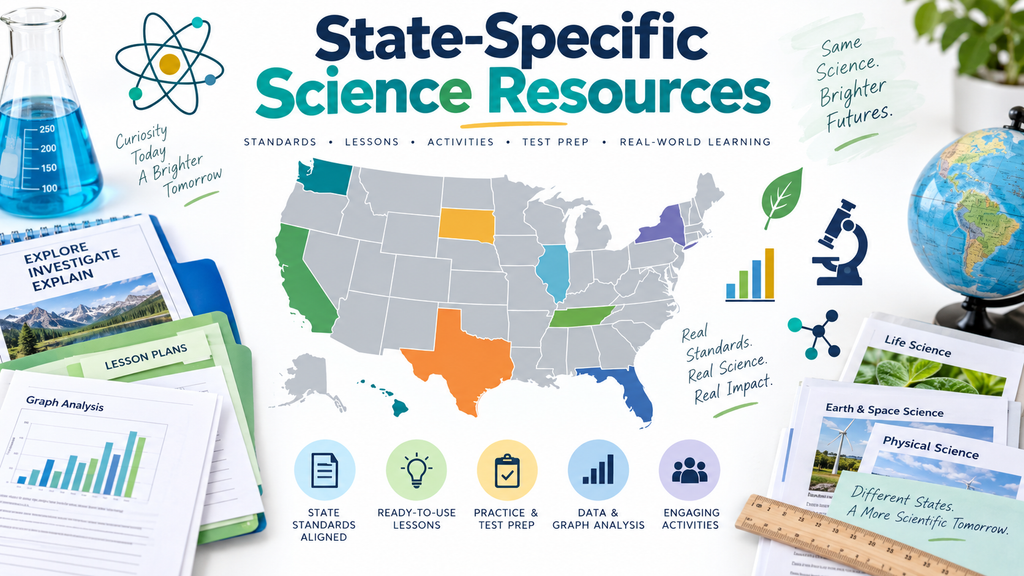
Science standards are not organized exactly the same way in every state. This is why you need state specific science resources.
Even when states use standards influenced by the Next Generation Science Standards, the grade placement, wording, course sequence, testing expectations, and emphasis can differ.
That can make finding the right science resources frustrating for teachers.
A lesson may teach excellent science but still be difficult to use if the concept is taught in a different grade in your state.
That is why I create state-specific science resources designed to help teachers find materials that fit the standards they are actually expected to teach.
Depending on the state and grade level, my resources may include:
- Full-year science curriculum
- 5E lessons
- Hands-on investigations
- Graph and data-analysis activities
- Science bell ringers
- CER practice
- Standards-based quizzes
- Science test prep
- Spiral review
- Review games
- Pacing guides
- Phenomena-based activities
- STEM and engineering activities
state specific science resources.
Availability varies by state and grade level, but the goal is always the same:
Make it easier for teachers to find science resources that match what their students are expected to learn. Use state specific science resources.
Why Use State-Specific Science Resources?
National science resources can be useful, but teachers are ultimately responsible for the standards required by their own state or district.
State-specific science resources can help teachers answer important planning questions:
Am I teaching the right concept at the right grade level?
Does this lesson address the standard my students will be assessed on?
Am I giving students practice with the kinds of data and reasoning required by my state standards?
How should I organize these standards across the school year?
A state-aligned resource can reduce the amount of time teachers spend sorting through materials that may or may not fit their curriculum.
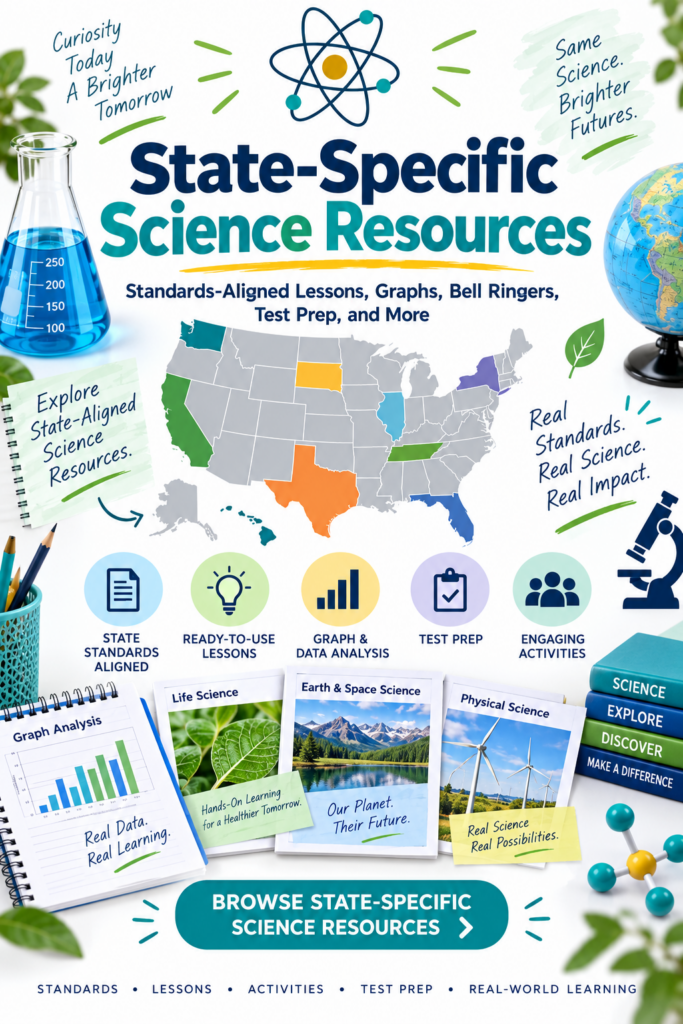
State Science Standards Are Not All the Same
Many state science standards share common ideas.
Students across the country study concepts such as:
- Matter
- Energy
- Forces
- Ecosystems
- Earth systems
- Weather
- Natural hazards
- Heredity
- Evolution
- Engineering design
However, those concepts may appear in different grades or be organized differently from one state to another.
For example, one state may teach a particular Earth science concept in 6th grade while another places it in 7th or 8th grade.
Some states organize middle school science by discipline.
Others use an integrated science sequence.
Some states use NGSS performance expectations very closely, while others have developed their own standards.
That is why I do not recommend assuming that a resource labeled simply “middle school science” automatically matches every state’s requirements. Using state specific scienc resources will help you better meet your students needs.
Full-Year and Curriculum-Based State Specific Science Resources
I have developed full-year or substantial curriculum collections for several states.
You can link each state name below directly to your corresponding curriculum or state-specific resource collection.
Arizona Science Resources
Science resources aligned with the Arizona Science Standards, including full-year curriculum resources, graph analysis, review, and test-prep materials for selected grades.
California Science Resources
California science resources include materials designed for California NGSS and the Integrated Model, as well as grade-specific curriculum, graph-analysis activities, CER practice, and science review.
California 5th grade Science Curriculum
Calfironia 6th grade Science Curriculum
California 7th grade Science Curriculum
California 8th grade Science Curriculum
Indiana Science Resources
Indiana science resources include full-year curriculum, standards-aligned lessons, graph and data analysis, review, and ILEARN-oriented science practice for selected grades.
Kentucky Science Resources
Kentucky resources include full-year middle school science curriculum and graph-analysis materials aligned to the Kentucky Academic Standards for Science.
North Carolina Science Resources
North Carolina resources include curriculum and supplemental materials aligned with the North Carolina Standard Course of Study, including lessons, graphs, CER, bell ringers, and science review.
Ohio Science Resources
Ohio science resources include grade-level curriculum, graph and data-analysis activities, bell ringers, and review materials aligned to Ohio science expectations.
Oklahoma Science Resources Aligned with 2026 standard
Oklahoma resources include curriculum and review materials aligned to the current Oklahoma Academic Standards for Science, including full-year bundles, graph practice, quizzes, review games, and pacing support.
Pennsylvania Science Resources
Pennsylvania resources include materials aligned to the Pennsylvania STEELS standards, including middle school supplemental curriculum, environmental literacy, technology and engineering, graph analysis, and pacing support.
South Carolina Science Resources
South Carolina resources include full-year science curriculum, standards-based lessons, graph and data analysis, review, and assessment support for selected grade levels.
South Carolina 4th grade Science
South Carolina 5th Grade Science
South Carolina 6th Grade Science
South Carolina 7th Grade Science
South Carolina 8th grade Science
Utah SEEd Science Resources
Utah is one of the state-specific areas I have worked with extensively.
My Utah SEEd resources include:
- Full-year science curriculum
- Grade-level units
- Utah RISE test prep
- Graph bell ringers
- CER activities
- Quizzes
- Phenomena
- Pacing guides
- Review games
Resources are available for multiple Utah grade levels.
Utah SEEd Kindergarten Science
More State Specific Science Resources
In addition to states where I offer larger curriculum collections, I also create graph-analysis, science bell ringer, standards review, and test-prep resources for a growing number of states.
These include resources for states such as:
Availability varies by grade and resource type.
These state-specific materials are especially useful for teachers who already have a core curriculum but need additional:
- Graph practice
- Test prep
- Daily review
- Data analysis
- CER
- Bell ringers
- Standards-based reinforcement
State Specific Science Resources for Graph Analysis
Graph and data-analysis practice is one of the areas where state alignment can be particularly useful.
Students may be asked to interpret data connected to the science concepts taught at their grade level.
State-specific graph resources allow students to practice data analysis and required science content at the same time.
Students may analyze:
- Bar graphs
- Line graphs
- Pie charts
- Data tables
- Experimental results
- Population data
- Weather data
- Energy data
- Earth science data
- Environmental data
Instead of practicing graph skills with unrelated examples, students can analyze data connected to the science standards they are already learning.
If you are looking specifically for graph instruction, visit my 5th Grade Science Graph & Data Analysis or Middle School Science Graph & Data Analysis guides.
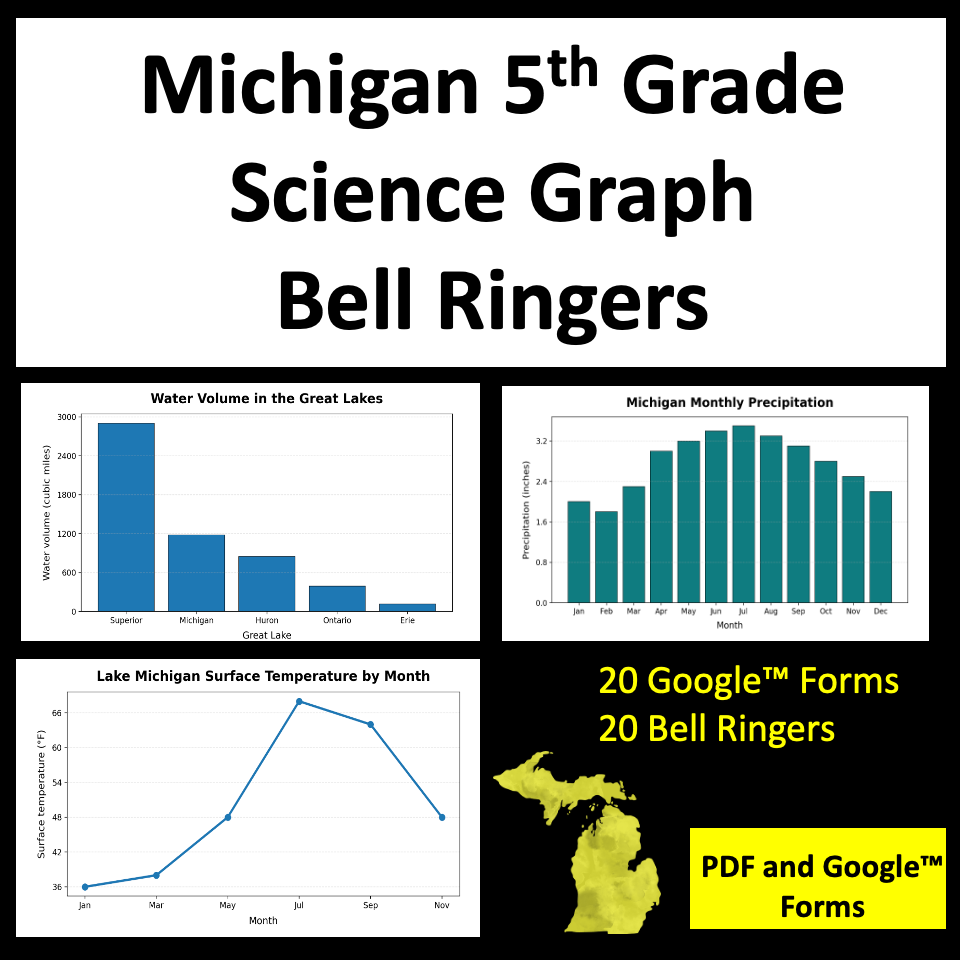
State Specific Science Resources for Bell Ringers see all my state specific graph bell ringers here
Bell ringers are another easy way to build state standards into daily instruction.
State-specific science warm-ups can help students:
- Review previously taught standards
- Analyze graphs
- Interpret data
- Practice scientific reasoning
- Prepare for state science assessments
- Maintain skills throughout the year
Short, consistent review is especially useful because students often need to remember science concepts taught many months before the state assessment.
For more ideas, visit my Middle School Science Bell Ringers & Daily Warm-Ups guide.
State Specific Science Resources for Test Prep
Science test prep is most effective when students regularly practice the kinds of thinking required on science assessments.
That includes much more than memorizing vocabulary.
Check out State-specific science test prep
Students may need to:
- Analyze an unfamiliar graph
- Interpret a data table
- Examine a model
- Identify a scientific pattern
- Compare evidence
- Draw a conclusion
- Apply a science concept
- Evaluate which statement is best supported
State-specific review allows teachers to focus that practice on the science content students are actually expected to know.
My state test-prep resources may include:
- Practice questions
- Graph analysis
- Spiral review
- Quizzes
- Review games
- CER activities
- Standards review
Pacing Guides for State Science Standards
Knowing what to teach is only part of curriculum planning.
Teachers also need to decide:
When should I teach each standard?
How much time should I spend on each topic?
Which resources fit each part of the year?
For several of my state-specific curriculum collections, I provide pacing support that organizes standards and suggested resources across the school year.
A pacing guide can help teachers see how individual lessons, investigations, assessments, and review activities fit together instead of viewing them as isolated products.
State Standards and NGSS
Teachers sometimes ask whether they can use NGSS resources if their state has its own science standards.
The answer depends on the state and the particular standard.
Many states share science concepts and practices with NGSS, but the exact expectation, wording, grade placement, and assessment may differ.
A resource can therefore be scientifically appropriate without being a perfect match for your particular grade-level standard.
When choosing a resource, compare:
- The science concept
- The performance expectation
- The grade level
- The Science and Engineering Practice
- The type of evidence students are expected to use
For teachers following NGSS directly, I also create resources specifically designed around NGSS performance expectations.
What If My State Is Not Listed?
I continue to develop new state-specific science resources.
If your state is not listed, you may still find useful resources in my:
- NGSS collections
- 5th grade science resources
- Middle school science curriculum
- Graph and data-analysis resources
- CER resources
- Bell ringers
- Test-prep resources
- Life science resources
- Earth science resources
- Physical science resources
Always compare the resource content with your current state or district standards before purchasing.
How Do I Choose the Right State Science Resource?
Start with your grade level and state standards.
Then ask:
Do I need a complete curriculum or supplemental practice?
If you need your main instructional resources, look for a full-year curriculum or standards bundle.
If you already have a curriculum but students need additional practice, consider:
- Graph bell ringers
- CER
- Quizzes
- Spiral review
- Test prep
- Crack the Code stations
- Review games
If your biggest challenge is organization, look for a pacing guide that shows how the resources fit into the school year.
Frequently Asked Questions About State-Specific Science Resources
Do all states use NGSS?
No. Some states have adopted NGSS, while others use standards that were influenced by NGSS or have developed their own state science standards.
Can I use NGSS resources in a state that does not officially use NGSS?
Possibly.
Many science concepts overlap, but teachers should compare the specific resource with their own state standard before using it as a primary standards-aligned lesson.
Why do science standards vary by state?
Education standards are established at the state level. States determine the concepts, practices, grade placement, and assessment expectations used in their public schools.
What is the difference between a state-specific curriculum and a general science curriculum?
A general curriculum may cover appropriate science concepts without following a particular state’s grade-level sequence.
A state-specific curriculum is organized around the standards teachers in that state are expected to teach.
Are state-specific graph activities useful for test prep?
Yes.
They allow students to practice analyzing data while reviewing science concepts associated with their grade-level standards.
Do state-specific resources replace a district curriculum?
Not necessarily.
Some teachers use them as their primary instructional materials, while others use them to supplement a district-adopted program.
The best use depends on the teacher’s school, district requirements, and available curriculum.
Why create separate science resources for different states?
A concept may appear in different grades or be assessed differently depending on the state.
State-specific resources make it easier for teachers to locate materials that match their own standards.
Find Science Resources That Fit What You Actually Teach
Teachers should not have to spend hours comparing resources with state standards just to determine whether an activity belongs in their course.
My goal with state-specific science resources is to make that process easier.
Whether you need a full-year science curriculum, graph-analysis practice, bell ringers, CER, quizzes, test prep, or a pacing guide, you can begin with the standards you are responsible for teaching and find resources designed around those expectations.
Explore Science Resources by State.
About Lynda R. Williams
Lynda R. Williams is a science educator, curriculum designer, and creator of Teaching Science with Lynda R. Williams.
With more than 20 years of classroom experience, she specializes in creating practical, standards-aligned resources for upper elementary and middle school science teachers.
Her work includes NGSS resources, state-specific science curriculum, graph and data analysis, Claim, Evidence, Reasoning, 5E instruction, phenomena-based learning, assessments, and hands-on STEM activities.
Lynda has also taught Science Methods at the university level and brings both classroom experience and curriculum-design expertise to the resources she creates.
Her goal is to help teachers spend less time searching for materials and more time helping students investigate, analyze evidence, and understand science.