Science and Engineering Practices are the skills and behaviors students use to investigate the natural world, explain scientific phenomena, and design solutions to problems. Often called SEPs, these practices help students learn science by actively doing the work of scientists and engineers.
Rather than simply memorizing scientific facts, students ask questions, develop models, analyze data, construct explanations, and communicate evidence-based ideas. The Science and Engineering Practices are an essential part of three-dimensional science instruction and the Next Generation Science Standards.
What Is the Purpose of Science and Engineering Practices?
The purpose of the Science and Engineering Practices is to help students understand how scientific knowledge is developed and how engineering problems are solved.
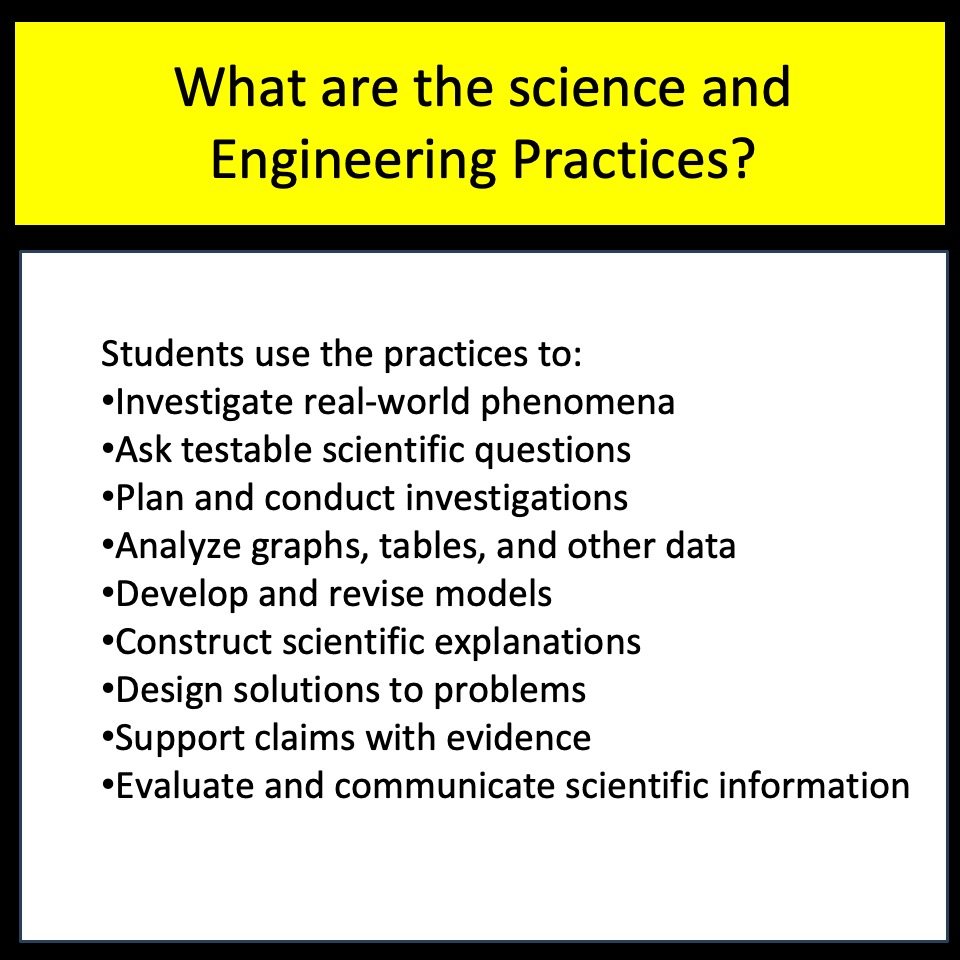
Students use the practices to:
- Investigate real-world phenomena
- Ask testable scientific questions
- Plan and conduct investigations
- Analyze graphs, tables, and other data
- Develop and revise models
- Construct scientific explanations
- Design solutions to problems
- Support claims with evidence
- Evaluate and communicate scientific information
The practices are not meant to be taught only as separate skills. Students should use them throughout science lessons, investigations, discussions, projects, and assessments.
What Are the Eight Science and Engineering Practices?
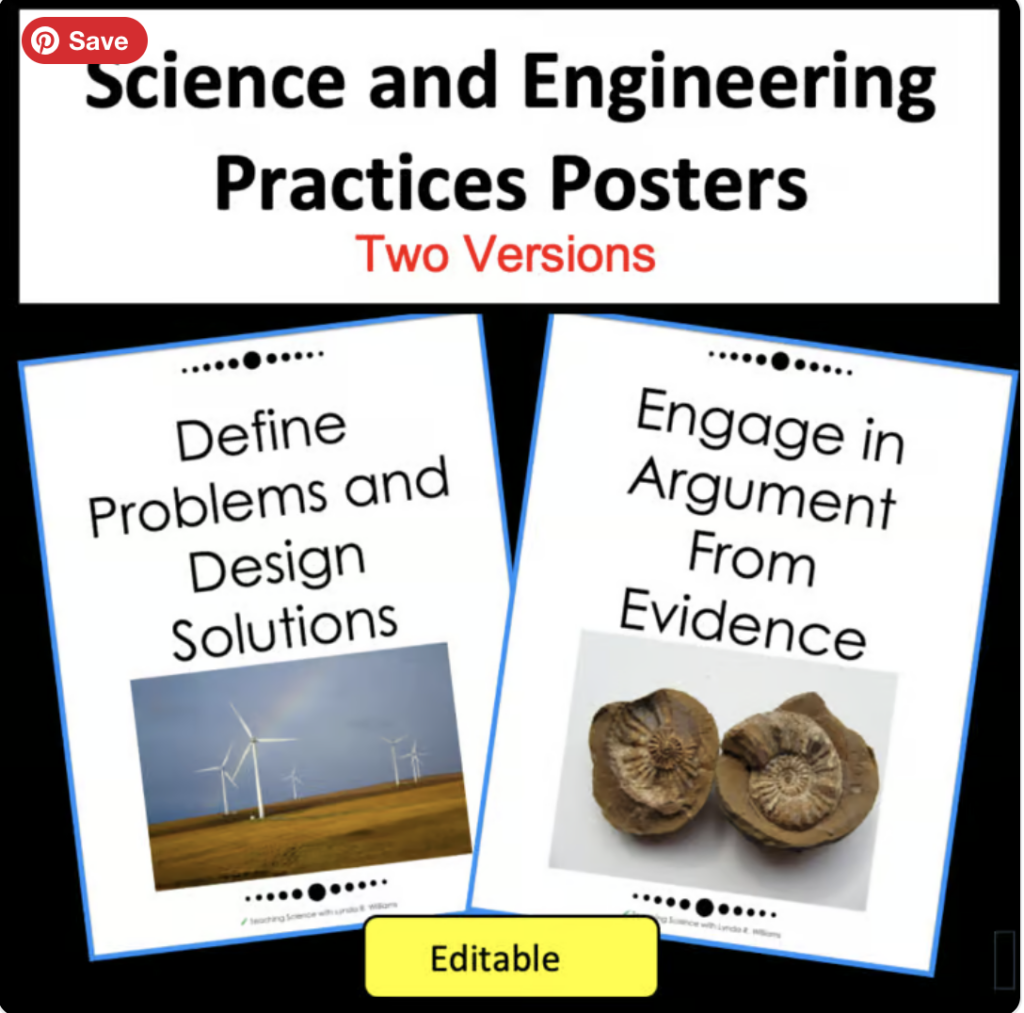
There are eight Science and Engineering Practices. The same eight practices are used across grade levels, but the level of complexity increases as students gain experience.
| Science and Engineering Practice | What Students Do | Classroom Example |
|---|---|---|
| 1. Asking Questions and Defining Problems | Students ask questions about scientific phenomena and clearly define engineering problems. | Students observe a photograph of a damaged wetland and ask questions about what caused the changes. |
| 2. Developing and Using Models | Students create, use, evaluate, and revise models to explain systems or processes. | Students draw a model showing how matter moves through a food web. |
| 3. Planning and Carrying Out Investigations | Students plan fair tests, identify variables, collect measurements, and conduct investigations safely. | Students plan an investigation to determine how the length of a pendulum affects its motion. |
| 4. Analyzing and Interpreting Data | Students organize, graph, compare, and interpret data to identify patterns and relationships. | Students analyze a graph showing how temperature affects plant growth. |
| 5. Using Mathematics and Computational Thinking | Students use measurements, calculations, patterns, ratios, formulas, and digital tools to solve problems. | Students calculate the average distance traveled by three paper-airplane designs. |
| 6. Constructing Explanations and Designing Solutions | Students explain scientific phenomena and design solutions using scientific ideas and evidence. | Students explain why a population changed or design a device that reduces erosion. |
| 7. Engaging in Argument from Evidence | Students make claims, support them with evidence, evaluate competing ideas, and respond to scientific reasoning. | Students use investigation data to defend which material is the best thermal insulator. |
| 8. Obtaining, Evaluating, and Communicating Information | Students gather information from reliable sources, evaluate its accuracy, and communicate scientific ideas. | Students compare two sources about renewable energy and present an evidence-based recommendation. |
Science and Engineering Practices in the Classroom
Science and Engineering Practices can be included in almost any science lesson. A teacher does not need to conduct a complicated laboratory investigation every day for students to engage in the practices.
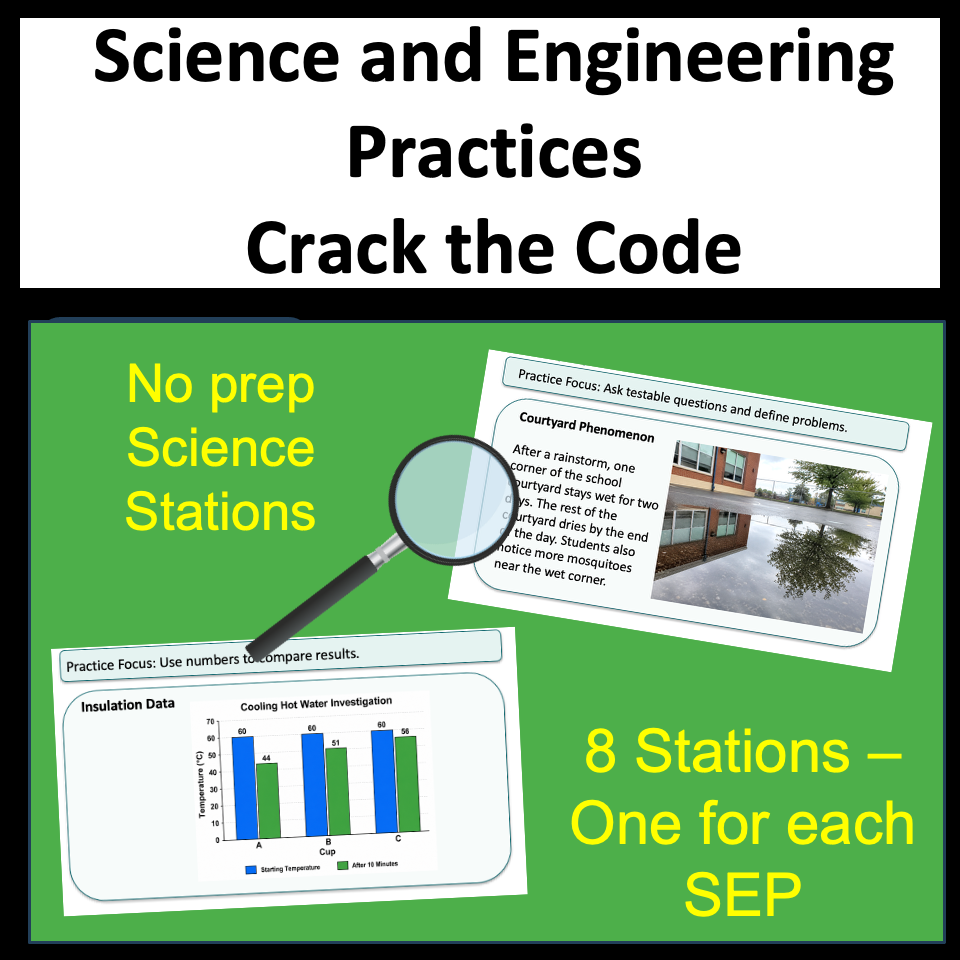
Introduce your students to the Science and Engineering Practices in an engaging and meaningful way. Get them up and moving with this fun Crack the Code Activity.
Students may use Science and Engineering Practices when they:
- Examine an unusual photograph
- Observe a demonstration
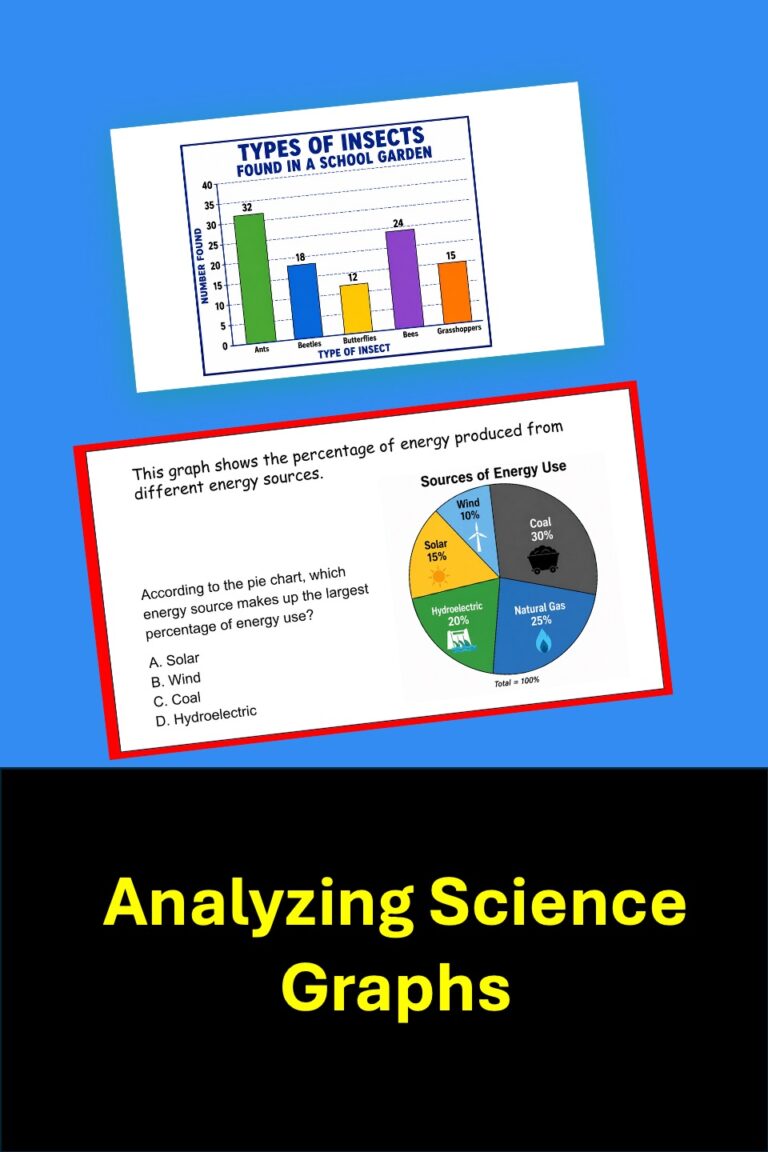
- Analyze a graph
- Develop a scientific model
- Discuss a real-world phenomenon
- Read a scientific text
- Compare possible engineering solutions
- Complete a Claim, Evidence, and Reasoning response
- Evaluate another student’s explanation
- Revise an explanation after gathering new evidence
For example, a teacher might show students an image of a plant growing toward a window. Students could make observations, ask questions, develop an initial model, and propose an explanation. After completing an investigation and analyzing data, they could revise their models and construct stronger explanations.
One simple phenomenon can involve several Science and Engineering Practices.
How Do Science and Engineering Practices Support Three-Dimensional Learning?
Three-dimensional science learning combines:
- Science and Engineering Practices
- Disciplinary Core Ideas
- Crosscutting Concepts
The disciplinary core ideas describe the science content students are learning. Crosscutting concepts help students recognize ideas that apply across different areas of science, such as patterns, cause and effect, systems, energy and matter, structure and function, and stability and change.
The Science and Engineering Practices describe what students do with that knowledge.
For example, students studying ecosystems might:
- Analyze population data
- Identify cause-and-effect relationships
- Develop a food web model
- Construct an explanation about changes in an ecosystem
- Use evidence to support their explanation
This approach helps students connect science content with scientific thinking.
Are Science and Engineering Practices the Same as the Scientific Method?
Science and Engineering Practices are broader and more flexible than a single scientific-method sequence.
Traditional scientific-method lessons often follow a fixed order:
- Ask a question.
- Form a hypothesis.
- Conduct an experiment.
- Analyze the results.
- Draw a conclusion.
Scientists do not always work through these steps in the same order. They may develop models, analyze existing data, revise questions, evaluate other explanations, or communicate findings before conducting a new investigation.
Engineering also involves defining problems, testing possible solutions, comparing design criteria, and improving designs.
The Science and Engineering Practices provide students with a more accurate picture of how science and engineering are actually carried out.
What Is the Difference Between Science Practices and Engineering Practices?
Science and engineering share many of the same practices, but they often have different goals.
Science focuses on explaining phenomena and understanding the natural world.
Engineering focuses on defining problems and designing effective solutions.
For example:
- A scientist may ask why a river is becoming polluted.
- An engineer may design a system that prevents trash from entering the river.
Both may analyze data, use models, communicate information, and evaluate evidence. The difference is usually the goal of the work.
| Science and Engineering Practice | Simple Introduction Strategy | Student-Friendly Question |
|---|---|---|
| Asking Questions & Defining Problems | Show an interesting phenomenon and have students generate questions before giving explanations. | “What do you notice? What do you wonder?” |
| Developing and Using Models | Ask students to draw what they think is happening inside a system. | “Can you sketch how this works?” |
| Planning and Carrying Out Investigations | Let students help design a simple investigation rather than following a recipe lab. | “How could we test this idea?” |
| Analyzing and Interpreting Data | Provide a graph, chart, or table and discuss patterns. | “What do you notice in the data?” |
| Using Mathematics and Computational Thinking | Have students calculate averages, compare values, or identify trends. | “What does the math tell us?” |
| Constructing Explanations & Designing Solutions | Ask students to explain a phenomenon using evidence. | “Why do you think this happened?” |
| Engaging in Argument from Evidence | Have students compare claims and support ideas with evidence. | “What evidence supports your answer?” |
| Obtaining, Evaluating, and Communicating Information | Give students a short article, diagram, or infographic to analyze. | “What information is most important?” |
How Can Teachers Introduce Science and Engineering Practices?
Teachers can begin by helping students recognize and name the practices they are already using.
A teacher might say:
- “You are asking questions about a phenomenon.”
- “You are analyzing and interpreting data.”
- “You are using evidence to support your claim.”
- “You are revising your model based on new information.”
- “You are comparing possible engineering solutions.”
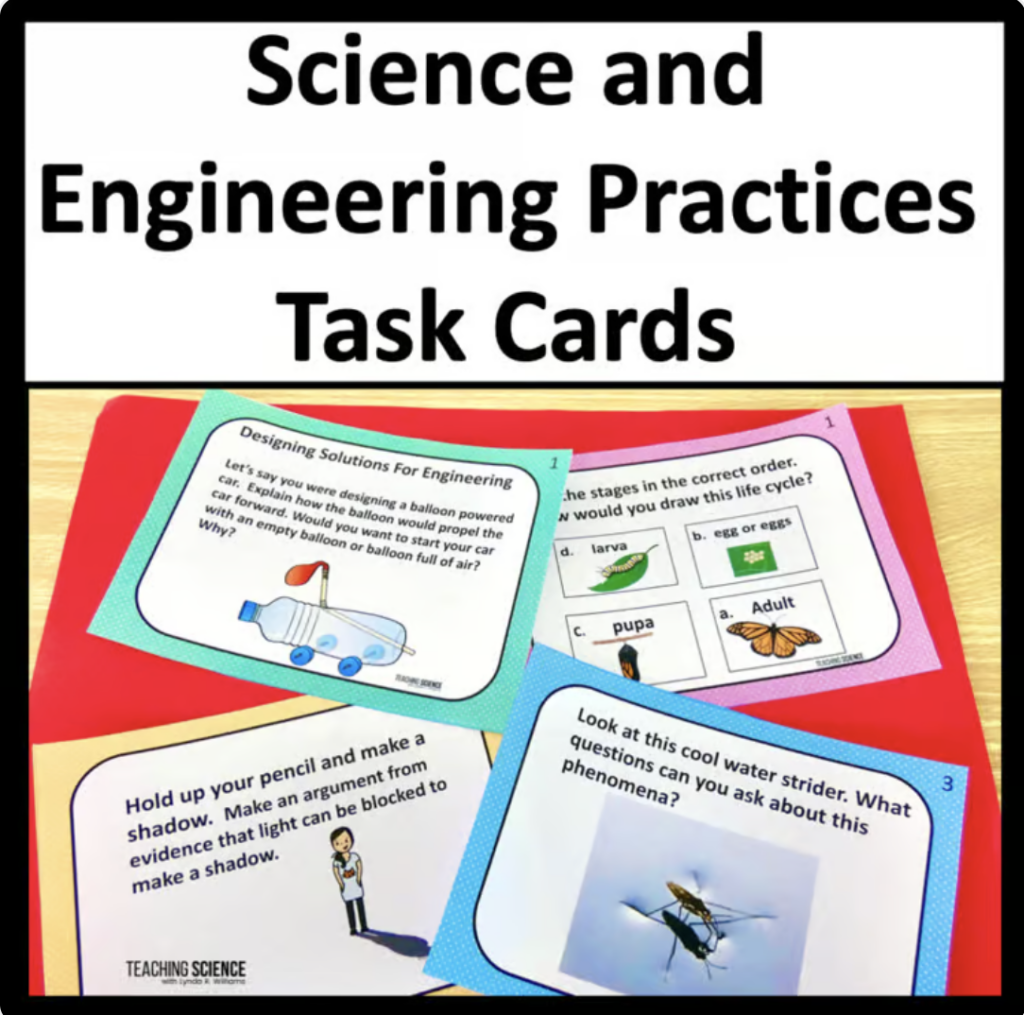
Displaying the eight Science and Engineering Practices in the classroom can also help students become familiar with the language. However, students need regular opportunities to use the practices—not simply memorize their names.
Why Are Science and Engineering Practices Important?
Science and Engineering Practices help students become active participants in science learning.
When students regularly use the practices, they learn how to:
- Think critically about scientific information
- Make careful observations
- Recognize patterns in data
- Evaluate the quality of evidence
- Explain their reasoning
- Revise ideas when new evidence becomes available
- Solve real-world problems
- Communicate scientific ideas clearly
These skills prepare students for science assessments, future coursework, careers, and informed decision-making in everyday life.
Frequently Asked Questions About Science and Engineering Practices
How many Science and Engineering Practices are there?
There are eight Science and Engineering Practices. They include asking questions, using models, conducting investigations, analyzing data, using mathematics, constructing explanations, arguing from evidence, and communicating information.
What does SEP mean in science?
SEP stands for Science and Engineering Practice. The plural abbreviation, SEPs, refers to all eight practices.
Do students need to use every practice in every lesson?
No. A lesson may emphasize one or two practices, while a longer investigation or unit may include several. Students should experience all eight practices repeatedly throughout the school year.
Can Science and Engineering Practices be used without a lab?
Yes. Students can use the practices while analyzing photographs, interpreting graphs, reading scientific texts, developing models, discussing phenomena, evaluating claims, and completing engineering challenges.
Are Science and Engineering Practices only part of the NGSS?
The specific set of eight practices is closely associated with the Framework for K–12 Science Education and the Next Generation Science Standards. Many states that use NGSS-based or three-dimensional science standards also incorporate these practices into classroom instruction and assessments.
What is an easy way to teach Science and Engineering Practices?
Begin with an observable phenomenon. Ask students to record what they notice and wonder, develop an initial explanation or model, and identify evidence they would need to understand the phenomenon. Return to their ideas as they investigate and learn new science content.
Final Thoughts
Science and Engineering Practices move science instruction beyond memorizing vocabulary and isolated facts. They give students opportunities to investigate, analyze, explain, design, evaluate, and communicate.
When students use the practices consistently, they begin to see science as something they actively do—not simply information they are expected to remember.
By incorporating Science and Engineering Practices into everyday lessons, teachers help students develop the curiosity, reasoning, and problem-solving skills they need to think like scientists and engineers.
About the Author

Lynda R. Williams is an experienced science and STEM educator who creates engaging, standards-aligned resources for upper-elementary and middle school science teachers. Her resources emphasize scientific phenomena, data analysis, evidence-based reasoning, three-dimensional learning, and meaningful Science and Engineering Practices.