How Is the Preferred Integrated Model Different from a Discipline-Specific Model?
In a discipline-specific sequence, students may study Earth science in sixth grade, life science in seventh grade, and physical science in eighth grade.
California’s Preferred Integrated Model takes a different approach. Students encounter multiple science disciplines each year, and related standards are intentionally connected through meaningful phenomena, questions, investigations, and instructional storylines.
For example, students might use ideas about thermal energy from physical science, weather and climate from Earth science, and organism adaptations from life science to explain how regional climates affect living things.
What Remains Consistent Across All Three Grade Levels?
Although the science content changes from grade to grade, students continue to use all three dimensions of the California Next Generation Science Standards:
- Science and Engineering Practices: What students do to investigate, model, analyze, explain, and design
- Crosscutting Concepts: Thinking tools such as patterns, systems, cause and effect, energy and matter, and stability and change
- Disciplinary Core Ideas: Essential knowledge from life, physical, Earth and space science, and engineering
The purpose of the integrated model is not simply to teach several unrelated science topics in the same year. The disciplines should work together to help students explain real-world phenomena and understand connections across science.

What Is California’s Preferred Integrated Model for Middle School Science?
California’s Preferred Integrated Model combines life science, physical science, Earth and space science, and engineering in grades 6, 7, and 8. Instead of studying only one branch of science each year, students make connections across scientific disciplines as they investigate phenomena and solve problems.
| Grade | Main Organizing Idea | Major Instructional Storylines | Science Disciplines Connected |
|---|---|---|---|
| Grade 6 | Systems within organisms and between organisms are connected to Earth’s climate systems. | Systems and subsystems in organisms and Earth; interactions among Earth systems that cause weather; effects of regional climates on organisms; effects of global warming on living systems | Life science, Earth and space science, physical science, climate science, and engineering |
| Grade 7 | Natural processes and human activities cause matter to cycle and energy to flow through Earth systems. | Atoms in living and nonliving matter; cycling of matter and flow of energy through organisms and rocks; natural and human influences on resources and ecosystems; sustaining biodiversity and ecosystem services | Physical science, life science, Earth and space science, environmental science, and engineering |
| Grade 8 | Processes that change Earth systems today also caused changes in Earth’s past. | Motion and collisions; gravity, electromagnetism, and other noncontact forces; Earth’s history and biological evolution; human impacts, waves, biodiversity, and environmental solutions | Physical science, Earth and space science, life science, environmental science, and engineering |
How Is the Preferred Integrated Model Different from a Discipline-Specific Model?
In a discipline-specific sequence, students may study Earth science in sixth grade, life science in seventh grade, and physical science in eighth grade.
California’s Preferred Integrated Model takes a different approach. Students encounter multiple science disciplines each year, and related standards are intentionally connected through meaningful phenomena, questions, investigations, and instructional storylines.
For example, students might use ideas about thermal energy from physical science, weather and climate from Earth science, and organism adaptations from life science to explain how regional climates affect living things.
What Remains Consistent Across All Three Grade Levels?
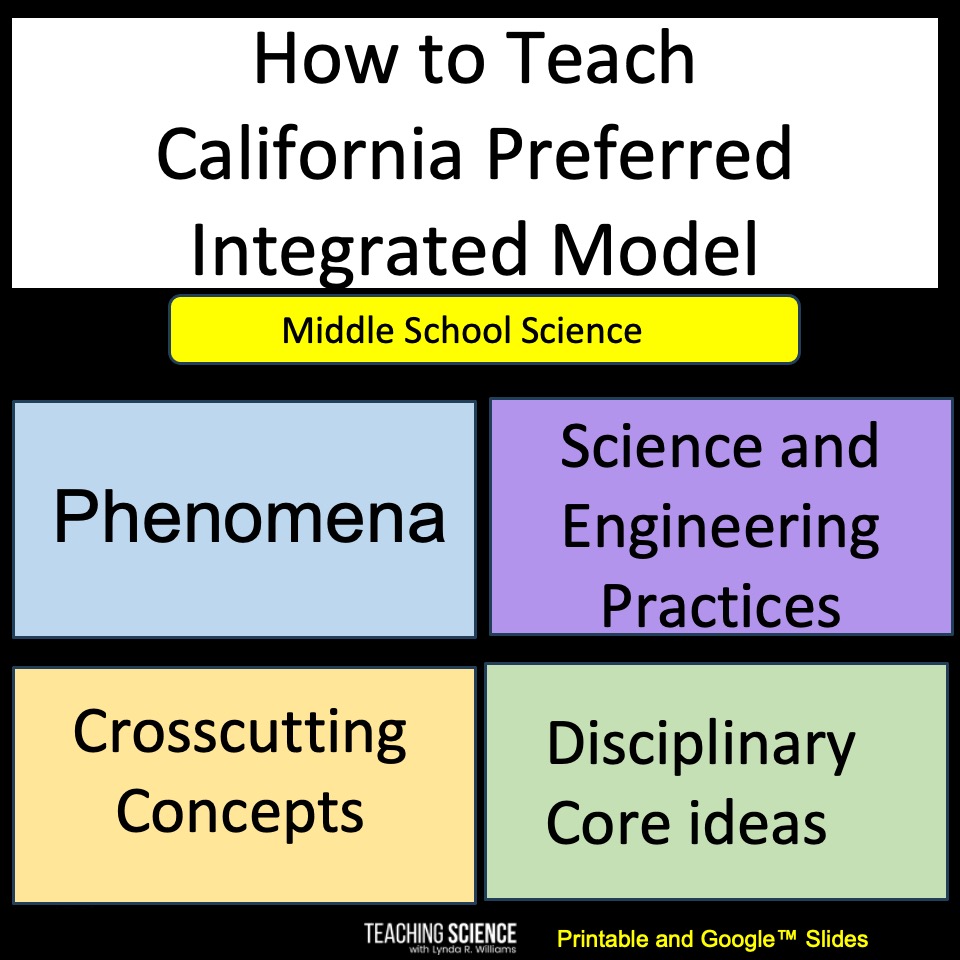
Although the science content changes from grade to grade, students continue to use all three dimensions of the California Next Generation Science Standards:
- Science and Engineering Practices: What students do to investigate, model, analyze, explain, and design
- Crosscutting Concepts: Thinking tools such as patterns, systems, cause and effect, energy and matter, and stability and change
- Disciplinary Core Ideas: Essential knowledge from life, physical, Earth and space science, and engineering
The purpose of the integrated model is not simply to teach several unrelated science topics in the same year. The disciplines should work together to help students explain real-world phenomena and understand connections across science.
More on Teaching Science with the California Integrated Model.
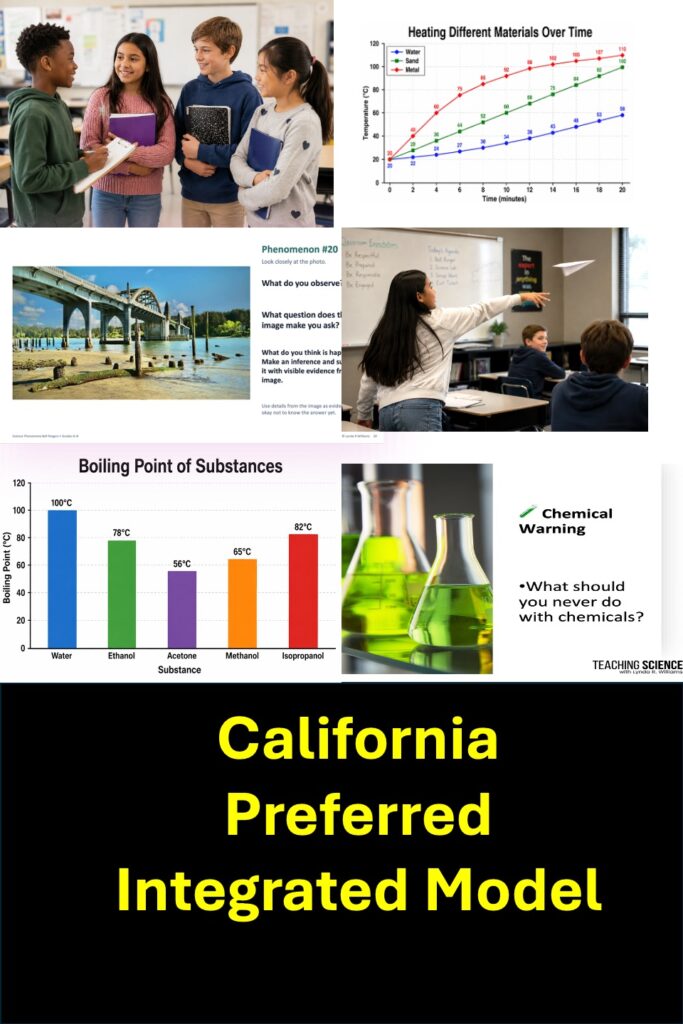
I have resources specifically aligned to the California Preferred Integrated Model. California Science Phenomena Resource
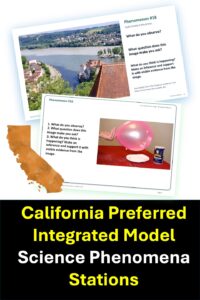
My California Science Phenomena resource was created specifically for middle school teachers using California’s Preferred Integrated Model of Science. It includes engaging real-world phenomena that connect life science, physical science, Earth and space science, and engineering concepts across the middle grades.
Teachers can use the photographs and prompts as bell ringers, task cards, science stations, discussion starters, or review activities. Each phenomenon encourages students to make observations, ask questions, identify patterns, and support their ideas with evidence.
The resource provides an easy, low-prep way to bring three-dimensional, phenomena-based learning into the classroom while helping students practice the scientific thinking skills they need for the CAST.

About the Author
Lynda R. Williams is an experienced science and STEM educator with more than 34 years in education. She holds a K–12 teaching license and a master’s degree in Curriculum and Instruction. Lynda taught in California for several years, giving her firsthand experience with the needs of California students, teachers, and science classrooms.
She has also taught Science Methods courses in university teacher-education programs and has extensive experience developing standards-based science curriculum. Her areas of expertise include phenomena-based instruction, three-dimensional learning, graph and data analysis, STEM engineering, inquiry, Claim-Evidence-Reasoning, NGSS, and California middle school science.
Learn more about Lynda R. Williams and her experience in science and STEM education.