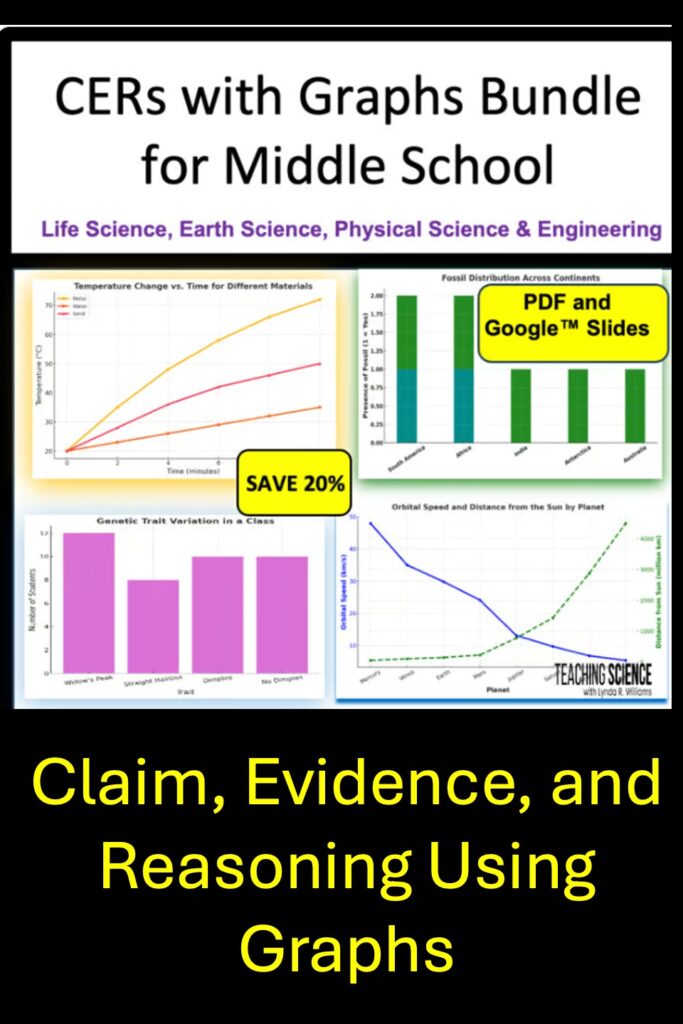
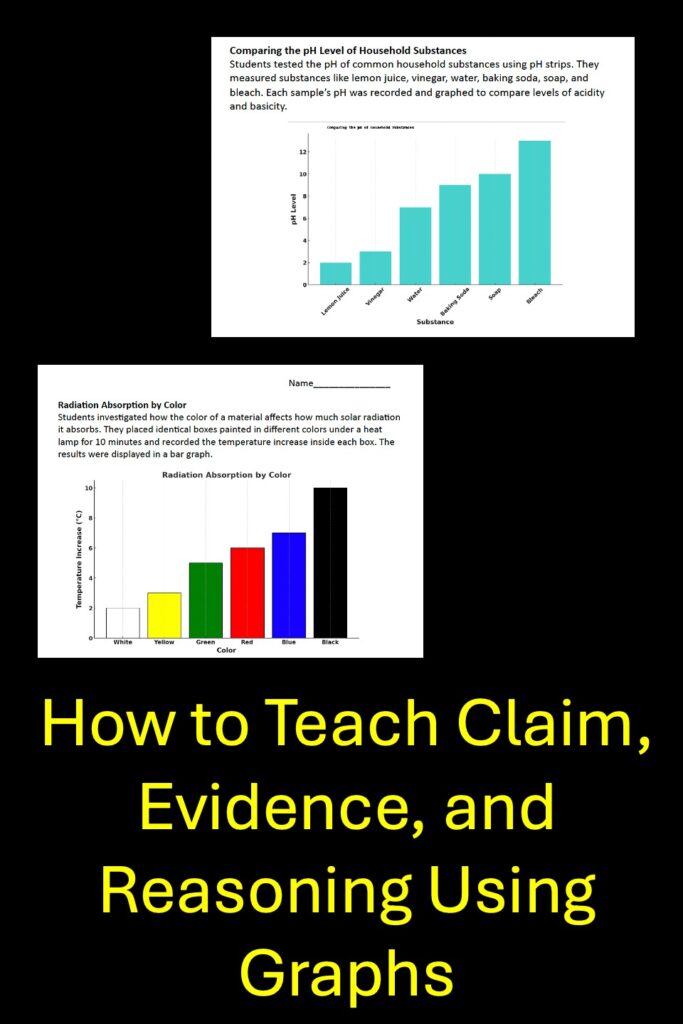
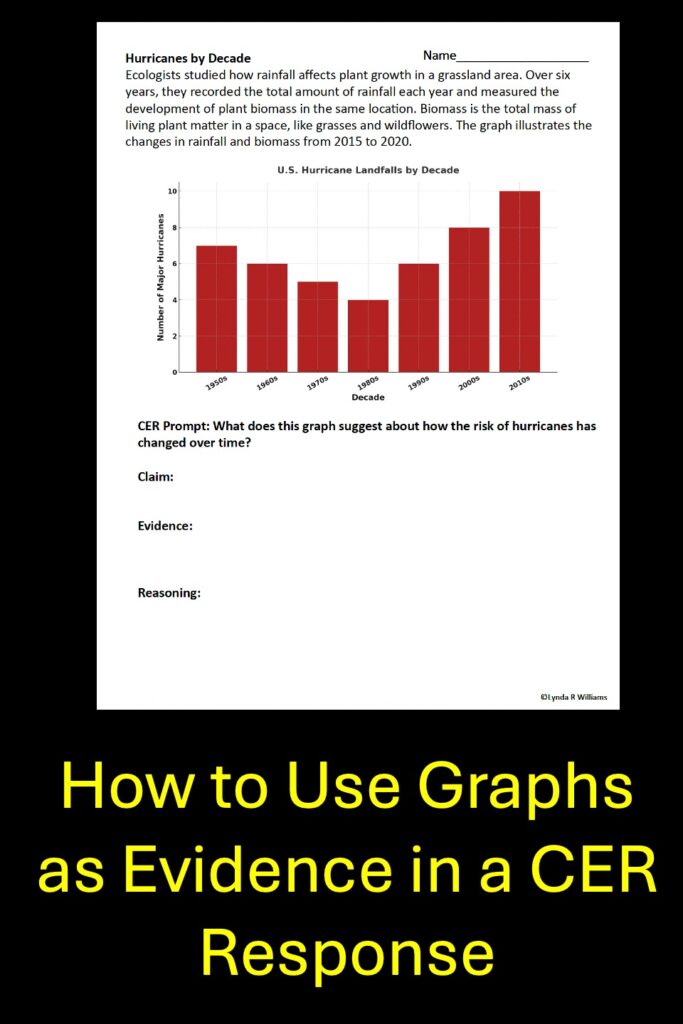
Do your students need to learn how to use graphs as evidence in a CER Response? Using graphs as evidence in a CER response helps students move beyond simply reading data. Students must identify relevant information, select specific values, and explain how those values support a scientific claim.
This is where graph analysis and scientific writing come together.
A strong CER response does not just mention the graph. It uses precise data from the graph as evidence and explains why that evidence supports the claim.
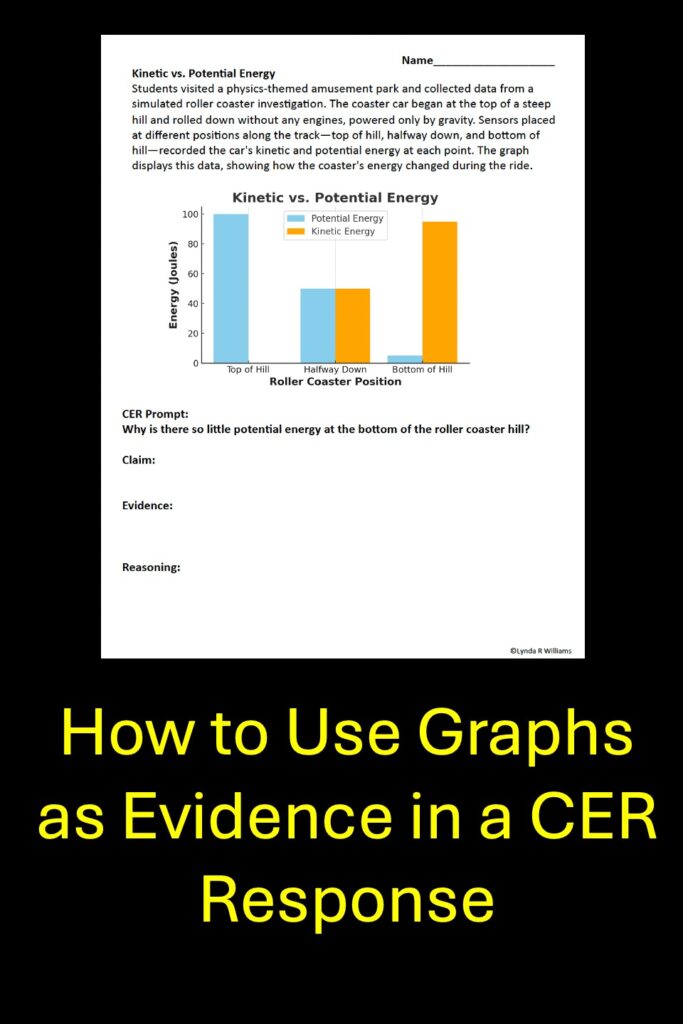
What Is CER in Science?
CER stands for:
- Claim
- Evidence
- Reasoning
A CER response is a structured way for students to explain scientific thinking.
The claim answers the question.
The evidence includes observations, measurements, or data that support the claim.
The reasoning explains why the evidence supports the claim using scientific ideas.
A simple CER structure looks like this:
| CER Component | Purpose | Example |
|---|---|---|
| Claim | Answers the scientific question | Plants exposed to more light grew taller. |
| Evidence | Uses specific observations or data | Plants receiving eight hours of light grew to 18 centimeters, while plants receiving four hours grew to 11 centimeters. |
| Reasoning | Explains why the evidence supports the claim | Plants need light for photosynthesis, so greater light exposure allows the plants to produce more food for growth. |
When students use graphs as evidence, the graph becomes more than a visual. It becomes a source of scientific support.
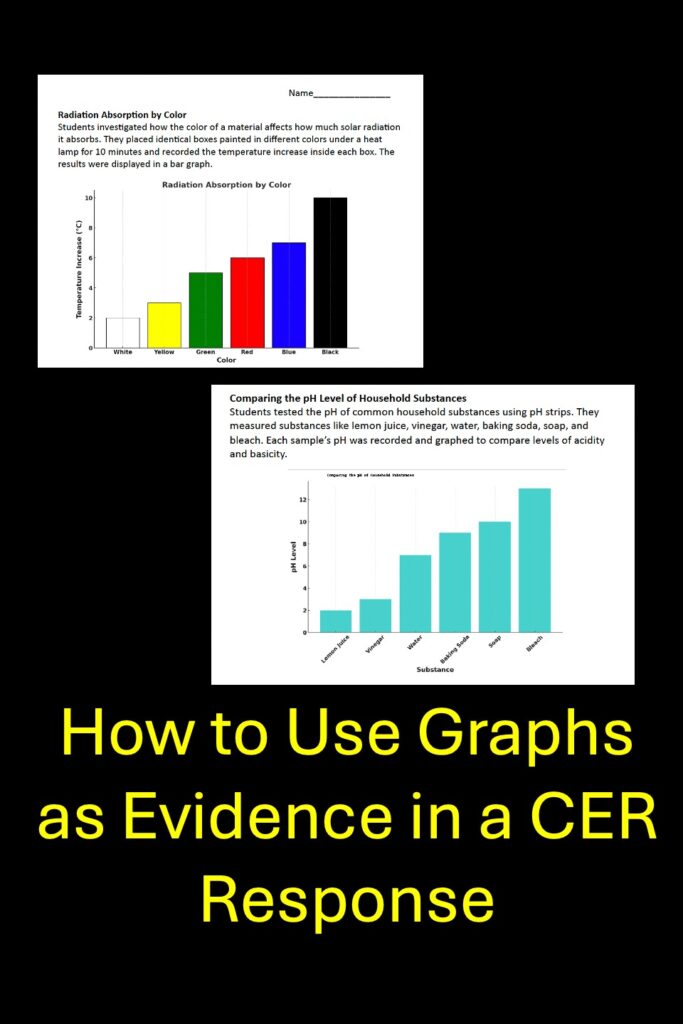
How Do You Use a Graph as Evidence in CER Writing?
To use a graph as evidence in a CER response, students should:
- Read the question carefully.
- Identify the claim they need to support.
- Examine the title, labels, units, and scale.
- Find the data points that are most relevant.
- Compare values when possible.
- Include specific numbers and units.
- Explain how the data supports the claim.
Students should not copy every number from the graph. They should select the strongest evidence.
For example, imagine a graph showing plant growth at different amounts of daily light.
A weak evidence statement might say:
The plants with more light grew more.
A stronger evidence statement would say:
Plants receiving eight hours of light grew to 18 centimeters, while plants receiving four hours of light grew to 11 centimeters.
The second response is stronger because it includes specific, measurable evidence.
What Is the Difference Between Evidence and Reasoning?
Evidence and reasoning are often confused because both appear after the claim.
The difference is simple:
Evidence tells what the data shows.
Reasoning explains why the data supports the claim.
Here is a comparison.
| Evidence | Reasoning |
|---|---|
| Comes directly from the graph, table, or investigation | Uses scientific ideas to explain the evidence |
| Includes numbers, measurements, or observations | Connects the evidence to the claim |
| Answers, “What data supports this?” | Answers, “Why does this data matter?” |
| Should be specific and accurate | Should include relevant scientific concepts |
| Does not explain the entire science concept | Does not simply repeat the data |
For example:
Claim: Increasing temperature increases the reaction rate.
Evidence: At 20°C, the reaction took 60 seconds. At 40°C, the reaction took 25 seconds.
Reasoning: Higher temperatures cause particles to move faster and collide more often, which can increase the rate of a chemical reaction.
The evidence gives the data. The reasoning explains the science.
Why Do Students Repeat Their Evidence as Reasoning?
One of the most common CER mistakes is repeating the evidence in the reasoning section.
A student may write:
Evidence: The plant with eight hours of light grew 18 centimeters.
Reasoning: This shows the plant with eight hours of light grew 18 centimeters.
The reasoning does not add anything new. It only repeats the measurement.
Students often do this because they understand that the evidence is important, but they do not know how to connect it to a scientific concept.
To help students move beyond repetition, teach them to ask:
- Why would this result happen?
- What scientific idea explains the pattern?
- How does the evidence make the claim more believable?
- What cause-and-effect relationship is shown?
- What science vocabulary belongs in the explanation?
A useful sentence frame is:
This evidence supports the claim because __________.
The word because pushes students to explain rather than repeat.
What Makes Strong Evidence in a CER Response?
Strong evidence is relevant, specific, accurate, and sufficient.
Relevant
The evidence must directly support the claim.
Students sometimes include numbers from a graph simply because they are available. The evidence should connect clearly to the scientific question.
Specific
Strong evidence includes exact values, comparisons, trends, or measurements.
For example:
The population increased.
is less effective than:
The population increased from 120 organisms in Year 1 to 210 organisms in Year 4.
Accurate
Students must read the graph correctly.
They should check:
- The scale
- Units
- Axis labels
- Categories
- Time intervals
- Key or legend
Sufficient
One data point is not always enough.
Students may need:
- Two values for comparison
- More than one trial
- An overall trend
- Evidence from several groups
- Data from different points in time
The amount of evidence depends on the claim.
How Do Students Choose the Best Evidence From a Graph?
Students should not automatically use the highest or lowest value.
They should choose the data that most directly supports the claim.
Teach students to ask:
- Which values show the strongest comparison?
- Which part of the graph directly answers the question?
- Does the claim involve change over time?
- Does the claim involve comparing groups?
- Does the claim depend on a pattern or trend?
- Are there data points that do not fit the pattern?
For example, if the claim is that increasing force increases acceleration, the best evidence would compare at least two force values and their corresponding accelerations.
A strong evidence statement might be:
When the force increased from 2 newtons to 8 newtons, the acceleration increased from 1 meter per second squared to 4 meters per second squared.
This evidence directly supports the relationship in the claim.
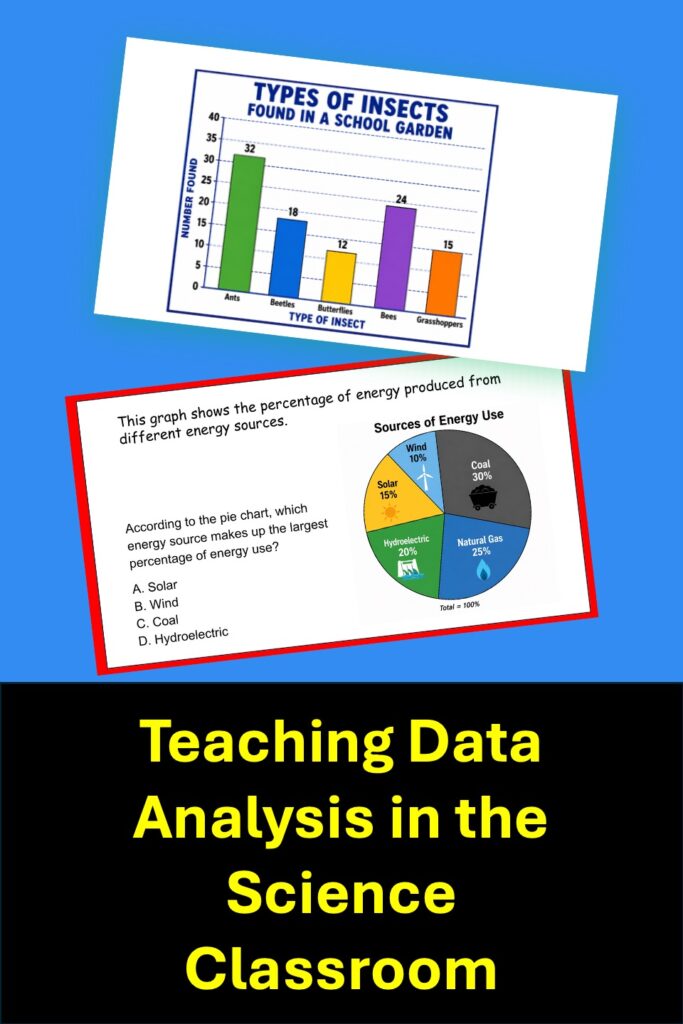
Teach Students to Read the Graph Before Writing the CER
Before students write, they need to understand the graph.
A useful prewriting routine is:
1. Read the Title
What is the graph about?
2. Identify the Variables
What is being changed, measured, or compared?
3. Check the Units and Scale
How are the values measured?
4. Notice the Pattern
Does the data increase, decrease, repeat, level off, or vary?
5. Select Evidence
Which values best support the claim?
6. Connect the Science
What scientific idea explains the pattern?
This short routine helps students organize their thinking before they begin writing.
A CER Example Using Graph Data
Imagine students are given a graph titled:
Rate of Photosynthesis at Different Light Intensities
The graph shows:
- 100 lux: 2 oxygen bubbles per minute
- 300 lux: 5 oxygen bubbles per minute
- 500 lux: 8 oxygen bubbles per minute
- 700 lux: 8 oxygen bubbles per minute
The question asks:
How does light intensity affect the rate of photosynthesis?
A strong CER response might be:
Claim
Increasing light intensity increases the rate of photosynthesis until the rate levels off.
Evidence
At 100 lux, the plant produced 2 oxygen bubbles per minute. At 500 lux, it produced 8 oxygen bubbles per minute. The rate remained at 8 bubbles per minute when the light intensity increased to 700 lux.
Reasoning
Light provides the energy needed for photosynthesis, so increasing light intensity allows the plant to photosynthesize faster. However, the rate eventually levels off because another factor may become limiting.
This response is strong because it uses several data points, identifies the pattern, and connects the evidence to a scientific explanation.
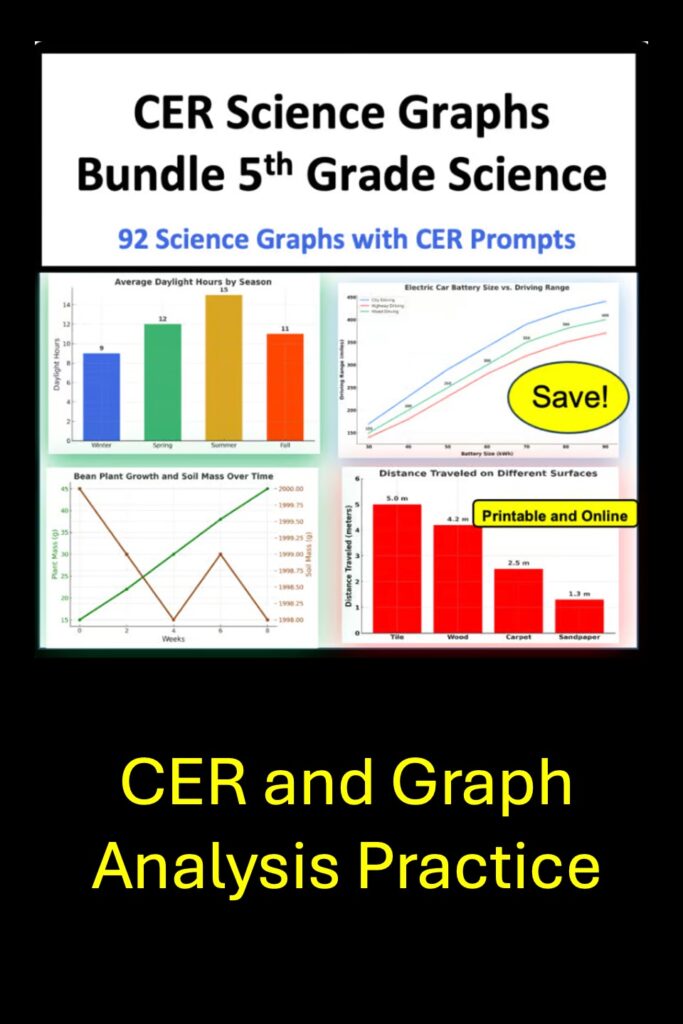
How to Scaffold CER Writing for Fifth Grade
Fifth-grade students can write effective CER responses when the task is broken into smaller steps.
Begin with short, clear questions and simple graphs.
Helpful scaffolds include:
- Color-coding the claim, evidence, and reasoning
- Providing sentence starters
- Modeling one section at a time
- Using short graph-analysis questions before the CER
- Allowing students to discuss the data before writing
- Providing a checklist
- Using partially completed examples
- Starting with one piece of evidence before requiring two
A fifth-grade CER organizer might include:
Claim: I think __________.
Evidence: The graph shows __________.
Reasoning: This supports my claim because __________.
As students become more confident, remove the sentence frames and ask them to write more independently.
How to Teach Scientific Reasoning
Reasoning is often the most difficult part of CER writing because students must connect evidence to a science concept.
Students may need explicit instruction in how to build that connection.
Teach them to use this structure:
The evidence supports the claim because [scientific idea].
For example:
The evidence supports the claim because plants need light energy to carry out photosynthesis.
Then encourage them to extend the explanation:
Because plants need light energy for photosynthesis, the plants receiving more light were able to produce more glucose for growth.
Students should understand that reasoning is not an opinion. It is a scientific explanation.
Use Science Vocabulary in the Reasoning
Strong reasoning often includes vocabulary connected to the science concept.
Examples include:
- Photosynthesis
- Energy transfer
- Gravity
- Friction
- Particle motion
- Adaptation
- Erosion
- Force
- Mass
- Ecosystem
- Predator
- Prey
- Inheritance
- Reaction rate
Students should use vocabulary accurately, not simply add science words to make the response sound more advanced.
For example:
The data supports the claim because friction slowed the object as it moved across the rougher surface.
This sentence uses vocabulary to explain the evidence.
How Graphs Strengthen CER Writing
Graphs are especially useful in CER instruction because they make patterns visible.
Students can use graphs to:
- Compare groups
- Track changes over time
- Identify relationships
- Find trends
- Notice unusual results
- Calculate differences
- Support cause-and-effect claims
- Evaluate whether a conclusion is reasonable
Graph-based CER tasks also help students practice two important skills at once: data analysis and scientific explanation.
This is especially valuable because students often struggle to transfer graph-reading skills into written responses.
[Add link to graph-based CER activities]
Use Graph Bell Ringers to Prepare Students for CER
Students may find a full CER response overwhelming if they are still struggling to interpret the graph.
Graph bell ringers can build the smaller skills students need before writing.
A short bell ringer might ask:
- What is the highest value?
- What pattern is shown?
- Which two data points best support the pattern?
- What scientific idea might explain the result?
Those questions naturally lead into a CER response.
Over time, students begin to recognize that graph analysis is not separate from scientific writing. The graph provides the evidence they need.
[Add link to graph bell ringers]
Use Phenomena to Create Meaningful CER Questions
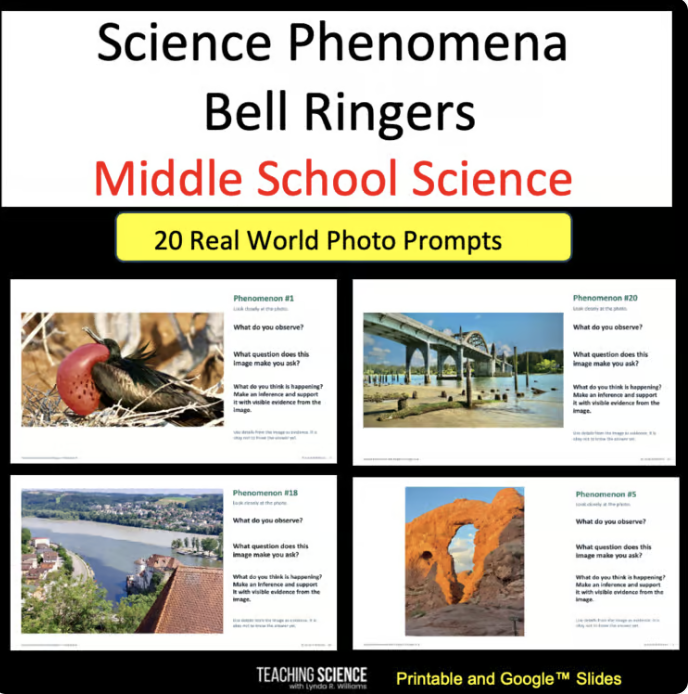
Phenomena give students something real and interesting to explain.
A photograph, observation, demonstration, or short video can lead to a scientific question. Students can then analyze a graph or data table connected to the phenomenon.
For example, students might observe that one side of a plant bends toward a window.
They could then examine a graph showing plant growth under different light conditions and write a CER response explaining the relationship.
Phenomena help make CER writing feel purposeful because students are using evidence to explain something they observed.
Connect CER to Scientific Investigations
CER writing is also a natural part of the scientific method and experimental design.
After an investigation, students can use their results to answer the original question.
A CER response helps them:
- State a conclusion
- Cite data from the investigation
- Explain the results scientifically
- Evaluate whether the hypothesis was supported
- Discuss unusual results
- Identify limitations
- Suggest future investigations
Scientific-method resources can help students understand where CER fits into the larger investigation process.
Common CER Mistakes and How to Fix Them
| Common Mistake | Why It Happens | How to Help |
|---|---|---|
| The claim is too vague | Students do not fully answer the question | Require a one-sentence claim that directly responds to the prompt |
| Evidence has no numbers | Students summarize instead of citing data | Ask for specific values and units |
| Evidence is irrelevant | Students choose any visible data | Teach them to match the evidence to the claim |
| Reasoning repeats the evidence | Students do not know which science concept to use | Ask, “Why did this happen?” |
| Reasoning is an opinion | Students are not grounding the explanation in science | Require scientific vocabulary or principles |
| Students include too much data | They think more evidence is always better | Ask them to select the strongest two or three examples |
| The claim changes during the response | Students lose focus | Have them reread the question before each CER section |
| Students ignore unusual data | They focus only on the main trend | Ask whether all data points support the claim |
How to Grade CER Without Spending Hours
CER responses can take a long time to grade if every sentence is marked in detail.
A simple rubric makes grading faster and more consistent.
Use a three-part checklist:
Claim
- Does it answer the question?
- Is it scientifically reasonable?
Evidence
- Is the evidence relevant?
- Does it include specific data?
- Are units included when appropriate?
Reasoning
- Does it explain why the evidence supports the claim?
- Does it use a correct scientific concept?
A quick scoring system might use 0, 1, or 2 points for each section.
| Score | Description |
|---|---|
| 0 | Missing or incorrect |
| 1 | Partially complete or unclear |
| 2 | Complete, accurate, and well supported |
This creates a six-point CER rubric.
Teachers can also save time by:
- Grading only one CER section at a time
- Using peer review with a checklist
- Highlighting claim, evidence, and reasoning in different colors
- Giving one focused comment
- Using whole-class feedback for common mistakes
- Having students revise only the weakest section
The goal is to help students improve their scientific thinking, not to correct every sentence.
A Simple CER Checklist for Students
Before submitting a response, students can ask:
Claim
- Did I answer the question?
- Is my claim clear and specific?
Evidence
- Did I use data from the graph?
- Did I include specific numbers?
- Did I include units?
- Does my evidence support my claim?
Reasoning
- Did I explain why the evidence supports the claim?
- Did I use a scientific idea?
- Did I avoid simply repeating the evidence?
This checklist encourages students to review their own work before the teacher grades it.
How Often Should Students Practice CER?
Students benefit from regular, short CER practice.
They do not need to write a full paragraph every time.
A weekly progression might look like this:
| Day | CER Focus |
|---|---|
| Monday | Write a clear claim |
| Tuesday | Select the strongest graph evidence |
| Wednesday | Explain the science concept |
| Thursday | Combine claim, evidence, and reasoning |
| Friday | Revise a sample CER response |
This routine helps students develop each skill separately before combining them.
Short, frequent practice is often more effective than assigning a long CER response only at the end of a unit.
How to Differentiate CER Instruction
Students may need different levels of support.
For Students Who Need More Support
- Provide sentence frames
- Highlight relevant graph values
- Use fewer data points
- Give a word bank
- Model the reasoning aloud
- Use partner discussion before writing
- Provide a partially completed CER
For Students Ready for More Challenge
- Require multiple pieces of evidence
- Include data that does not perfectly fit the pattern
- Ask students to evaluate the strength of the claim
- Require discussion of limitations
- Ask for an alternative explanation
- Use more complex graphs
- Require evidence from multiple sources
Differentiation should change the amount of support, not remove the scientific thinking.
CER Writing Supports Important Science Practices
CER writing helps students participate in several science and engineering practices, including:
- Analyzing and interpreting data
- Constructing explanations
- Engaging in argument from evidence
- Planning and carrying out investigations
- Using mathematics and computational thinking
- Communicating scientific information
It also supports crosscutting concepts such as:
- Patterns
- Cause and effect
- Systems and system models
- Energy and matter
- Structure and function
- Stability and change
When students use graphs in CER writing, they connect data analysis, science content, and evidence-based reasoning.
Using CER During the First Month of Science
The beginning of the school year is a good time to introduce CER in a simple, structured way.
Students do not need to master the full format immediately.
A practical sequence is:
- Teach students to write a clear claim.
- Practice finding evidence in a graph.
- Model the difference between evidence and reasoning.
- Use sentence frames.
- Complete a CER response as a class.
- Move to partner writing.
- Assign an independent response.
This sequence fits well with first-month science instruction because students can practice graph analysis, scientific method, and evidence-based writing together.

Final Thoughts
Using graphs as evidence in CER writing helps students understand that scientific claims must be supported by data.
Students need to do more than mention the graph. They need to select relevant values, include specific numbers and units, and explain how the evidence supports the claim.
The most effective CER instruction separates the three parts clearly:
- The claim answers the question.
- The evidence comes from the data.
- The reasoning explains the science.
With regular graph analysis, modeling, and short writing practice, students become more confident at using evidence to explain scientific ideas.
That is the real purpose of CER: helping students think, write, and communicate like scientists.
Frequently Asked Questions About CER Writing
What does CER stand for in science?
CER stands for claim, evidence, and reasoning. The claim answers the question, the evidence supports the claim with data, and the reasoning explains why the evidence supports the claim.
Can students use graphs as evidence in CER writing?
Yes. Students can use specific values, comparisons, trends, and patterns from a graph as evidence. Strong graph evidence includes accurate numbers and units.
What is the difference between evidence and reasoning?
Evidence comes directly from data, observations, or measurements. Reasoning explains why that evidence supports the claim using scientific concepts.
What makes strong evidence in a CER response?
Strong evidence is relevant, specific, accurate, and sufficient. It directly supports the claim and includes measurable data whenever possible.
How do you help students who repeat evidence as reasoning?
Ask students to explain why the result occurred, which scientific concept applies, and how the data makes the claim more believable. Sentence frames using the word “because” can help.
How do you grade CER quickly?
Use a simple rubric that scores the claim, evidence, and reasoning separately. Focus on one improvement at a time and use whole-class feedback for common errors.
Can fifth-grade students write CER responses?
Yes. Fifth-grade students can write CER responses with modeling, sentence frames, clear graphs, guided practice, and short, focused prompts.
About the Author
Lynda R. Williams is an experienced science educator, curriculum writer, and former university science-methods instructor. She creates practical science resources for grades 5 through 8 that help teachers build data literacy, scientific reasoning, and evidence-based writing skills.