Teaching students to write a strong Claim, Evidence, Reasoning response, often called a CER, can be challenging.
Students may understand the science concept but still struggle to explain their thinking in writing. They may make a good claim but provide weak evidence. They may copy data without explaining what it means. Or they may repeat their evidence in the reasoning section instead of connecting the evidence to a scientific idea.
The goal of CER is not simply to teach students a writing formula.
CER helps students learn to make a scientific claim, support it with evidence, and explain why that evidence supports the claim.
When students practice Claim, Evidence, Reasoning regularly, they begin to think more carefully about the evidence behind their scientific explanations.
I use CER throughout my upper elementary and middle school science resources because it gives students a practical structure for explaining what scientific data, observations, models, and investigations actually mean.
What Does CER Mean in Science?
CER stands for:
Claim
Evidence
Reasoning
It is a structure students can use to answer scientific questions and explain their thinking.
A CER response begins with a question or problem.
Students then make a claim, support that claim with evidence, and explain how the evidence connects to the scientific concept.
| CER Component | What the Student Does | Question to Ask |
|---|---|---|
| Claim | Answers the scientific question | What do I think the answer is? |
| Evidence | Uses observations, measurements, data, or information that support the claim | What evidence supports my answer? |
| Reasoning | Explains why the evidence supports the claim using science ideas | Why does this evidence support my claim? |
What Is a Claim in Science?
A claim is a statement that answers a scientific question.
A strong claim should be:
- Clear
- Concise
- Related directly to the question
- Supported by evidence
For example, students might investigate which conditions affect plant growth.
A possible claim could be:
Plants that received adequate water grew more than plants that received very little water.
The claim answers the question, but it does not yet explain why the student believes it.
That comes next.
What Is Evidence in a CER?
Evidence is the scientific information that supports the claim.
Evidence may come from:
- Graphs
- Data tables
- Measurements
- Lab observations
- Experiments
- Models
- Scientific text
- Maps
- Images
- Recorded observations
Strong evidence should be specific.
Instead of writing:
The plant with more water grew better.
a student might write:
The plant receiving 100 mL of water grew 8 cm, while the plant receiving 25 mL grew only 3 cm.
The second response is stronger because the student is using actual data as evidence.
What Is Reasoning in a CER?
The reasoning explains why the evidence supports the claim.
This is often the most difficult part of CER for students.
Evidence tells us:
What happened?
Reasoning explains:
Why does that evidence support the claim?
For example:
Claim
Plants receiving adequate water grew more.
Evidence
The plant receiving 100 mL of water grew 8 cm, while the plant receiving only 25 mL grew 3 cm.
Reasoning
Plants need water for processes necessary for growth. The greater growth of the plant receiving more water supports the claim that adequate water helped the plant grow.
The reasoning connects the data to the science concept.
That connection is what many students need the most practice learning to make.
Evidence and Reasoning Are Not the Same Thing
One of the most common CER problems I see is students repeating their evidence in the reasoning section.
For example:
Evidence
The temperature increased from 20°C to 35°C.
Weak Reasoning
The temperature increased by 15°C.
The student has simply repeated the evidence.
A stronger reasoning statement explains the scientific significance of the evidence.
Students need to understand:
Evidence = What does the data show?
Reasoning = Why does that evidence matter scientifically?
I often tell students to think of reasoning as the bridge between the evidence and the claim.
How Do You Teach CER Step by Step?
Students usually have more success with CER when teachers introduce the parts gradually.
Step 1: Start With a Clear Scientific Question
Students need to understand exactly what they are trying to explain.
A good question might be:
How does the amount of sunlight affect plant growth?
or:
Which material is the best thermal insulator?
or:
How does resource availability affect a population?
Step 2: Write the Claim
Ask:
What is your answer to the question?
Encourage students to write a complete statement rather than a single word.
Step 3: Find the Strongest Evidence
Ask students:
What data support your claim?
Students should look for:
- Measurements
- Numbers
- Patterns
- Comparisons
- Observations
Not every piece of information is equally useful.
Students should learn to choose the evidence that most strongly supports their claim.
Step 4: Explain the Reasoning
Now ask:
Why does this evidence support your claim?
Students should connect their evidence to the relevant scientific concept.
This step often requires more modeling and practice than the claim or evidence sections.
Step 5: Reread the Entire CER
Students should check:
Did I answer the question?
Did I include specific evidence?
Did I explain why the evidence supports my claim?
This helps students see CER as one connected scientific explanation rather than three unrelated boxes.
What Counts as Good Evidence in Science?
Not all evidence is equally strong.
Good scientific evidence should be:
Relevant
The evidence should relate directly to the claim.
Specific
Whenever possible, students should include actual measurements, values, observations, or trends.
Accurate
The evidence should match the information provided.
Sufficient
Students should provide enough evidence to support the claim.
For younger students, one strong piece of evidence may be appropriate.
As students become more experienced, they can learn to use multiple pieces of evidence and evaluate which evidence provides the strongest support.
Using Graphs and Data With CER
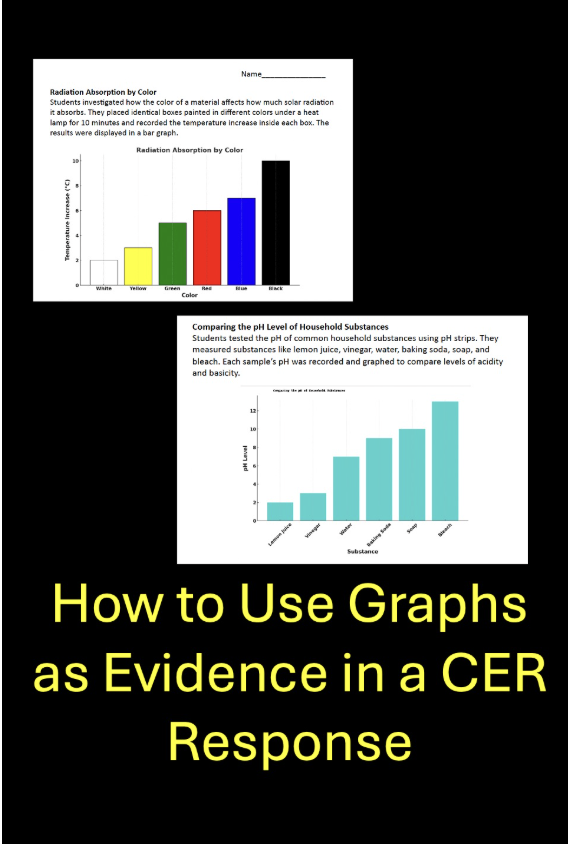
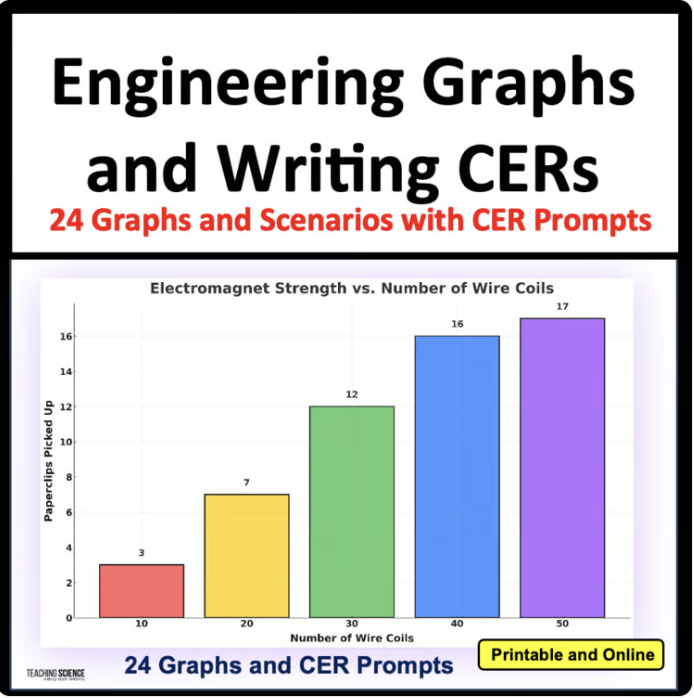
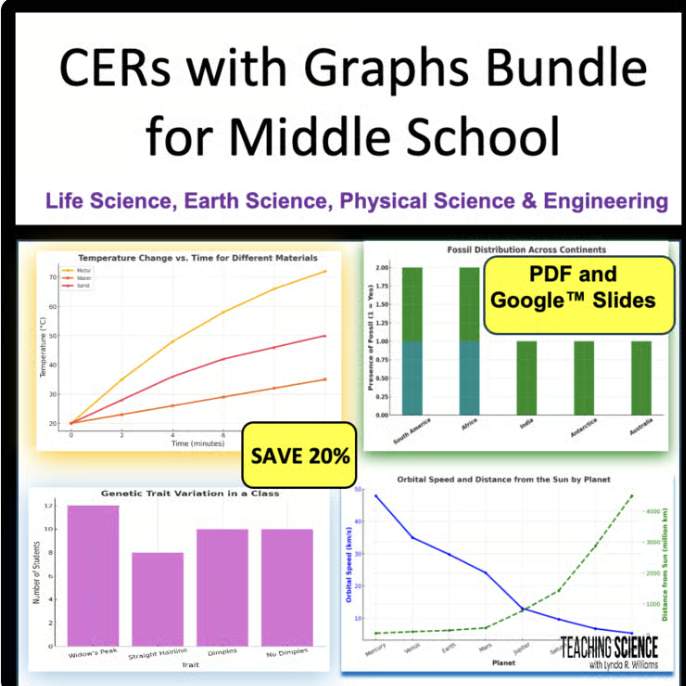
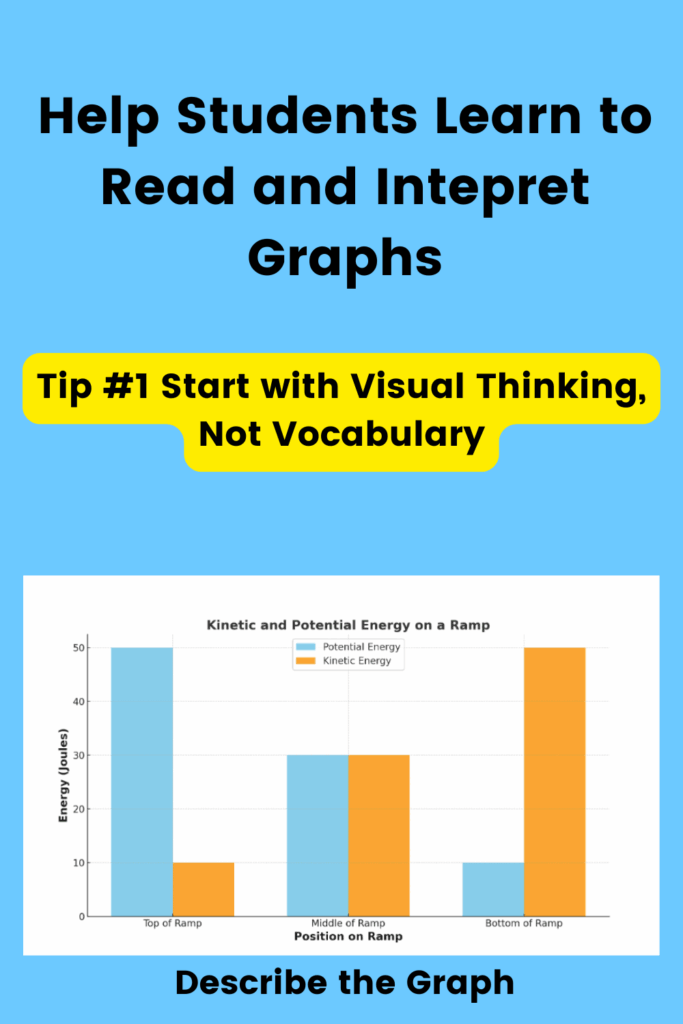
Graphs are one of my favorite ways to teach CER because they give students clear evidence to work with.
Students do not have to wonder:
What evidence should I use?
The evidence is already in the graph.
For example, students may analyze:
- Plant growth data
- Predator and prey populations
- Weather patterns
- Resource availability
- Kinetic energy data
- Natural selection
- Chemical reactions
- Earth systems
- Human impacts
Students can then answer a scientific question using the graph.
This makes graph analysis and CER a natural combination.
Claim
Students make a conclusion based on the graph.
Evidence
Students cite specific values, comparisons, or patterns.
Reasoning
Students explain the scientific relationship represented by the data.
If you are working specifically on graph analysis, visit my 5th Grade Science Graph & Data Analysis guide or my Middle School Science Graph & Data Analysis, Grades 6–8 guide.
A Simple CER Example
Imagine students are shown a graph of two plant populations growing under different light conditions.
Question
How did access to light affect plant growth?
Claim
Plants receiving more light grew taller.
Evidence
Plants receiving 8 hours of light averaged 18 cm in height, while plants receiving 2 hours averaged 9 cm.
Reasoning
Plants use light energy during photosynthesis to produce sugars needed for growth. The plants receiving more light grew taller, which supports the claim that greater access to light increased plant growth.
Notice that each section has a different job.
The claim answers the question.
The evidence provides the data.
The reasoning explains the science.
CER Sentence Starters for Science
Sentence starters can help students learn the structure of CER without writing the response for them.
Claim Sentence Starters
- The evidence shows that…
- I claim that…
- Based on the investigation…
- The data support the conclusion that…
Evidence Sentence Starters
- The data show…
- According to the graph…
- One piece of evidence is…
- The results show…
- In the investigation…
Reasoning Sentence Starters
- This evidence supports the claim because…
- This is important because…
- Scientifically, this makes sense because…
- The evidence connects to the claim because…
- We know that…
As students become more confident, they should rely less on sentence starters and develop their own scientific explanations.
Common CER Mistakes
Students often make predictable mistakes when they first begin writing CER responses.
The Claim Does Not Answer the Question
Students sometimes write a fact about the topic instead of answering the question.
Have students reread the question before writing their claim.
The Evidence Is Too General
A student may write:
The graph went up.
Encourage students to include specific data:
The population increased from 120 organisms to 185 organisms.
Students Include Opinions Instead of Evidence
Statements such as:
I think this happened because…
are not evidence.
Students should learn to distinguish between an opinion and information supported by observations or data.
Students Repeat Their Evidence as Reasoning
This is probably the CER mistake teachers encounter most often.
Remind students:
Evidence tells what happened.
Reasoning explains why it matters.
Students Add Information That Is Not Supported
Students sometimes make assumptions beyond what the data actually show.
Teach students to ask:
Can I point to evidence that supports this statement?
If not, they may be making an unsupported conclusion.

How Do You Introduce CER in 5th Grade?
Fifth grade is an excellent time to begin developing CER skills.
I would keep the structure simple at first.
Students can begin with:
One clear claim
One or two pieces of evidence
A short explanation connecting the evidence to the science idea
Graphs and simple investigations work particularly well because students have concrete evidence to use.
Students do not need to write long paragraphs when they first learn CER.
The goal is for them to understand the relationship among:
Claim → Evidence → Reasoning
As their science knowledge and writing skills grow, their CER responses can become more sophisticated.
How to Teach Students to Analyze Science Graphs
Teaching CER in Middle School Science
By middle school, students should begin moving beyond a simple formula.
They can learn to:
- Evaluate multiple pieces of evidence
- Decide which evidence is strongest
- Use quantitative data
- Compare variables
- Identify patterns
- Explain cause-and-effect relationships carefully
- Connect evidence to scientific concepts
- Develop arguments supported by evidence
Students may also encounter data that do not perfectly support one conclusion.
That creates opportunities to discuss:
Which claim is best supported?
Which evidence is strongest?
What additional evidence would help?
CER becomes more powerful when students understand it as a scientific thinking process rather than simply a writing template.
Using CER With Science Labs and Investigations
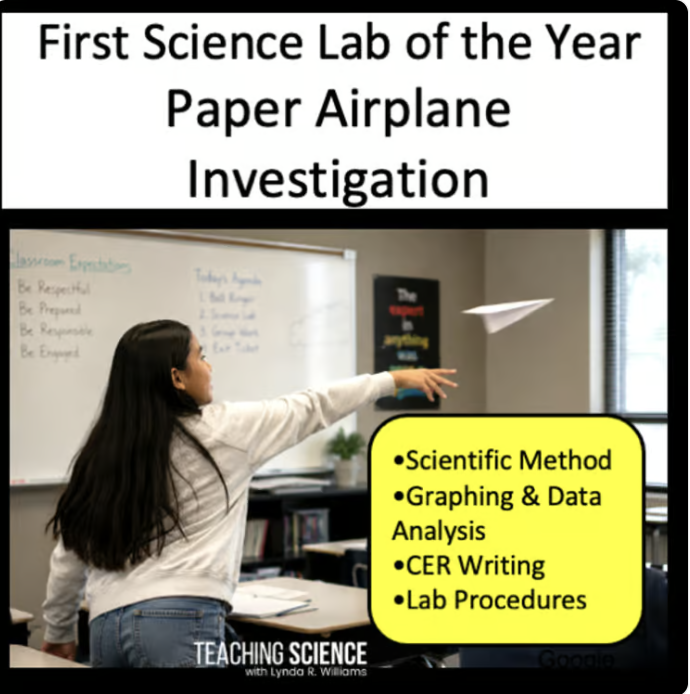
CER works especially well after hands-on investigations.
Students conduct an investigation, collect data, and then use their results to answer a scientific question.
Instead of ending a lab with:
“What happened?”
teachers can ask students to explain:
What do your results tell you?
A CER response helps students connect the hands-on activity to the scientific concept.
For example:
Investigation → Data → Claim → Evidence → Reasoning
This gives the lab a clear purpose and helps students understand why scientists collect evidence in the first place.
CER and the Next Generation Science Standards
Claim, Evidence, Reasoning fits naturally with the Next Generation Science Standards because NGSS asks students to use evidence as part of scientific explanations and arguments.
Two Science and Engineering Practices are especially closely connected:
Constructing Explanations and Designing Solutions
and
Engaging in Argument from Evidence
Students are expected to do more than memorize scientific facts.
They should be able to use observations, data, models, and other evidence to explain scientific phenomena and support conclusions.
CER gives teachers a practical structure for helping students practice those skills.
CER Is Not Just a Writing Activity
It is easy to think of CER as a science writing strategy.
It is much more than that.
CER teaches students to ask:
What am I claiming?
What evidence supports that claim?
Why does the evidence support it?
Those are scientific thinking skills.
Students can use CER when analyzing:
- Graphs
- Experiments
- Models
- Informational text
- Maps
- Images
- Data tables
- Phenomena
- Demonstrations
The format may change, but the thinking remains the same.
CER Activities for Science
Students usually need repeated CER practice before the structure becomes natural.
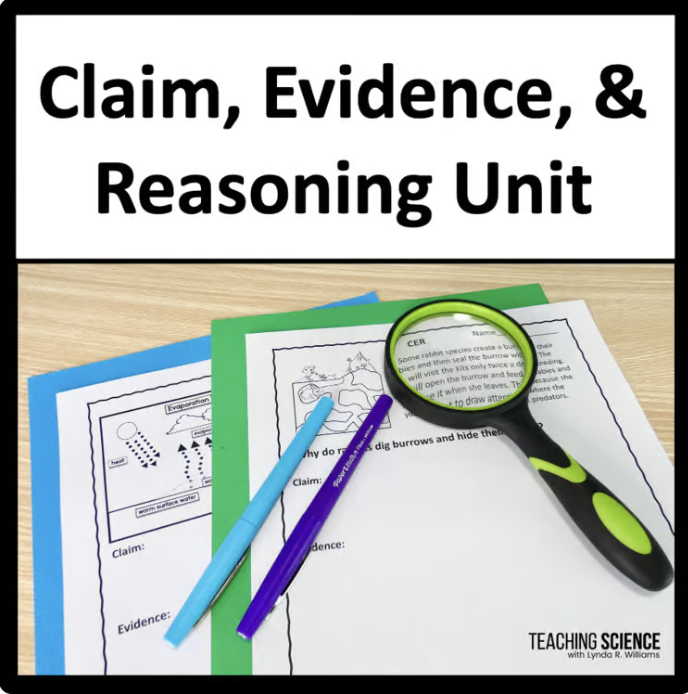
I have developed CER resources for upper elementary and middle school students that provide students with scientific information and evidence to analyze.
CER With Science Graphs
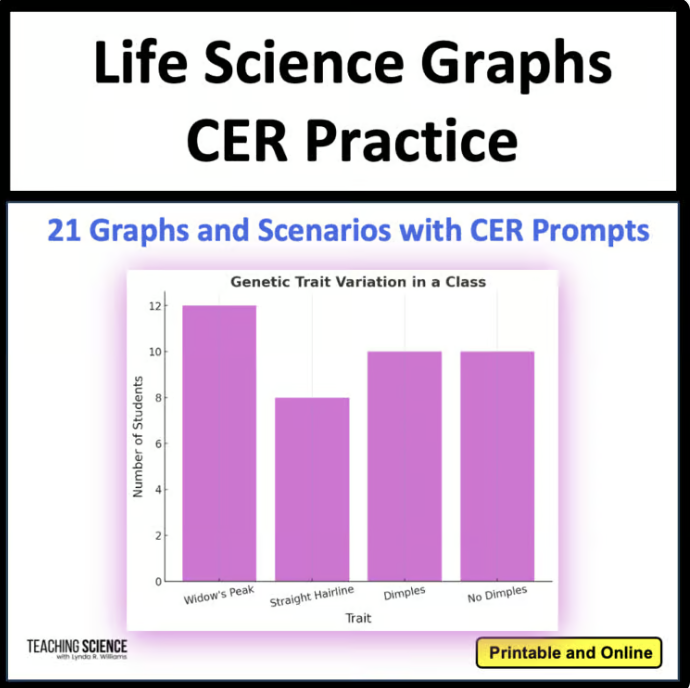
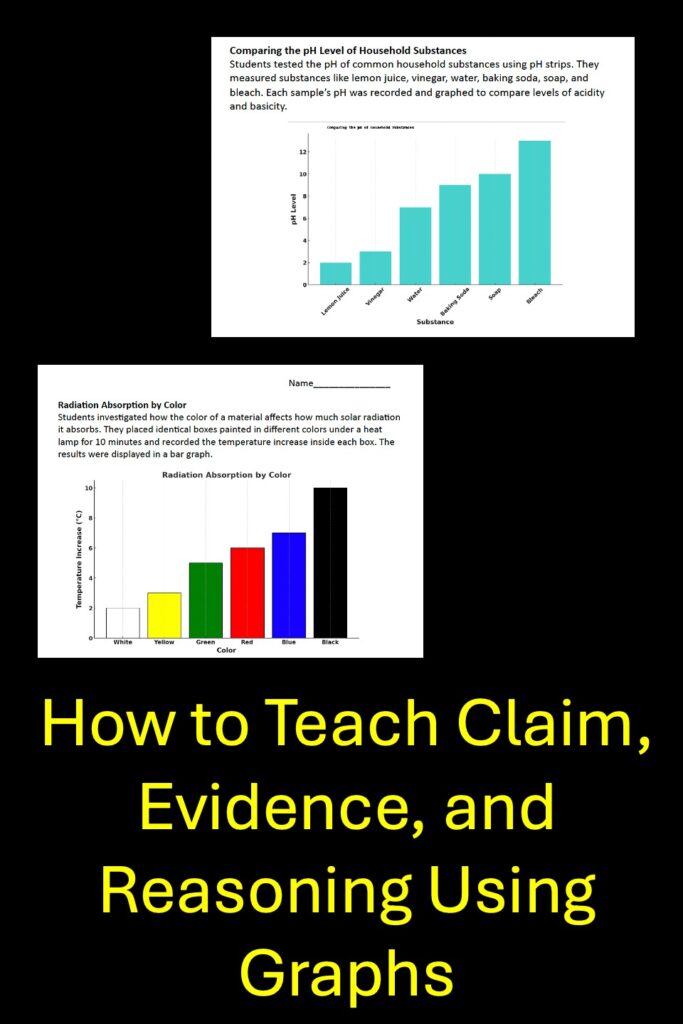
Students analyze scientific graphs and use specific data as evidence for their claims.
Explore CER Science Graph and Data Analysis Activities.
5th Grade CER Practice
CER activities designed for 5th grade students provide structured practice with claims, evidence, reasoning, graphs, and age-appropriate science concepts.
Explore 5th Grade CER Science Resources.
Middle School CER Practice
Middle school students work with more complex data and scientific relationships while practicing evidence-based explanations.
Explore Middle School CER Science Resources.
CER Bell Ringers and Warm-Ups
Short CER prompts can also be used throughout the year to give students frequent practice without requiring an entire class period.
Explore CER Bell Ringers and Science Warm-Ups.
Frequently Asked Questions About CER in Science
What does CER stand for in science?
CER stands for Claim, Evidence, Reasoning.
The claim answers a scientific question, the evidence supports the claim, and the reasoning explains why the evidence supports the claim.
What is the difference between evidence and reasoning in CER?
Evidence comes from data, measurements, observations, graphs, investigations, or other scientific information.
Reasoning explains how that evidence connects to the scientific concept and supports the claim.
What is an example of evidence in CER?
If students investigate plant growth, evidence might be:
The plant receiving 8 hours of light grew to 18 cm, while the plant receiving 2 hours grew to 9 cm.
This is evidence because it uses specific data from the investigation.
What makes a good CER claim?
A good claim clearly answers the scientific question and can be supported with evidence.
Claims should generally be concise and should not include all of the evidence and reasoning.
Why is CER reasoning difficult for students?
Reasoning requires students to connect evidence to scientific knowledge.
Students often understand what the data show but need practice explaining why the data support the claim.
How long should a CER response be?
There is no single required length.
Beginning students may write a short claim, one or two pieces of evidence, and a few sentences of reasoning.
More experienced students can develop longer explanations using multiple pieces of evidence.
The quality of the scientific thinking is more important than the number of sentences.
Can elementary students use CER?
Yes. Upper elementary students can learn a simplified CER structure using clear questions, concrete evidence, and age-appropriate reasoning.
Fifth grade is an excellent time to begin developing these skills.
Can graphs be used for CER?
Yes. Graphs are especially useful for CER because students can cite specific values, comparisons, and patterns as evidence.
Is CER part of NGSS?
CER is not itself an NGSS Science and Engineering Practice, but the structure supports several NGSS practices, particularly Constructing Explanations and Engaging in Argument from Evidence.
Should students use sentence starters for CER?
Sentence starters can be helpful when students are first learning the structure.
As students become more confident, they should gradually move toward writing their own scientific explanations.
My Work With Claim, Evidence, and Reasoning
CER has been an important part of my science teaching and curriculum work for many years.
I was also consulted as a science education expert for wikiHow’s article “How to Write a CER,” which explains how students can construct a Claim, Evidence, Reasoning response.
You can read the article here:
My approach to CER focuses on helping students understand that the structure is not simply a writing formula. It is a way to organize scientific thinking and communicate explanations based on evidence.
Help Students Move From Answers to Evidence-Based Explanations
The most important part of teaching CER is helping students understand that science is not just about knowing the answer.
Scientists ask:
What evidence supports this conclusion?
and
How does the evidence help explain what happened?
When students learn to make a claim, identify relevant evidence, and explain their reasoning, they are practicing the same kind of evidence-based thinking.
CER gives them a structure for doing that.
With consistent practice, students can move from:
“I think this is the answer.”
to:
“This is my claim, here is the evidence, and this is why the evidence supports my conclusion.”
That is a much more powerful way to think about science.
Explore Claim, Evidence & Reasoning Science Resources for Grades 5–8.
About Lynda R. Williams
Lynda R. Williams is a science educator, curriculum designer, and creator of Teaching Science with Lynda R. Williams.
With more than 20 years of classroom experience, she specializes in practical, standards-aligned science resources for upper elementary and middle school teachers.
Her work focuses on helping students make sense of science through Claim, Evidence, Reasoning, graph and data analysis, phenomena-based instruction, 5E lessons, and hands-on STEM activities.
Lynda has also taught Science Methods at the university level and has been consulted as a science education expert on teaching Claim, Evidence, Reasoning.
Her goal is to help teachers save planning time while giving students meaningful opportunities to analyze evidence, explain scientific ideas, and think like scientists.