
Description
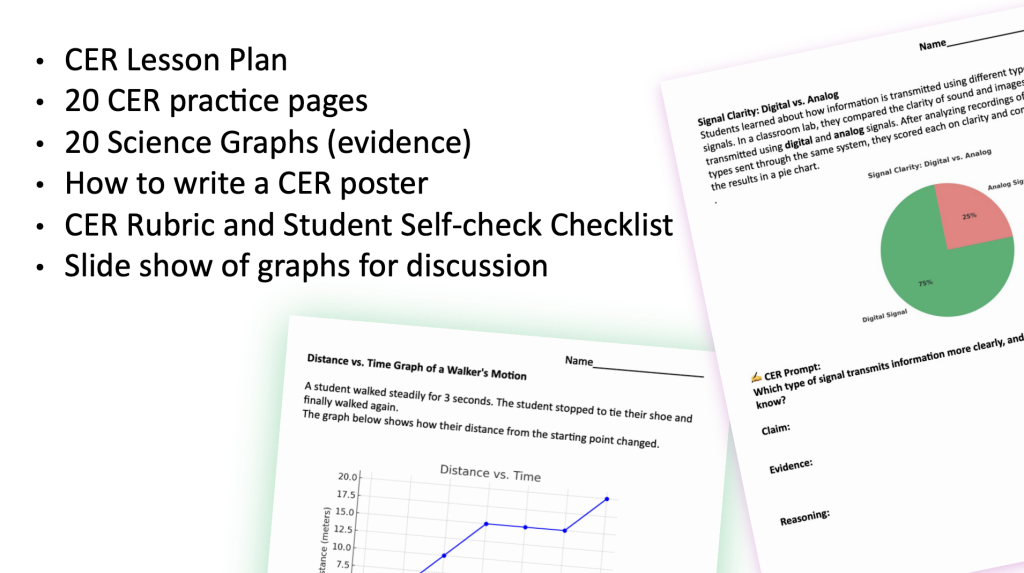
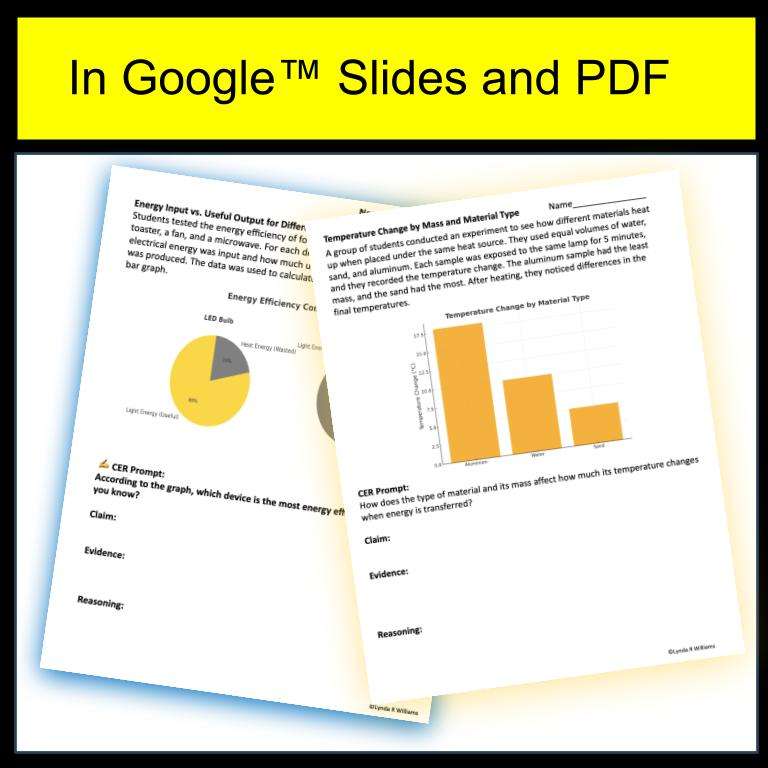
Enhance your 8th-grade physical science curriculum with this comprehensive set of Claim-Evidence-Reasoning (CER) activities, meticulously aligned with the Next Generation Science Standards (NGSS). Students will use a CER Graphic organizer, CER prompt pages, and more to organize their thoughts. Includes a CER Rubric for Grading. Designed to foster critical thinking and scientific literacy, these lessons guide students through constructing well-supported scientific arguments. Students will use Graphs as Evidence!
What’s Included in the CER Graph Analysis Unit?:
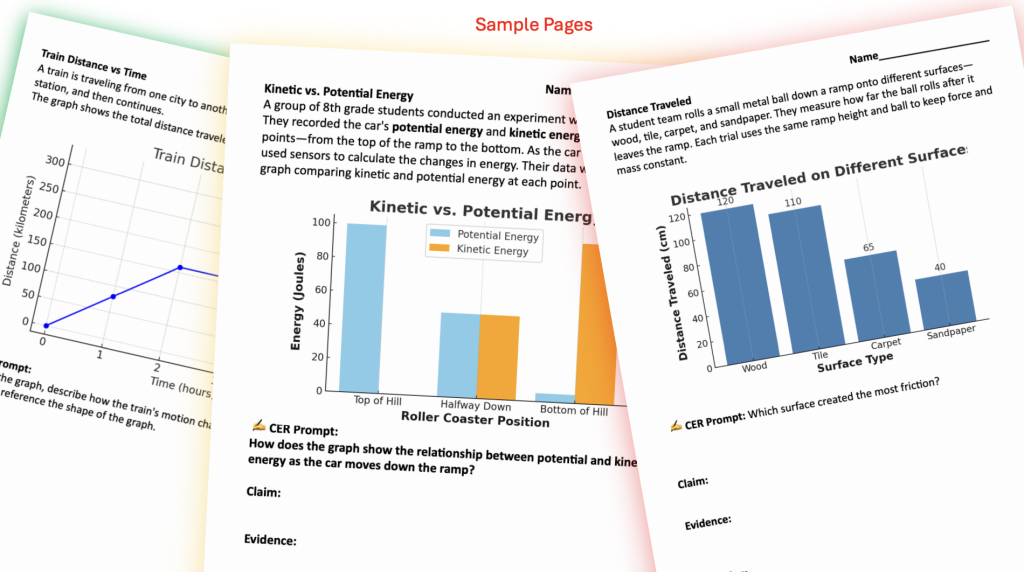
- Twenty engaging CER worksheets covering various physical science topics
- Step-by-step lesson plan to help students formulate claims, gather evidence, and articulate reasoning
- CER rubric to evaluate student understanding and a student checklist for self-evaluation (editable)
- Poster for Claim Evidence Reasoning (editable)
- Slide show with just the graphs for projecting and discussing with students
- Answer Keys
- Student pages are in a printable PDF and Google™ Slides
- CER Graphic Organizer
- CER Prompts
No-prep! Ready to use lesson, slides, and response pages. Download today and use tomorrow! Get your students writing amazing Claim Evidence Reasoning Responses!
Key Features:
- Tailored for grades 6-8, ensuring age-appropriate content
- Supports NGSS three-dimensional learning by integrating Science and Engineering Practices
- Versatile for use in classrooms, remote learning, or homeschooling environments
- Students use graphs and data as evidence to support their CER
Table of Contents: Graph CER – Physical Science
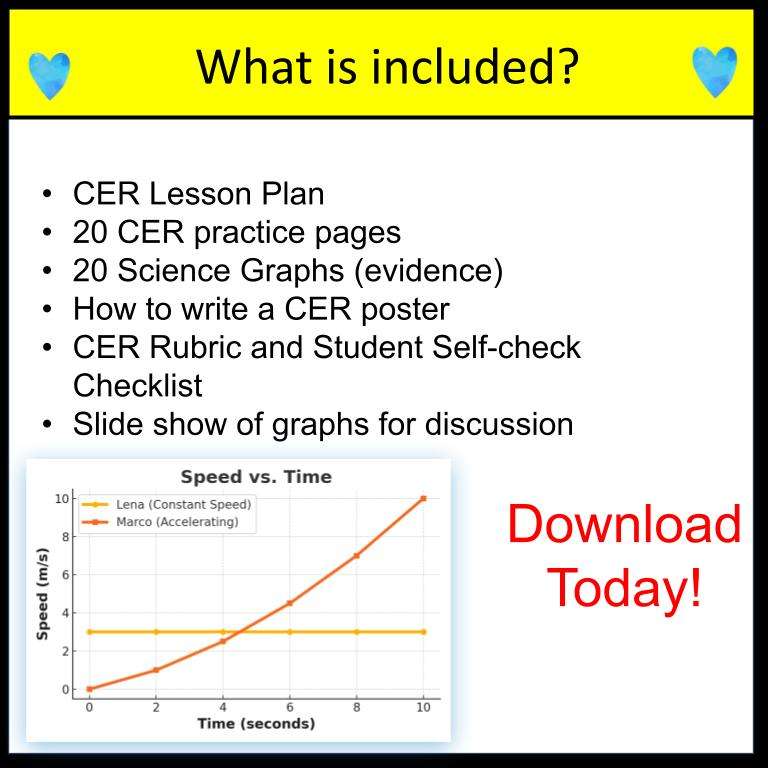
Speed vs. Time: Two Cyclists
MS-PS2-2: Motion and graphing
Acceleration vs. Mass
MS-PS2-2: Force and acceleration relationship
Friction and Distance on Different Surfaces
MS-PS2-1: Forces and motion
Kinetic vs. Potential Energy on a Ramp
MS-PS3-1: Energy transformations
Elastic Potential Energy: Stretch vs. Force
MS-PS3-2: Relationships among energy, force, and motion
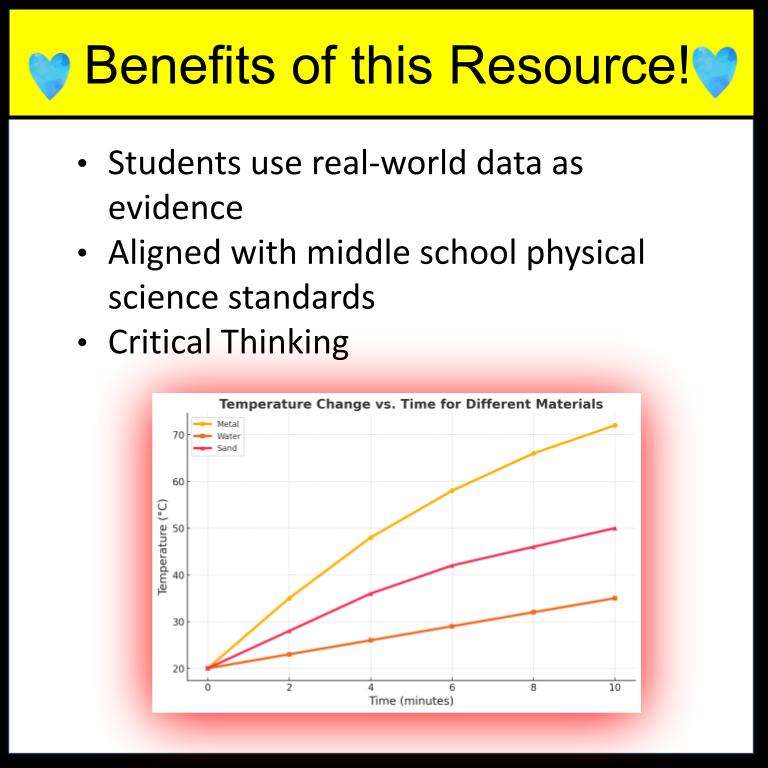
Temperature Change vs. Time (Metal, Water, Sand)
MS-PS3-4: Energy transfer between substances
Energy Shift on Ramp: Kinetic and Potential
MS-PS3-5: Energy conservation and transformations
Energy Efficiency of Devices
MS-PS3-3: Design and evaluation of energy-efficient systems
Mass Before and After a Chemical Reaction
MS-PS1-5: Conservation of mass
Comparing the pH Level of Household Substances
MS-PS1-2: Properties and pH of substances
Solubility vs. Temperature
MS-PS1-4: Physical changes and solubility
Phase Change: Time vs. Temperature During Melting
MS-PS1-4: Physical changes of matter
Frequency vs. Wavelength of Sound Waves
MS-PS4-1: Wave properties
Volume vs. Distance from Speaker
MS-PS4-2: Sound energy and wave behavior
Digital vs. Analog Signal Clarity
MS-PS4-3: Signal transmission and information
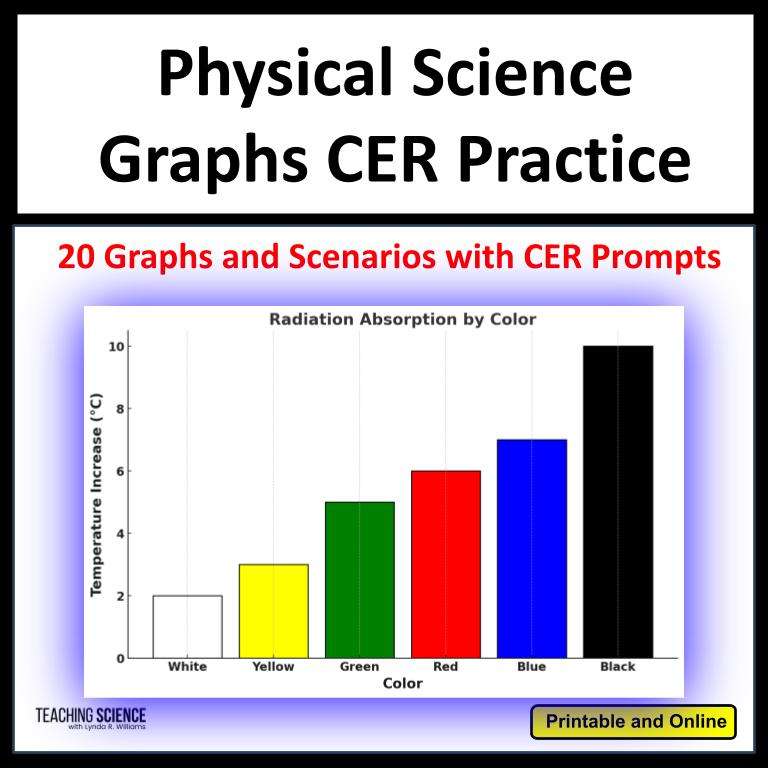
Radiation Absorption by Color
MS-PS3-3: Energy absorption by materials
Magnetic Force vs. Distance
MS-PS2-3: Magnetic fields and strength
Walker Motion: Distance vs. Time
MS-PS2-2: Interpreting motion graphs
Train Motion: Distance vs. Time
MS-PS2-2: Interpreting speed and motion over time
Temperature Change by Mass and Material Type
MS-PS3-4: Energy transfer between substances
CER Graphic Organizer (Student Support Page)
(No specific standard – instructional support)
CER Graphic organizers, CER Rubric, CER student checklist, CER poster, and slide show of graphs are also included!