Description
Teach balanced and unbalanced forces with this complete 3rd grade NGSS-aligned Force and Motion STEM unit! Includes inquiry-based labs, response pages, nonfiction passages, and engaging hands-on investigations.
Aligned with
3-PS2-1. Plan and conduct an investigation to provide evidence of the effects of balanced and unbalanced forces on the
motion of an object.
3-PS2-2. Make observations and/or measurements of an object’s motion to provide evidence that a pattern can be used to
predict future motion.
3-5-ETS1-1. Define a simple design problem reflecting a need or a want that includes specified criteria for success and
constraints on materials, time, or cost.
3-5-ETS1-2. Generate and compare multiple possible solutions to a problem based on how well each is likely to meet the
criteria and constraints of the problem.
3-5-ETS1-3. Plan and carry out fair tests in which variables are controlled and failure points are considered to identify
aspects of a model or prototype that can be improved.
This resource also addresses standards for Utah SEEd.
Utah SEEd 3.3.1 Plan and carry out investigations that provide evidence of the effects of balanced and unbalanced forces on the motion of an object. Examples could include an unbalanced force on one side of a ball causing it to move and balanced forces pushing on a box from both sides producing no movement. Emphasize using fair tests by changing only one variable at a me.
Utah SEEd 3.3.2
Analyze data from observations and measurements of an object’s moon to identify patterns that can be used to predict future moon. Examples of moon with a predictable pattern could include a child swinging in a swing, a ball rolling back and forth in a bowl, and two children on a see-saw.
Science concepts include:
Forces and motion
Balanced and unbalanced forces
Objects in motion
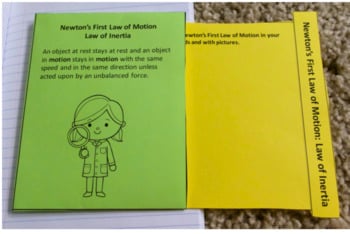
Newton’s Three Laws of Motion
Inertia
Momentum
Speed
Acceleration
Measurement
Patterns
Recording data
Variables
Collecting Evidence
Making predictions
Planning an investigation
Push and Pull
Gravity
Friction
Engineering and Design
Science and Engineering Practices Students Will Use:
1. Asking questions (for science) and defining problems (for engineering)
2. Developing and using models
3. Planning and carrying out investigations
4. Analyzing and interpreting data
5. Using mathematics and computational thinking
6. Constructing explanations (for science) and designing solutions (for engineering)
7. Engaging in argument from evidence
8. Obtaining, evaluating, and communicating information
Please view some of my other resources for science:
Life Cycle of a Rabbit Close Reading Passage With Interactive Notebook Flaps
Close Reading Life cycle of a Butterfly With Interactive Notebook Inserts