
Description
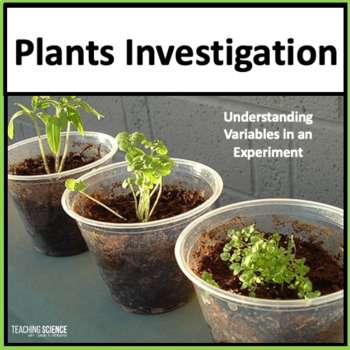
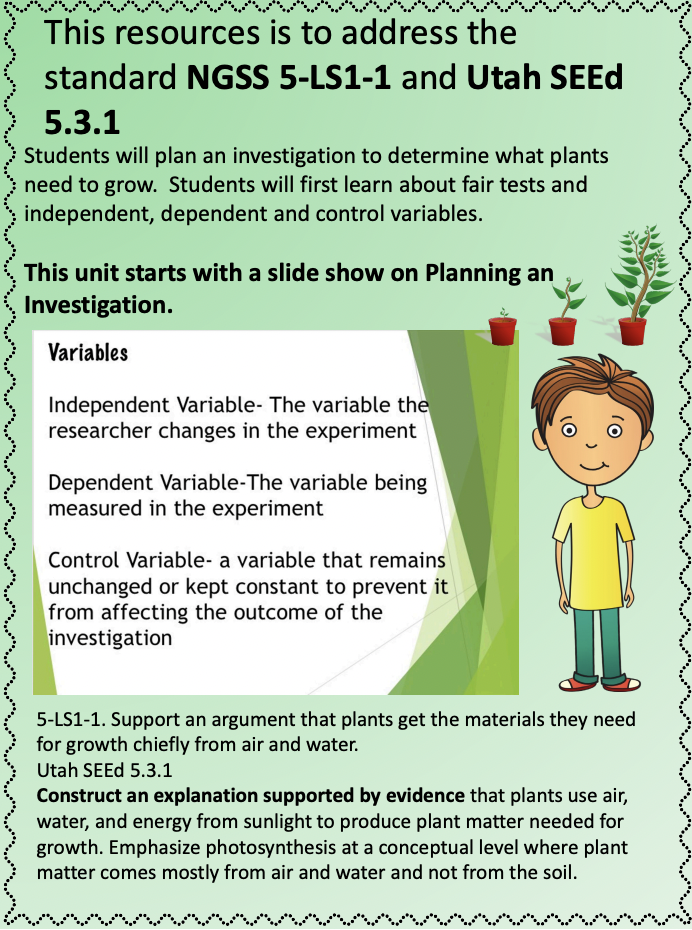
Do you need to teach about Plants and What they need to grow? Students will learn that plants produce their own food through photosynthesis. Students will learn about a plant’s needs. Students will love planning and conducting their own investigations. This resource also addresses the scientific misconception that plants consume soil as food. Students will learn through fair tests that plants need air, sunlight, and water to grow. Students will learn how to conduct fair tests and investigations with controls and variables in this unit on plants.
This unit begins with phenomena, and students use science and engineering practices to investigate what plants need to grow.
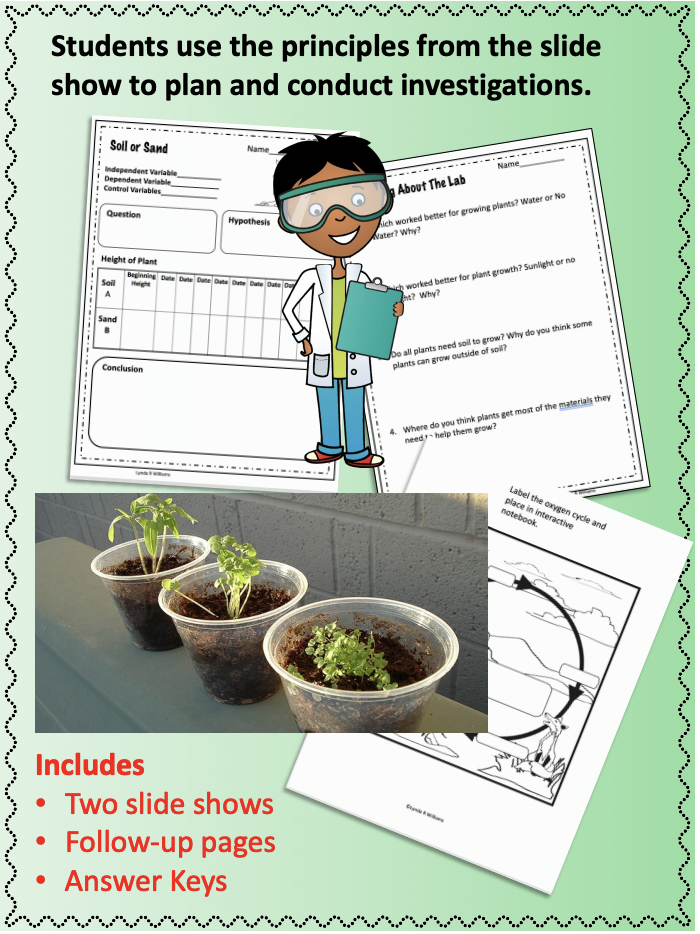
This unit includes:
- two slide shows
- labs
- lab sheets
- response pages
- answer keys
Teachers Love This Unit! ❤️❤️❤️
Madison ⭐️ ⭐️ ⭐️ ⭐️ ⭐️ Extremely Satisfied
My students loved doing this activity! I highly recommend this purchase to anyone that is on the fence about purchasing it! The students were engaged and able to take control of their learning with this activity!
This resource is designed for NGSS 5-LS1 From Molecules to Organisms: Structures and Processes. This resource addresses the NGSS standard for 5th grade:
5-LS1-1. Support an argument that plants get the materials they need for growth chiefly from air and water.
Utah SEEd 5.3.1
Construct an explanation supported by evidence that plants use air, water, and energy from sunlight to produce plant matter needed for growth. Emphasize photosynthesis at a conceptual level where plant matter comes mostly from air and water and not from the soil.
This resource addresses the following science concepts:
- Plants get the materials they need for growth from air and water
- How to set up an investigation
- Independent variables
- Dependent variables
- Controlled variables
- Fair Tests
- Photosynthesis (introduction)
- Interdependence of animals and plants
Students will use ALL Eight of the Science and Engineering Practices:
1. Asking questions (for science) and defining problems (for engineering)
2. Developing and using models
3. Planning and carrying out investigations
4. Analyzing and interpreting data
5. Using mathematics and computational thinking
6. Constructing explanations (for science) and designing solutions (for engineering)
7. Engaging in argument from evidence
8. Obtaining, evaluating, and communicating information
Students will process their ideas in response pages and through interactive notebook flaps.
Save 20% by purchasing in the Utah SEEd 5th-grade Bundle.
Save 20% by purchasing in the NGSS 5th Grade Bundle
Save 20% by purchasing in Utah SEEd 5th Grade PLUS Reading Units Bundle