
Description
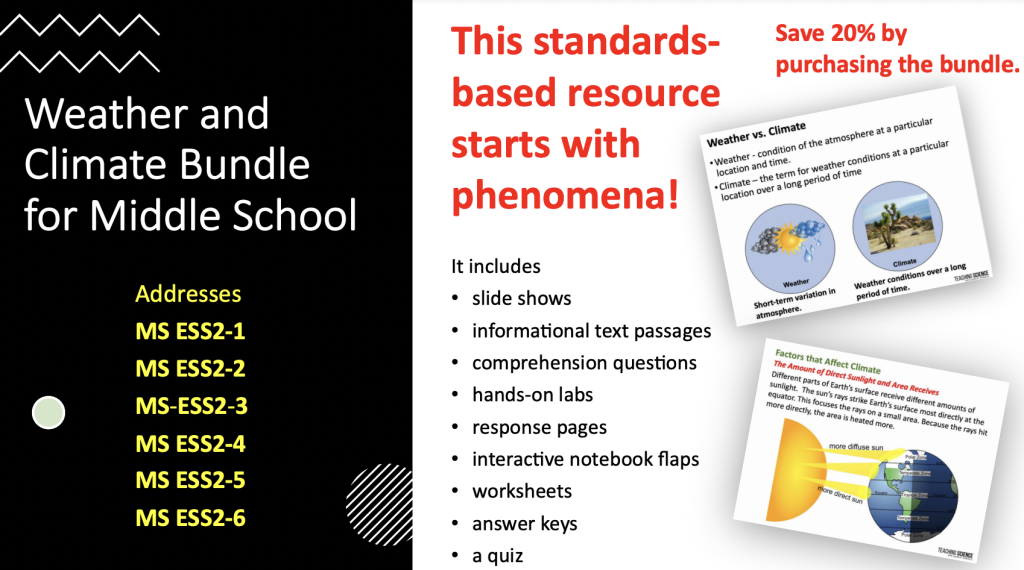
Weather and climate are complicated topics. This middle school science bundle has everything you need to teach the weather and climate standards. Students will learn about patterns in weather, air masses, air pressure, weather fronts, climate, uneven heating of the earth, climate change, and more. Purchase as a bundle and save 20% on these weather and climate resources for middle school science. Complete coverage of these standards From the Disciplinary Core Ideas: Earth’s Systems: ESS2.D Weather and Climate for NGSS Middle School.
Students will use the following NGSS science and engineering practices:
- Asking Questions and Defining Problems. …
- Developing and Using Models. …
- Planning and Carrying Out Investigations. …
- Analyzing and Interpreting Data. …
- Using Mathematics and Computational Thinking. …
- Constructing Explanations and Designing Solutions. …
- Engaging in Argument from Evidence.
- Obtaining, Evaluating, and Communicating Information
This resource is also aligned with CCSS for reading informational text. Students will practice reading skills and learn more about science by reading nonfiction passages on scientific topics.
NGSS MS–ESS2–5. Collect data to provide evidence for how the motions and complex interactions of air masses result in changes in weather conditions.
From the disciplinary core idea Earth’s Systems: ESS2.D Weather and Climate
NGSS MS ESS2-6 Develop and use a model to describe how unequal heating and rotation of the Earth cause patterns of atmospheric and oceanic circulation that determine regional climates. This is from the Earth”s Systems strand.
NGSS MS-ESS3-5. Ask questions to clarify evidence of the factors that have caused the rise in global temperatures over the past century.
NGSS MS-ESS2-1. Develop a model to describe the cycling of Earth’s materials and the flow of energy that drives this process
NGSS MS-ESS2-4 Develop a model to describe the cycling of water through Earth’s systems driven by energy from the sun and the force of gravity.
Covers the Utah SEEd Standards for 6th-grade
Utah SEEd 6.3.1
Develop a model to describe how the cycling of water through Earth’s systems is driven by energy from the Sun, gravitational forces, and density.
Utah SEEd 6.3.2 Investigate the interactions between air masses
that cause changes in weather conditions. Collect and analyze weather data to provide evidence for how air masses flow from regions of high pressure to low pressure causing a change in weather. Examples of data collection could include field observations, laboratory experiments, weather maps, or diagrams.
Utah SEEd 6.3.3 Develop and use a model to show how unequal heating of the Earth’s systems causes patterns of atmospheric and oceanic circulation that determine regional climates. Emphasize how warm water and air move from the equator toward the poles.
Utah SEEd 6.3.4
Construct an explanation supported by evidence for the role of the natural greenhouse effect in Earth’s energy balance and how it enables life to exist on Earth. Examples could include comparisons between Earth and other planets, such as Venus and Mars. – From the Utah Core.
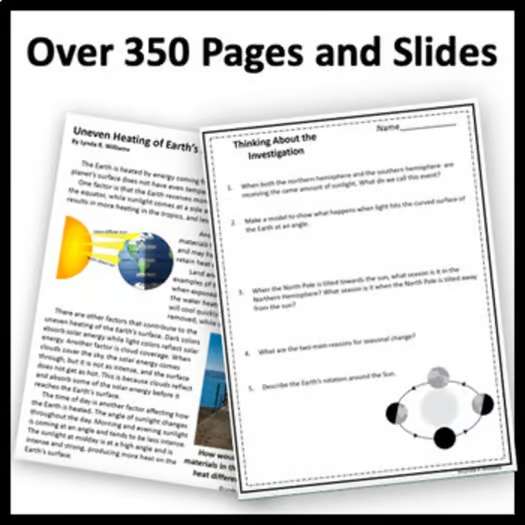
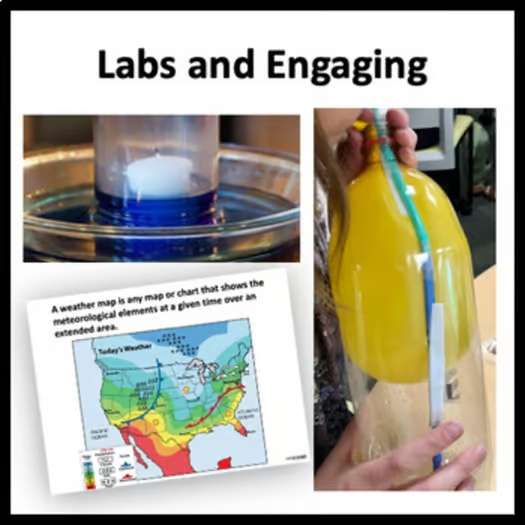
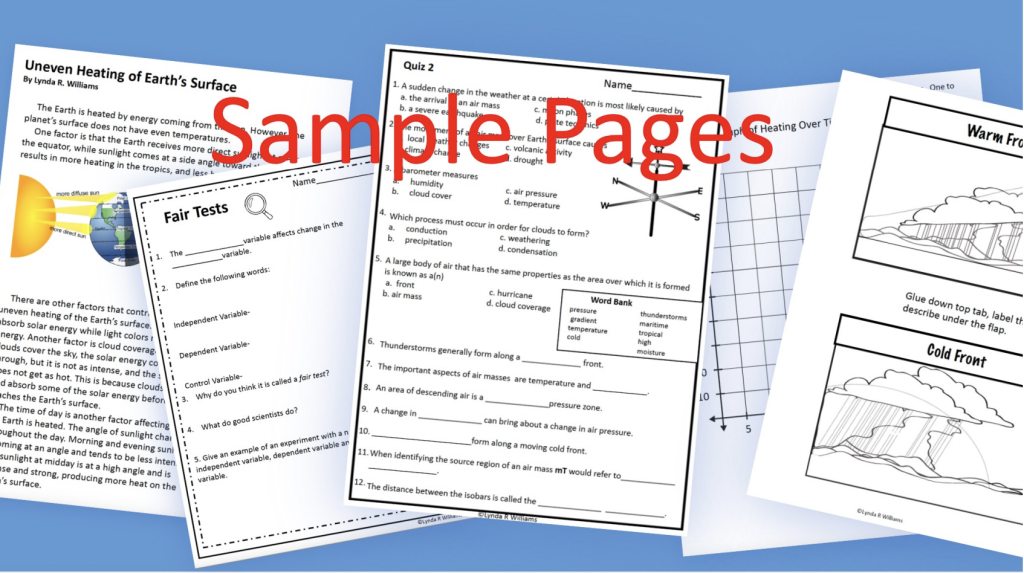
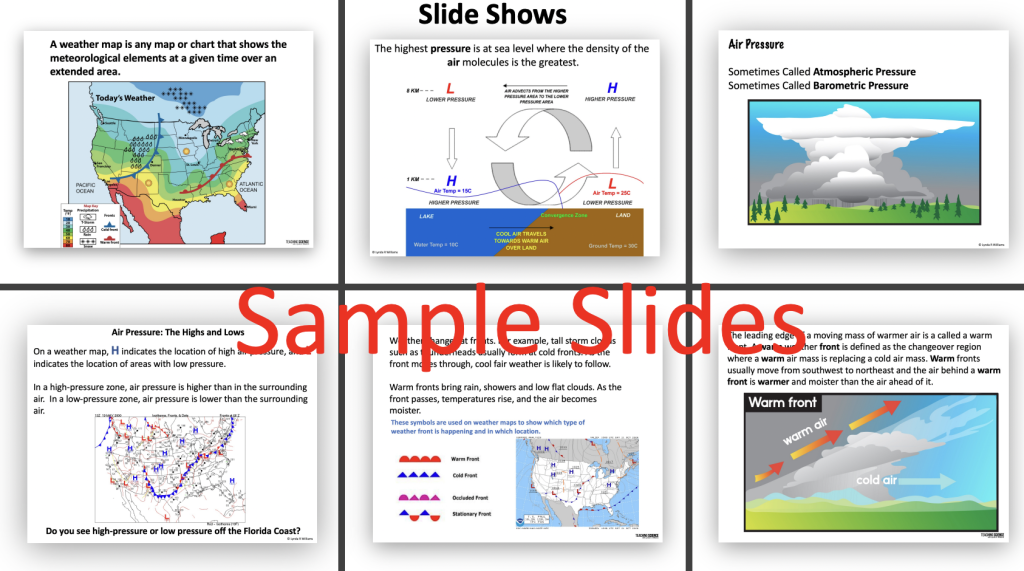
This huge resource includes slideshows, hands-on inquiry-based labs, response pages, charts, interactive notebook inserts, nonfiction reading passages, comprehension questions, QR code research, and more.

You might like this companion weather and climate jeopardy review game!
You can read more about Middle School Science NGSS here!