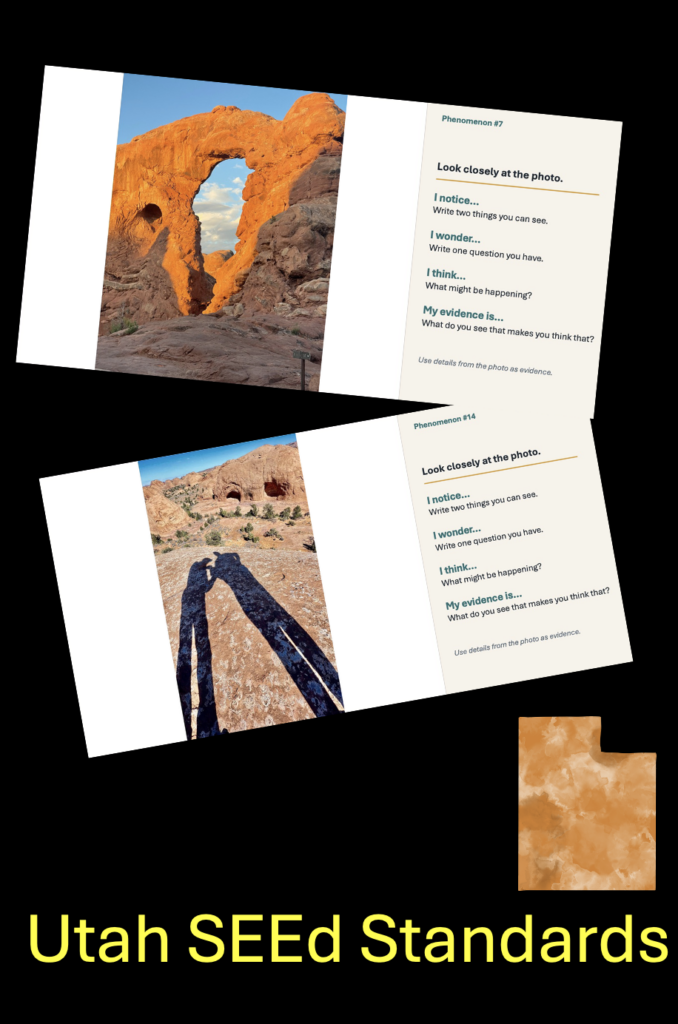
Utah SEEd science instruction asks students to do more than memorize scientific facts.
Students are expected to observe phenomena, ask questions, analyze data, identify patterns, construct explanations, and support their ideas with evidence.
However, it can be difficult to fit consistent practice with these skills into an already busy science class.
Utah SEEd science bell ringers provide a simple solution.
Graph bell ringers help students strengthen their data-analysis skills.
Phenomena bell ringers help students practice observation, questioning, inference, and evidence-based reasoning.
Together, these activities give students regular practice with the scientific thinking emphasized throughout the Utah SEEd standards.
Watch: Utah SEEd Standards Explained
What are the Utah SEEd standards, and what do they mean for Utah science teachers?
In this short video, I explain how the Utah SEEd standards support three-dimensional science learning through real-world phenomena, data analysis, scientific reasoning, and engineering.
Utah SEEd asks students to use science concepts instead of simply memorizing them. Students investigate the natural world, analyze evidence, explain what is happening, and use engineering to solve problems.
Graph analysis and phenomena bell ringers provide an easy way to reinforce these important skills throughout the school year.
What Does Utah SEEd Stand For?
SEEd stands for Science with Engineering Education.
The Utah SEEd standards are based on three-dimensional science learning. Students use three important dimensions together:
Science and Engineering Practices
Crosscutting Concepts
Disciplinary Core Ideas
Students use these dimensions as they investigate phenomena, analyze evidence, construct explanations, develop models, and design solutions.
Utah SEEd instruction is not only about what students know.
It is also about what students can do with their scientific knowledge.
What Are Utah SEEd Science Bell Ringers?
Utah SEEd science bell ringers are short activities students complete at the beginning of class.
A science bell ringer may ask students to read a graph, compare data, identify a pattern, make a prediction, observe a phenomenon, ask a question, or explain an idea using evidence.
These short activities help students begin class with a clear purpose.
They also provide teachers with a consistent classroom routine that reinforces science skills throughout the year.
Why Use Graph Bell Ringers in Science?
Students need repeated practice reading and interpreting scientific data.
A student may understand a science concept during a lesson but still struggle when the same information is presented in a graph.
Graph bell ringers give students practice with these important skills in small, manageable amounts.
Students can practice reading graph titles, identifying variables, interpreting axes, using units, comparing values, calculating changes, recognizing patterns, making predictions, and selecting conclusions supported by evidence.
Instead of waiting until test-preparation season, teachers can make graph analysis part of their normal classroom routine.
A few minutes of practice each day can help students become more confident and independent when working with scientific data.
Why Use Phenomena Bell Ringers?
A science phenomenon is an observable event or process that students can investigate and explain.
Phenomena create curiosity and give students a reason to use scientific ideas.
A phenomenon bell ringer may ask students:
What do you observe?
What questions do you have?
What do you think is happening?
What evidence supports your inference?
These prompts help students understand the difference between an observation and an inference.
They also encourage students to support their ideas with visible evidence instead of simply guessing.
Phenomena bell ringers can be used to introduce a unit, begin a discussion, review a concept, or practice scientific reasoning.
Utah SEEd Bell Ringer Resources at a Glance
| Resource | Grade Level | Main Focus | Suggested Uses |
|---|---|---|---|
| Utah SEEd Science Phenomena Bell Ringers, Stations, and Task Cards | Grades 5–8 | Observation, questioning, inference, evidence, and sensemaking | Bell ringers, stations, gallery walks, unit introductions, and partner discussions |
| Utah SEEd 6th Grade Science Graph Bell Ringers | Grade 6 | Graph analysis connected to Utah sixth-grade science concepts | Warm-ups, spiral review, homework, stations, and formative assessment |
| Utah SEEd 7th Grade Science Graph Bell Ringers | Grade 7 | Data analysis connected to physical, life, Earth, and evolutionary science | Bell ringers, exit tickets, intervention, review, and assessment practice |
| Utah SEEd 8th Grade Science Graph Bell Ringers | Grade 8 | Graph analysis connected to physical, life, Earth, and Utah-specific science topics | Warm-ups, review stations, homework, sub plans, and test preparation |
Utah SEEd Science Phenomena Bell Ringers
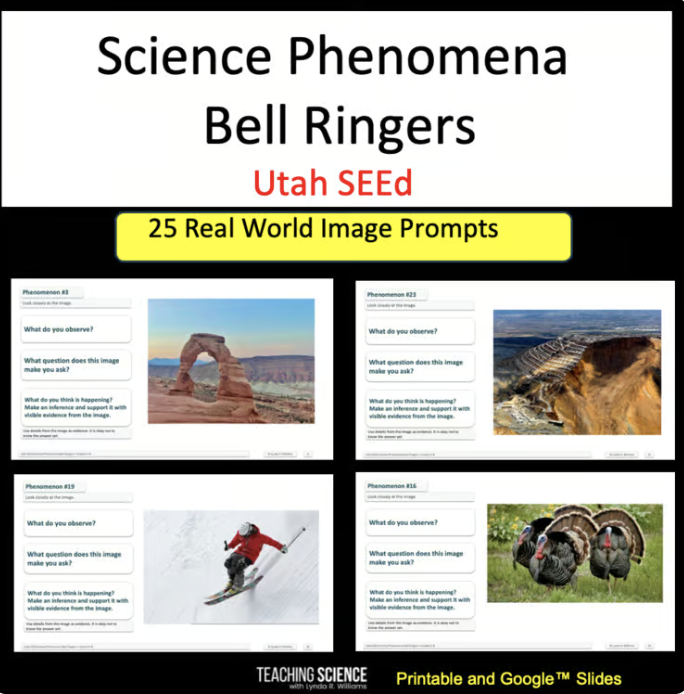
The Utah SEEd Science Phenomena Bell Ringers, Stations, and Task Cards help students practice careful observation and scientific thinking.
Students examine authentic science images and respond to questions about what they observe, what they wonder, and what they think may be happening.
The phenomena connect to Utah landforms, weathering and erosion, fossils, geologic history, adaptations, plant and animal interactions, energy transfer, forces and motion, sound waves, weather, renewable energy, natural hazards, and human impacts on Earth systems.
The resource can be projected for whole-class bell ringers or printed as task cards.
Teachers can also use the phenomena cards for science stations, gallery walks, partner discussions, small-group work, early finishers, and unit introductions.
Explore the Utah SEEd Science Phenomena Bell Ringers, Stations, and Task Cards:
Utah SEEd 6th Grade Science Graph Bell Ringers
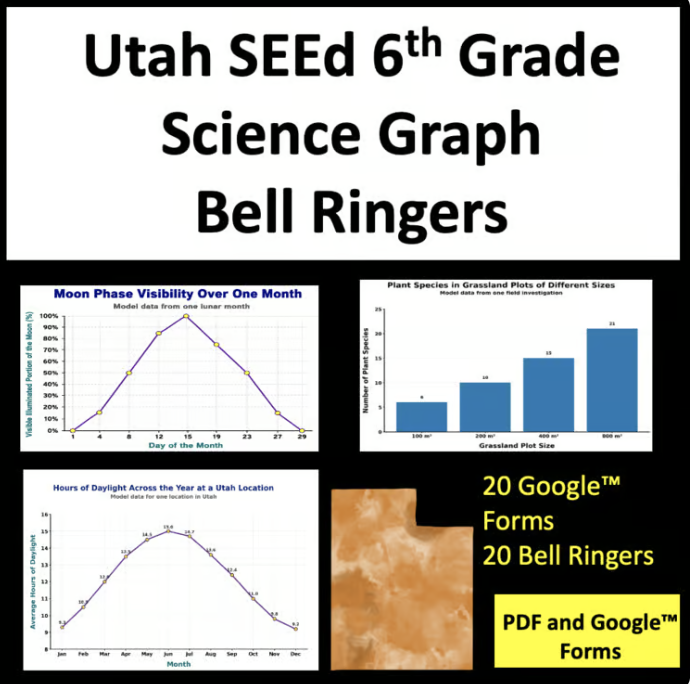
The Utah SEEd 6th Grade Science Graph Bell Ringers provide repeated practice with graph analysis while reviewing important sixth-grade science concepts.
Students analyze data connected to topics such as planetary motion, moon phases, seasonal daylight, thermal energy, heating and cooling, changes of state, weather, air pressure, Utah snowfall, Utah precipitation, predator-prey relationships, biodiversity, wetland ecosystems, and pollinators.
Each graph includes questions that ask students to read data, compare values, identify patterns, make predictions, and choose conclusions supported by evidence.
The activities can be used for daily warm-ups, spiral review, homework, science stations, small groups, makeup work, substitute plans, and assessment preparation.
Explore the Utah SEEd 6th Grade Science Graph Bell Ringers:
Utah SEEd 7th Grade Science Graph Bell Ringers
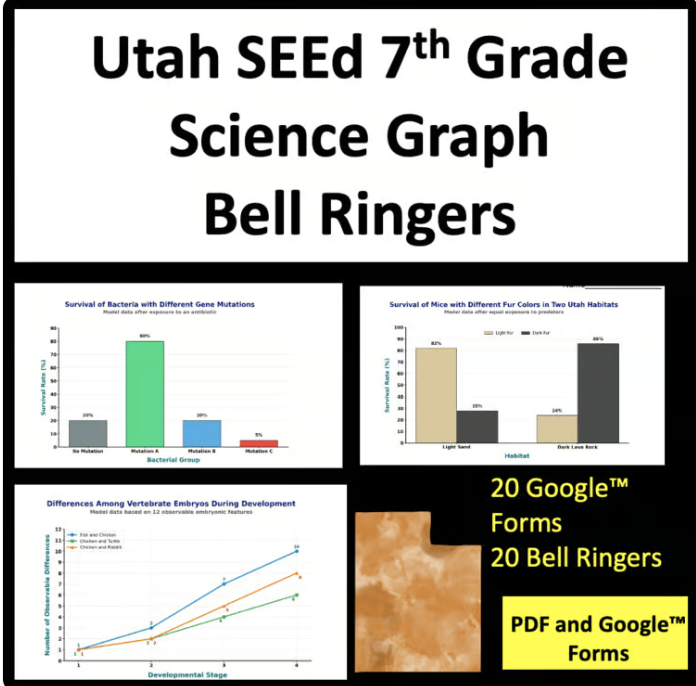
The Utah SEEd 7th Grade Science Graph Bell Ringers and Warm-Ups help students analyze data connected to physical science, Earth science, life science, genetics, and evolution.
Topics include force and acceleration, collisions, magnetic force, gravity, crystal formation, soil erosion, earthquakes, rock layers, plate boundaries, photosynthesis, cell structures, body systems, genetic variation, mutations, artificial selection, natural selection, fossils, and comparative anatomy.
Students practice reading graphs, calculating differences, identifying patterns, making predictions, and selecting evidence-based conclusions.
These activities can be used for beginning-of-class warm-ups, exit tickets, spiral review, formative assessments, small-group practice, and test preparation.
Explore the Utah SEEd 7th Grade Science Graph Bell Ringers and Warm-Ups:
Utah SEEd 8th Grade Science Graph Bell Ringers
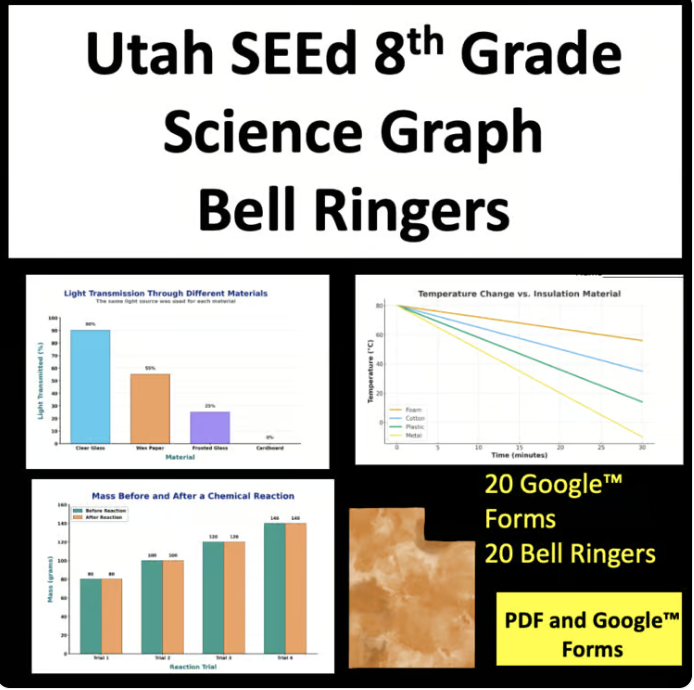
The Utah SEEd 8th Grade Science Graph Bell Ringers give students practice working with data from physical science, life science, Earth science, and Utah-specific science topics.
Graph topics include particle motion, temperature, solubility, chemical reactions, conservation of mass, kinetic and potential energy, waves, signal transmission, photosynthesis, cellular respiration, carbon movement, Great Salt Lake water levels, Utah snowpack, Utah electricity generation, Utah earthquakes, and Utah water use.
These activities help students practice identifying relationships, interpreting trends, comparing data, making predictions, and drawing evidence-based conclusions.
The Utah-specific examples also help students connect science concepts to the state where they live.
Explore the Utah SEEd 8th Grade Science Graph Bell Ringers:
Graph Bell Ringers and Phenomena Bell Ringers
Graph bell ringers and phenomena bell ringers support different but complementary science skills.
| Graph Bell Ringers | Phenomena Bell Ringers |
|---|---|
| Focus on numerical data | Begin with an observable event or image |
| Build graph-reading skills | Build observation skills |
| Ask students to compare values | Ask students to notice important details |
| Help students identify trends | Encourage students to ask questions |
| Require evidence-based conclusions | Require evidence-based inferences |
| Work well for review and assessment practice | Work well for discussion and sensemaking |
Teachers can use both types of activities throughout the school year.
A phenomenon can introduce a topic and create curiosity.
A graph can later provide evidence that helps students explain the phenomenon.
How to Use Utah SEEd Bell Ringers
Begin Class with a Clear Routine
Project one graph or phenomenon as students enter the classroom.
Students can respond independently before discussing their thinking with a partner or the class.
Connect Bell Ringers to Current Units
Choose a graph or phenomenon related to the topic students are currently studying.
This reinforces science content without requiring an additional lesson.
Use Bell Ringers for Spiral Review
Bring back concepts from earlier units so students continue practicing them throughout the year.
Use Them as Formative Assessments
Student responses can quickly reveal misunderstandings.
Teachers can use this information to decide whether students are ready to move forward or need additional support.
Add Them to Science Stations
Printed graphs and phenomena task cards can be used during station rotations, partner work, or small-group instruction.
Prepare Students for Science Assessments
Graph bell ringers build confidence with data-analysis questions.
Students become more familiar with reading graphs, recognizing patterns, comparing information, and choosing conclusions supported by evidence.
Do Bell Ringers Fully Teach a Utah SEEd Standard?
Bell ringers support Utah SEEd instruction, but they should not replace complete science lessons, investigations, or performance tasks.
Students also need opportunities to conduct investigations, collect data, develop models, construct explanations, argue from evidence, design solutions, and communicate scientific ideas.
Bell ringers are most effective when they are used as one part of a complete Utah SEEd science curriculum.
Frequently Asked Questions About Utah SEEd Science Bell Ringers
What does Utah SEEd stand for?
Utah SEEd stands for Science with Engineering Education.
What is a science bell ringer?
A science bell ringer is a short activity students complete at the beginning of class. It can review content, introduce a topic, assess understanding, or provide practice with a science skill.
How long should a science bell ringer take?
Most science bell ringers can be completed in approximately five to ten minutes.
Why are graph bell ringers important?
Graph bell ringers give students regular practice interpreting data, comparing values, identifying patterns, making predictions, and drawing evidence-based conclusions.
Why are phenomena important in Utah SEEd?
Phenomena give students something observable to investigate and explain. They encourage curiosity, questioning, modeling, discussion, and evidence-based reasoning.
What is the difference between an observation and an inference?
An observation describes something that can be directly seen or measured.
An inference is an explanation based on observations, evidence, and prior knowledge.
Can graph bell ringers help with Utah science test preparation?
Yes. Graph bell ringers help students practice data-analysis skills that are useful during classroom and state science assessments.
Can phenomena task cards be used in stations?
Yes. Phenomena task cards work well for stations, centers, gallery walks, partner discussions, small groups, and early finishers.
Make Utah SEEd Science Practice Part of Every Day
Meaningful science practice does not always require an entire class period.
A well-designed bell ringer can help students begin class ready to observe, analyze, question, and explain.
Use graph bell ringers to build data literacy.
Use phenomena bell ringers to build curiosity and scientific reasoning.
Together, these resources give Utah students consistent practice with the skills at the heart of Utah SEEd science instruction.
Explore the Utah SEEd Resources
Utah SEEd Science Phenomena Bell Ringers, Stations, and Task Cards
Utah SEEd 6th Grade Science Graph Bell Ringers
Utah SEEd 7th Grade Science Graph Bell Ringers and Warm-Ups
Utah SEEd 8th Grade Science Graph Bell Ringers
About Lynda R. Williams
Lynda R. Williams is an experienced science educator and curriculum designer with more than 20 years of experience teaching upper elementary and middle school science. She has also taught science methods courses at the university level, helping prepare future teachers to use inquiry, data analysis, engineering design, and evidence-based instruction. Through Teaching Science with Lynda R. Williams, she creates engaging, standards-aligned resources that help teachers make Utah SEEd science easier to plan, organize, and teach.