Pennsylvania science education has changed.
The PA STEELS standards bring science, technology, engineering, environmental literacy, and sustainability together in one integrated set of academic standards.
For many Pennsylvania teachers, the most noticeable change is not simply an updated list of science concepts. It is the increased emphasis on two areas that may not have been fully addressed in traditional science curricula:
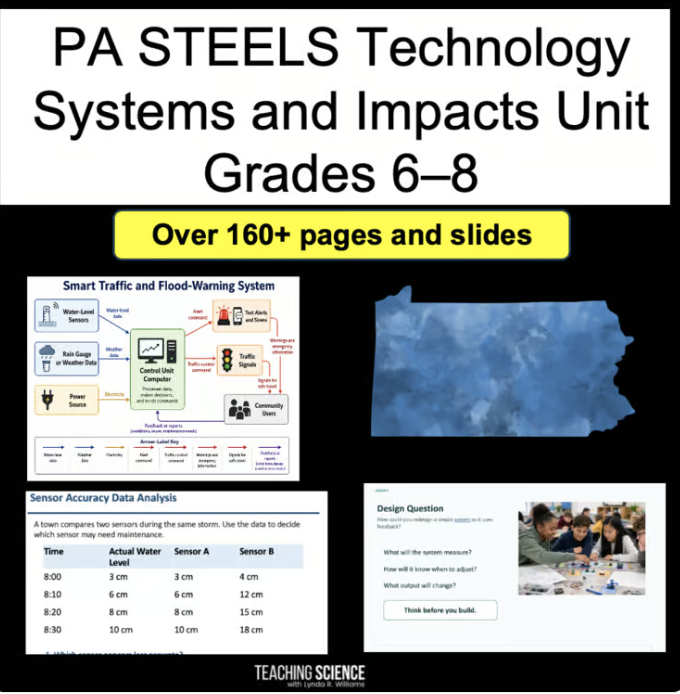
Technology and Engineering
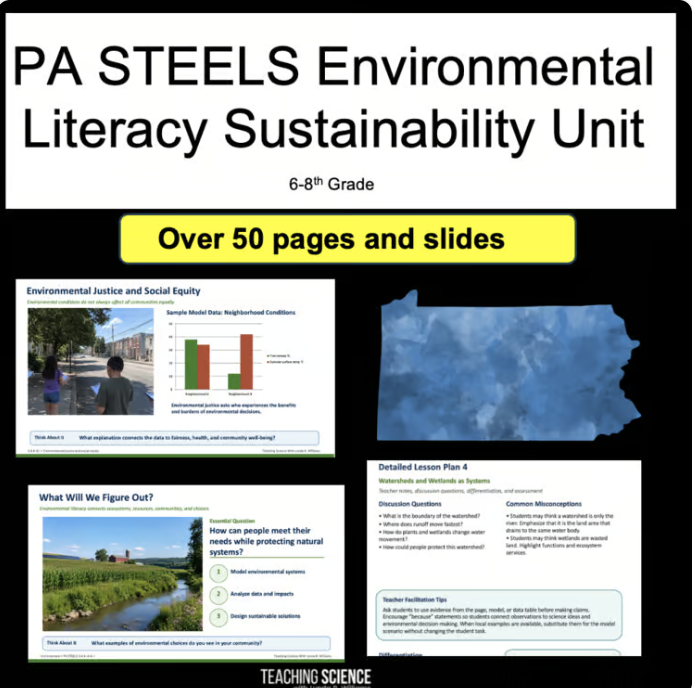
Environmental Literacy and Sustainability
These areas are not treated as optional extensions or occasional enrichment activities. They are included as distinct parts of the PA STEELS standards and need to be intentionally addressed through instruction.
The standards were adopted by the Pennsylvania State Board of Education in January 2022 and were fully integrated into classroom instruction beginning with the 2025–2026 school year.
What Does PA STEELS Stand For?
PA STEELS stands for:
Science
Technology and Engineering
Environmental Literacy and Sustainability
The standards guide students in studying both the natural world and the human-designed world through inquiry, critical thinking, authentic exploration, and problem solving.
Students are expected to do more than memorize vocabulary and scientific facts. They investigate phenomena, interpret data, evaluate technological systems, consider environmental impacts, and design evidence-based solutions.
What Is Different About the PA STEELS Standards?
Compared with science standards that are organized primarily around life science, physical science, Earth and space science, and general engineering practices, PA STEELS gives Technology and Engineering and Environmental Literacy and Sustainability a much more visible role.
Teachers may already have strong resources for cells, forces, chemical reactions, ecosystems, weather, and Earth systems. However, those materials may not fully cover standards involving:
Technological systems and feedback
Helpful and harmful effects of technology
The influence of society on technological development
Environmental stewardship
Resource-management practices
Environmental laws
Environmental justice and social equity
Local Pennsylvania environmental issues
This means even a strong science curriculum may need supplemental lessons specifically designed for the new PA STEELS expectations.
PA STEELS Standards at a Glance
| PA STEELS Area | What Students Are Expected to Do | Possible Middle School Learning Experiences | Why Supplemental Resources May Be Needed |
|---|---|---|---|
| Technology and Engineering | Examine, create, use, and evaluate technological products, processes, and systems | Analyze a flood-warning system, identify system inputs and outputs, compare design solutions, and evaluate technology’s effects | Many science programs include engineering challenges but do not explicitly teach technological systems and impacts |
| Impacts of Technology | Evaluate the positive and negative effects of technology on individuals, society, and the environment | Investigate transportation, communication, energy, agriculture, or manufacturing technologies | Students need opportunities to analyze trade-offs rather than simply build a product |
| Technological Systems | Explain how components, inputs, processes, outputs, and feedback work together | Model an open-loop or closed-loop system and examine what happens when a component fails | Systems vocabulary and feedback loops may not appear in traditional middle school science units |
| Environmental Literacy | Gather, interpret, and communicate information about environmental systems and issues | Analyze local environmental data, research a Pennsylvania issue, or investigate watershed health | General ecosystem lessons may not include local data, decision-making, or community connections |
| Sustainability and Stewardship | Examine resource-management practices and design solutions to environmental problems | Compare land-use decisions, evaluate conservation practices, and propose a stewardship plan | Sustainability must be taught as more than recycling or conservation vocabulary |
| Environmental Justice | Explain how environmental conditions can affect communities differently | Analyze regional conditions and consider environmental justice and social equity | This is an important PA STEELS expectation that may be missing from older science materials |
Technology and Engineering in the PA STEELS Standards
The PA STEELS Technology and Engineering standards address the human-designed world.
According to the Pennsylvania Department of Education, technology and engineering education helps students understand the interactions among technology, engineering, society, and the environment. Students should be able to use, create, and assess current and emerging technologies.
This is broader than giving students a stack of materials and asking them to build the tallest tower.
Students need to understand how a complete technological system works. They may need to identify:
Inputs
Processes
Outputs
Components
Feedback
System failures
Design criteria
Constraints
Trade-offs
Intended effects
Unintended effects
For example, students might examine a technological system used for flood safety. Sensors collect information, a control unit processes the data, and an alert system communicates a warning.
Students can then ask deeper questions:
What happens if a sensor fails?
Does the system require human intervention?
Who benefits from the technology?
Could the technology create an unintended environmental or social impact?
How could the system be improved?
The middle school standards ask students to differentiate among inputs, processes, outputs, and feedback in technological systems. They also ask students to evaluate trade-offs and examine how technology may have both positive and negative effects.
Technology Education Is More Than an Engineering Challenge
Engineering challenges can be valuable, but a single building activity may not address the full intent of the PA STEELS Technology and Engineering standards.
Students also need opportunities to:
Analyze existing technologies
Investigate why technologies were developed
Compare possible solutions
Evaluate social and environmental effects
Consider different perspectives
Use evidence to defend design decisions
Explain how systems work
Recognize that technological solutions can create new problems
A lesson about transportation technology, for example, could go beyond designing a vehicle.
Students might compare transportation systems, examine how they have changed communities, evaluate energy use, and consider the environmental effects of different transportation choices.
This approach connects science, engineering, history, society, and environmental decision-making.
Environmental Literacy and Sustainability in PA STEELS
Environmental Literacy and Sustainability is another major component of the Pennsylvania standards.
Pennsylvania identifies three central areas within this domain:
Agricultural and Environmental Systems and Resources
Environmental Literacy Skills
Sustainability and Stewardship
These standards include the study of agricultural systems, food systems, natural resources, watersheds, wetlands, local environmental data, environmental laws, stewardship, and environmental justice.
This represents more than adding an Earth Day activity to the curriculum.
Students are expected to investigate environmental issues, interpret evidence, evaluate possible solutions, and consider how human choices affect natural and social systems.
What Does Environmental Literacy Look Like in a Middle School Classroom?
Environmental literacy begins with helping students understand that environmental issues involve connected systems.
A water-quality issue, for example, may involve:
Watersheds
Land use
Agriculture
Industry
Community decisions
Government policies
Technology
Economic needs
Wildlife
Human health
Students should not only learn that pollution exists. They should investigate where it comes from, examine data, evaluate perspectives, and consider possible responses.
Middle school PA STEELS students may collect and interpret environmental data, investigate Pennsylvania environmental issues, describe the functions of watersheds and wetlands, examine resource-management practices, and design solutions that encourage environmental stewardship.
Why Pennsylvania-Specific Environmental Connections Matter
The PA STEELS standards give teachers an opportunity to connect science learning to issues students may recognize in their own communities.
Possible Pennsylvania connections include:
Watershed health
Acid mine drainage
Road salt and water quality
Agricultural runoff
Forest management
Habitat changes
Energy production
Flooding
Land development
Waste management
Air quality
These phenomena give students a meaningful reason to read graphs, interpret evidence, construct explanations, and propose solutions.
A student may not immediately connect with an abstract environmental scenario from a distant location. A question involving a Pennsylvania stream, community, forest, farm, or transportation system can make the learning feel more immediate and relevant.
Environmental Justice and Social Equity
One especially important part of the PA STEELS Environmental Literacy and Sustainability standards is environmental justice.
For grades 6–8, students are expected to construct explanations describing regional environmental conditions and their implications for environmental justice and social equity.
This does not require teachers to tell students what to think.
Instead, students can examine evidence and ask questions such as:
Are environmental risks distributed equally?
Which communities are most affected by a decision?
Who receives the benefits of a new technology?
Who may experience the negative consequences?
What scientific evidence should decision-makers consider?
How can a solution support both environmental quality and community well-being?
These questions help students recognize that scientific and technological decisions occur within communities and affect real people.
Watch: A Quick Introduction to the PA STEELS Standards
This short video explains the basics of the PA STEELS standards and why the Technology and Engineering and Environmental Literacy and Sustainability sections deserve special attention.
Watch the PA STEELS Standards video
To embed the video in WordPress, paste the YouTube URL on a line by itself:
How Can Teachers Prepare for PA STEELS?
Begin by reviewing your current curriculum separately for each PA STEELS domain.
Do not assume that an existing science or NGSS-aligned resource automatically covers every Pennsylvania expectation.
Look specifically for lessons that require students to:
Analyze technological systems
Identify inputs, outputs, processes, and feedback
Evaluate the effects of technology
Consider design trade-offs
Investigate local environmental issues
Interpret environmental data
Study resource-management practices
Examine sustainability and stewardship
Consider environmental justice
Design and defend evidence-based solutions
A standards-alignment chart or pacing guide can help reveal where these expectations are already addressed and where supplemental instruction is needed.
PA STEELS Supplemental Resources for Middle School
Creating separate lessons for every Technology and Engineering and Environmental Literacy and Sustainability standard can take an enormous amount of planning.
Teachers need more than a list of standards. They need classroom-ready materials that help students understand the content and demonstrate the required practices.
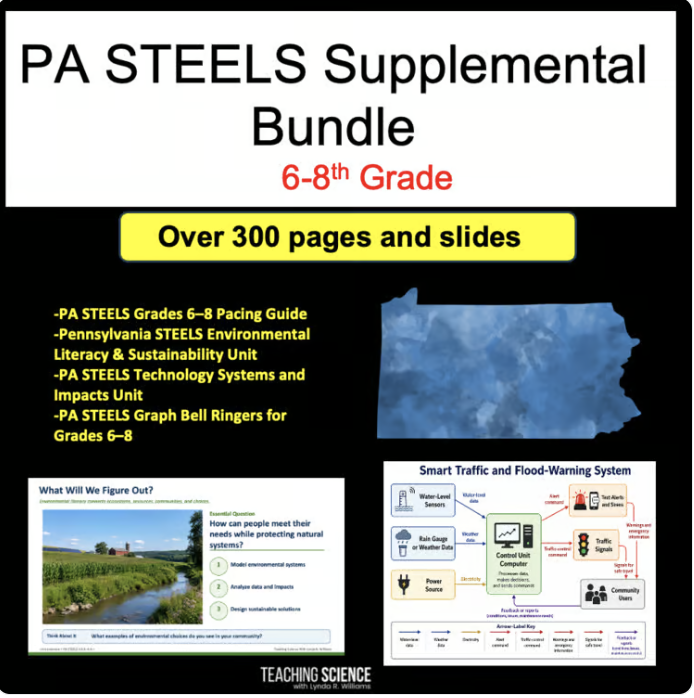
That is why I created a PA STEELS Supplemental Bundle for Grades 6–8.
The bundle is designed to help Pennsylvania teachers strengthen the areas that may be missing from a traditional science curriculum, especially:
Technology systems
Technology’s impacts on people and the environment
Design thinking and problem solving
Pennsylvania environmental issues
Environmental data analysis
Sustainability
Resource management
Stewardship
Environmental justice
The goal is to make the new PA STEELS expectations manageable while giving students meaningful, real-world learning experiences.
Frequently Asked Questions About PA STEELS Standards
What does PA STEELS stand for?
PA STEELS stands for Science, Technology and Engineering, Environmental Literacy and Sustainability.
When did the PA STEELS standards take effect?
The standards were adopted in January 2022 and were fully integrated into Pennsylvania classroom instruction beginning with the 2025–2026 school year.
Are PA STEELS standards the same as NGSS?
PA STEELS uses many three-dimensional science-learning principles associated with modern science standards, including practices, disciplinary core ideas, and crosscutting concepts. However, Pennsylvania also includes distinct Technology and Engineering and Environmental Literacy and Sustainability domains with Pennsylvania-specific expectations.
Does an NGSS-aligned curriculum cover all PA STEELS standards?
Not necessarily. An NGSS-aligned curriculum may strongly cover life, physical, Earth and space science, and engineering design while still needing additional instruction in technological systems, environmental literacy, sustainability, stewardship, or environmental justice.
What is included in the Environmental Literacy and Sustainability standards?
The standards address agricultural and environmental systems, natural resources, watersheds, environmental investigations, environmental data, sustainability, stewardship, and environmental justice.
What is included in the Technology and Engineering standards?
Students examine technological systems, design processes, innovation, system components, impacts of technology, trade-offs, feedback, problem solving, and the relationship among technology, society, and the environment.
Final Thoughts
The PA STEELS standards reflect an important shift in science education.
Students still need a strong understanding of scientific concepts. They also need to understand the technological systems surrounding them, evaluate the effects of human decisions, interpret environmental evidence, and propose thoughtful solutions.
For teachers, the challenge is making sure these newer areas are not overlooked. Do you need a pacing guide for PA STEELS 6th-8th?
With purposeful instruction, Pennsylvania students can learn to see science, technology, engineering, communities, and the environment as connected systems. That is the heart of PA STEELS and an important part of preparing students to make informed decisions in the real world.
Lynda R. Williams is an experienced science educator and curriculum designer with more than 20 years of experience teaching upper elementary and middle school science. She has also taught science methods courses at the university level, helping prepare future teachers to use inquiry, data analysis, engineering design, and evidence-based instruction in the classroom. Through Teaching Science with Lynda R. Williams, she creates engaging, standards-aligned resources that help teachers make complex science standards, including PA STEELS, easier to understand and teach.