Looking for a complete 5th-grade NGSS science curriculum that includes lessons, labs, assessments, review activities, and digital resources?
This 5th Grade NGSS Science Curriculum Bundle includes 44 resources designed to help teachers plan, teach, practice, review, and assess fifth-grade science throughout the school year.
You can explore the complete bundle here:
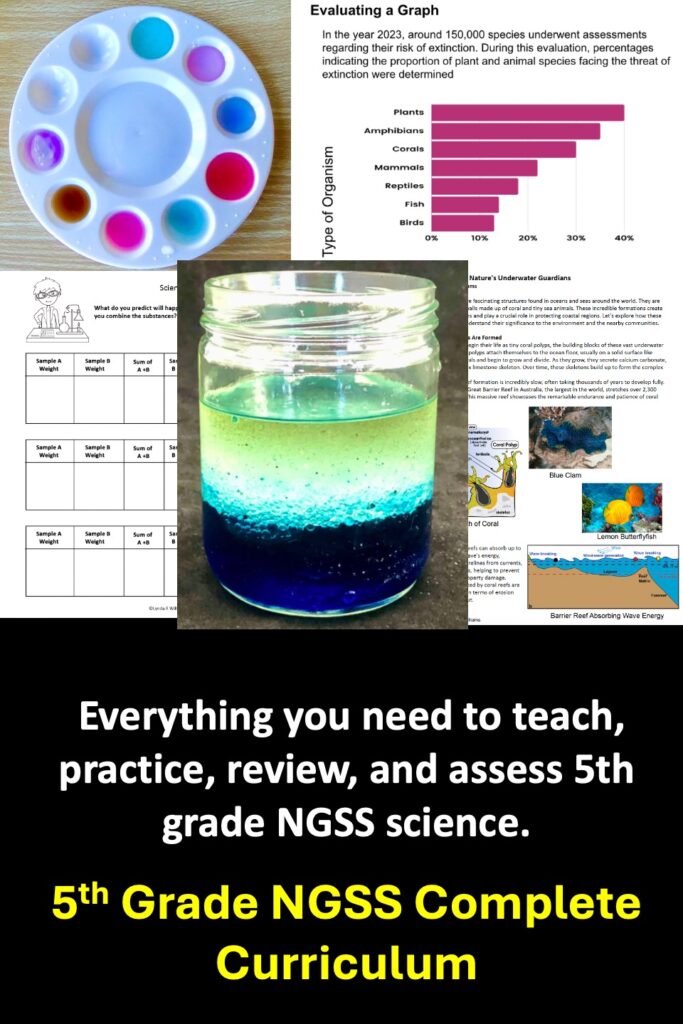
5th Grade NGSS Science Curriculum Bundle: 5E Lessons, Labs, and Assessments
The bundle includes physical science, life science, Earth and space science, environmental science, engineering design, scientific practices, graph analysis, CER writing, and test preparation.
What Is Included in This 5th Grade NGSS Science Curriculum?
This full-year science bundle includes a wide variety of resources to help teachers introduce concepts, guide investigations, reinforce learning, assess understanding, and provide ongoing review.
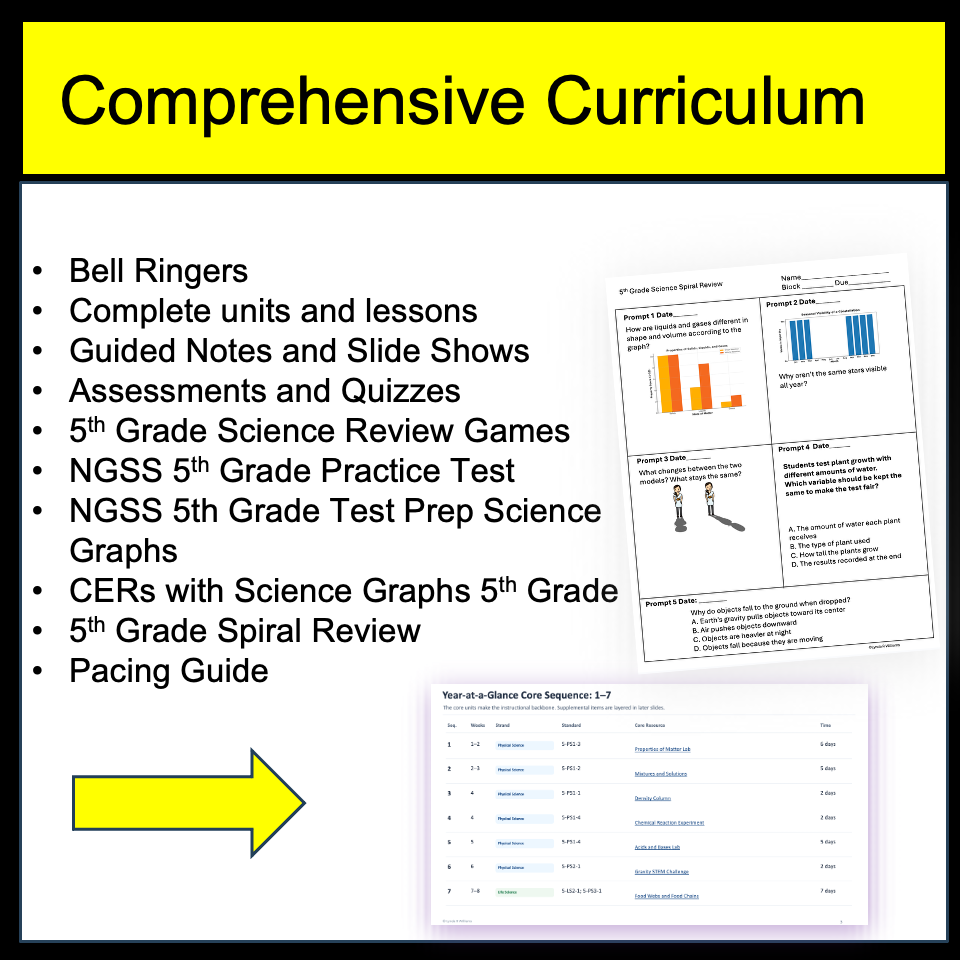
The bundle includes:
- Complete NGSS-aligned science units
- Hands-on science labs and investigations
- 5E science lessons
- STEM engineering challenges
- Project-based learning activities
- Guided notes and teaching slides
- Science reading passages
- Graphing and data analysis activities
- Claim, Evidence, and Reasoning practice
- Unit assessments and quizzes
- Science bell ringers
- Spiral review activities
- Digital board games
- Whole-class review games
- NGSS test-preparation resources
- A teacher-friendly pacing guide with active resource links
Teachers can follow the suggested sequence or adjust the materials to match their district’s pacing guide, school calendar, and students’ needs.
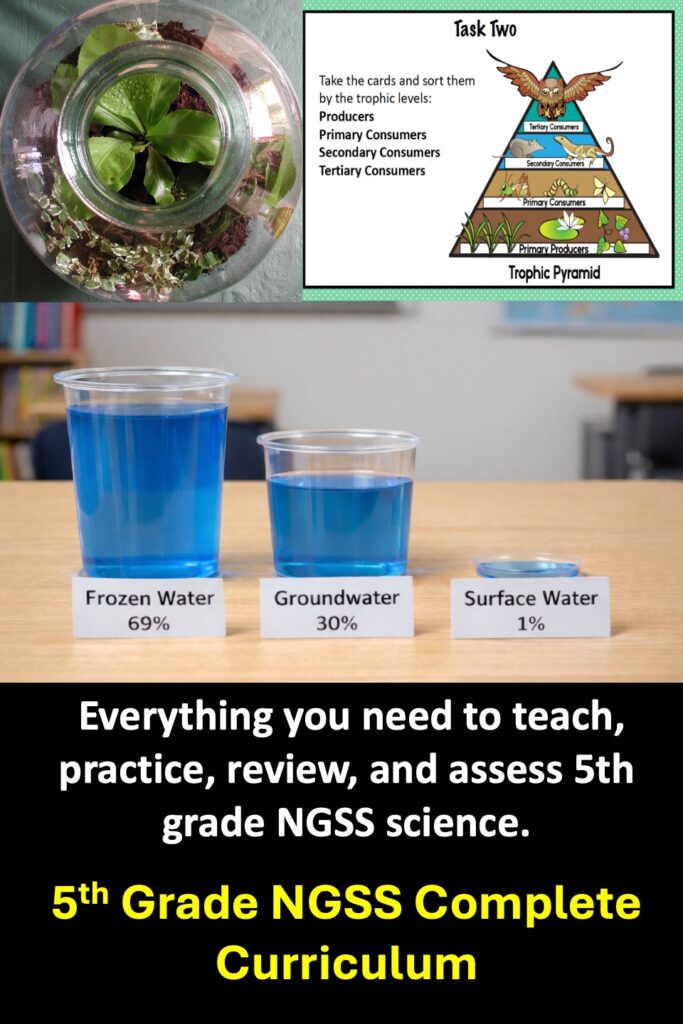
Why Use a Full-Year 5th Grade Science Curriculum Bundle?
Planning an entire year of elementary science instruction can take a tremendous amount of time.
Teachers need more than worksheets. They need materials that help students investigate, discuss, analyze, explain, review, and apply scientific ideas.
A comprehensive fifth-grade science curriculum bundle can help teachers:
- Save time searching for separate science activities
- Build a logical sequence of instructions
- Connect lessons directly to NGSS performance expectations
- Provide students with repeated practice using science skills
- Balance hands-on investigations with reading and writing
- Include formative and summative assessments
- Offer both printable and digital learning options
- Provide a meaningful review before the unit and state testing
Instead of collecting disconnected activities throughout the year, teachers have a coordinated set of resources available in one place.
What 5th-Grade NGSS Standards Are Covered?
The curriculum addresses the major fifth-grade Next Generation Science Standards across physical science, life science, Earth and space science, and engineering.
Physical Science
Students investigate the properties of matter, mixtures, solutions, chemical reactions, gravity, and conservation of matter.
Topics include:
- Matter is made of particles too small to be seen
- Properties of materials
- Identifying materials through observations and measurements
- Mixtures and solutions
- Solubility
- Conservation of matter
- Chemical reactions
- Acids and bases
- Relative density
- Gravity
- Engineering applications involving forces
Students make observations, measure materials, analyze data, conduct investigations, and use evidence to explain what happened.
Life Science
Students explore how plants obtain the materials they need for growth and how matter and energy move through ecosystems.
Topics include:
- Plant needs
- Photosynthesis
- Fair tests with plants
- Food chains
- Food webs
- Producers, consumers, and decomposers
- Energy from the sun
- Movement of matter through ecosystems
- Ecosystem interactions
- Pollinator habitats
Students develop models, analyze relationships, and explain how organisms depend on one another and their environment.
Earth and Space Science
Students examine patterns in the sky, Earth’s systems, water distribution, and ways communities protect natural resources.
Topics include:
- Apparent brightness of the sun and stars
- Distance to stars
- Seasonal patterns of stars
- Sunlight and shadows
- Earth’s geosphere, hydrosphere, atmosphere, and biosphere
- Interactions among Earth’s systems
- Water distribution on Earth
- Freshwater and saltwater reservoirs
- Human impact on natural resources
- Environmental protection
- Coral reefs and shoreline protection
Students use models, graphs, readings, and evidence to explain patterns and interactions in Earth and space systems.
Engineering Design
Students also practice the engineering design process.
They may:
- Define a problem
- Identify criteria and constraints
- Compare possible solutions
- Build and test models
- Analyze results
- Identify failure points
- Improve a design
Engineering challenges help students apply science concepts while building problem-solving and collaboration skills.
How Does This Curriculum Support Three-Dimensional Science Learning?
NGSS instruction is not simply a list of facts students must memorize.
Three-dimensional science learning combines:
- Disciplinary Core Ideas
- Science and Engineering Practices
- Crosscutting Concepts
Throughout the bundle, students engage in scientific practices such as:
- Asking questions
- Making observations
- Measuring and collecting data
- Developing models
- Planning investigations
- Reading graphs
- Analyzing patterns
- Constructing explanations
- Supporting claims with evidence
- Communicating scientific ideas
- Designing and improving solutions
Students learn science content while also learning how scientists and engineers investigate the natural world.
| Resource Type | How It Supports Teachers | How It Supports Students |
|---|---|---|
| Complete science units | Provides organized, standards-aligned instruction | Builds understanding through connected lessons |
| Hands-on labs and investigations | Reduces planning and material-prep time | Gives students opportunities to observe, test, and collect evidence |
| Guided notes and teaching slides | Supports direct instruction and review | Helps students organize important science ideas |
| Graphing and data analysis | Provides ready-to-use science practice | Builds skills in reading graphs, identifying patterns, and drawing conclusions |
| CER activities | Makes scientific writing easier to teach | Helps students support claims with evidence and reasoning |
| Science reading passages | Integrates literacy into science lessons | Strengthens comprehension and science vocabulary |
| Bell ringers and spiral review | Provides quick daily practice | Improves retention through repeated review |
| Assessments and quizzes | Makes formative and summative assessment easier | Gives students practice with NGSS-style questions |
| Review games | Offers engaging whole-class or small-group review | Increases participation and motivation |
| STEM and engineering challenges | Supports engineering design instruction | Encourages collaboration, problem-solving, and creativity |
| Printable and digital options | Gives teachers flexibility for different classroom needs | Allows students to learn in multiple formats |
| Teacher-friendly pacing guide | Helps organize the full year of instruction | Creates a logical sequence of learning |
Hands-On Science Labs and Investigations
Hands-on science is an important part of elementary science instruction.
Students need opportunities to interact with materials, collect evidence, compare results, and discuss what their observations mean.
The bundle includes investigations related to:
- Solubility
- Properties of matter
- Mixtures and solutions
- Conservation of matter
- Chemical reactions
- Acids and bases
- Gravity
- Plant growth
- Water distribution
- Earth’s systems
- Engineering design
These activities help students connect abstract science ideas to observable evidence.
Graphing and Data Analysis Practice
Graph analysis is an essential science skill.
Students must be able to read titles and axes, identify variables, compare values, notice trends, and use data as evidence.
This curriculum includes resources that help fifth graders practice:
- Reading bar graphs
- Reading line graphs
- Interpreting data tables
- Comparing quantities
- Identifying patterns
- Describing relationships
- Drawing conclusions from evidence
- Supporting claims with graph data
Graph practice can be used during instruction, as bell ringers, for small-group support, or as test preparation.
Claim, Evidence, and Reasoning Practice
Claim, Evidence, and Reasoning, often called CER, helps students organize scientific explanations.
Students learn to:
- Make a clear claim
- Select relevant evidence
- Explain how the evidence supports the claim
- Use scientific ideas in their reasoning
CER activities help students move beyond choosing an answer and begin explaining why an answer is supported by evidence.
Guided Notes and Teaching Slides
Guided notes provide structure while helping students focus on the most important information.
The bundle includes guided notes and slides for topics such as:
- Matter
- Ecosystems
- Plant needs
- Distance and brightness of stars
- Sunlight and shadows
- Earth’s spheres
- Water distribution
Teachers can use the slides and notes to introduce a topic, clarify ideas after an investigation, support absent students, or review before an assessment.
Science Bell Ringers and Spiral Review
Short, consistent review can help students retain science concepts over time.
The included bell ringers and spiral review activities provide practice with:
- Physical science
- Life science
- Earth and space science
- Graph analysis
- Science vocabulary
- Data interpretation
- NGSS-style questions
These resources work well for:
- Morning work
- Science warm-ups
- Exit tickets
- Early finishers
- Small-group review
- Test preparation
Even five to ten minutes of focused practice can help students build confidence and improve retention.
Assessments and Test Preparation
Assessment materials help teachers identify what students understand and where they need additional support.
The bundle includes:
- Unit quizzes
- NGSS-aligned assessments
- Practice test questions
- Informational reading questions
- Graph-analysis questions
- Test-taking strategies
- Spiral review
- Digital Google Forms
- Whole-class review games
Teachers can use these resources for formative assessment, summative assessment, intervention, reteaching, or spring test preparation.
| Science Strand | Topics Included |
|---|---|
| Physical Science | Matter, mixtures, solutions, chemical reactions, gravity |
| Life Science | Plant needs, photosynthesis, ecosystems, food webs, energy flow |
| Earth and Space Science | Stars, sunlight, shadows, Earth’s spheres, water distribution |
| Earth and Human Activity | Natural resources, human impact, environmental protection |
| Engineering Design | Criteria, constraints, testing, and improving solutions |
Engaging Science Review Games
A review does not always need to look like another worksheet.
The bundle includes interactive review options such as:
- Digital board games
- Whole-class science review games
- Grudgeball
- Properties of Matter Games
- Ecosystem games
- Plant needs games
- Sun and shadows games
- Water distribution games
- Earth’s systems games
- Cumulative NGSS review
These activities can increase participation while helping students revisit important science concepts.
Printable and Digital Science Resources
Different classrooms have different technology needs.
Depending on the individual resource, the bundle may include:
- Printable PDF pages
- PowerPoint teaching slides
- Google Slides activities
- Google Forms
- Self-checking digital practice
- Student recording sheets
- Answer keys
- Teacher directions
Teachers can select the format that works best for whole-class instruction, centers, independent work, homework, sub plans, or digital learning.
Teacher-Friendly 5th Grade Science Pacing Guide
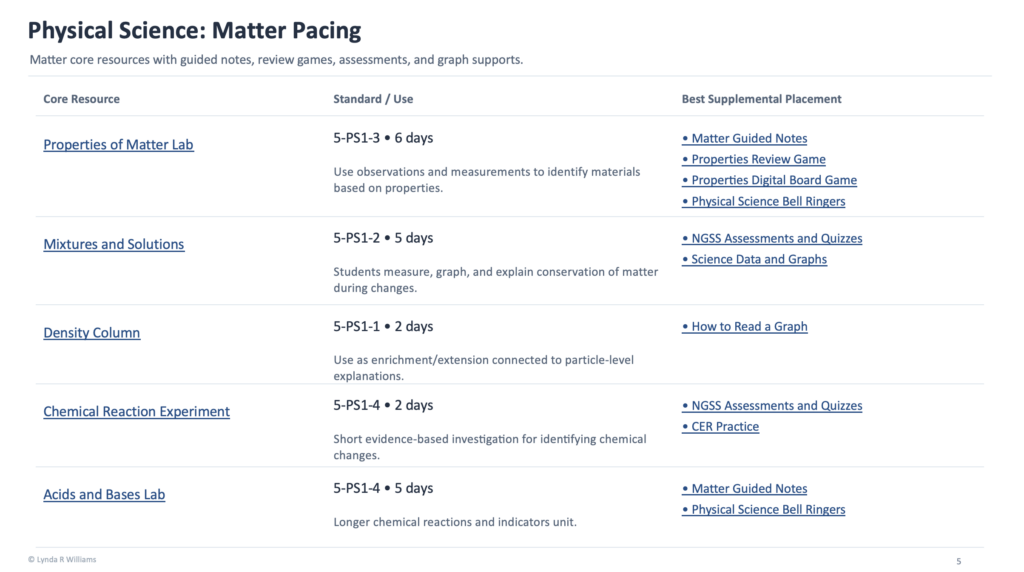
The bundle includes a teacher-friendly pacing guide that organizes the resources into a suggested instructional sequence.
The pacing guide includes:
- NGSS performance expectations
- Core instructional units
- Suggested teaching time
- Supplemental resources
- Review activities
- Assessments
- Active links to the included products
The pacing guide is flexible. Teachers can follow it from beginning to end or rearrange the units to match district requirements.
Who Is This 5th Grade Science Curriculum For?
This bundle may be especially helpful for:
- Fifth-grade classroom teachers
- Departmentalized elementary science teachers
- Teachers without a complete science textbook
- Teachers supplementing an existing curriculum
- New teachers are building a science program
- Homeschool educators
- Intervention teachers
- Enrichment teachers
- Teachers preparing students for NGSS-aligned assessments
It can be used as a primary resource collection or as a supplement to a district curriculum.
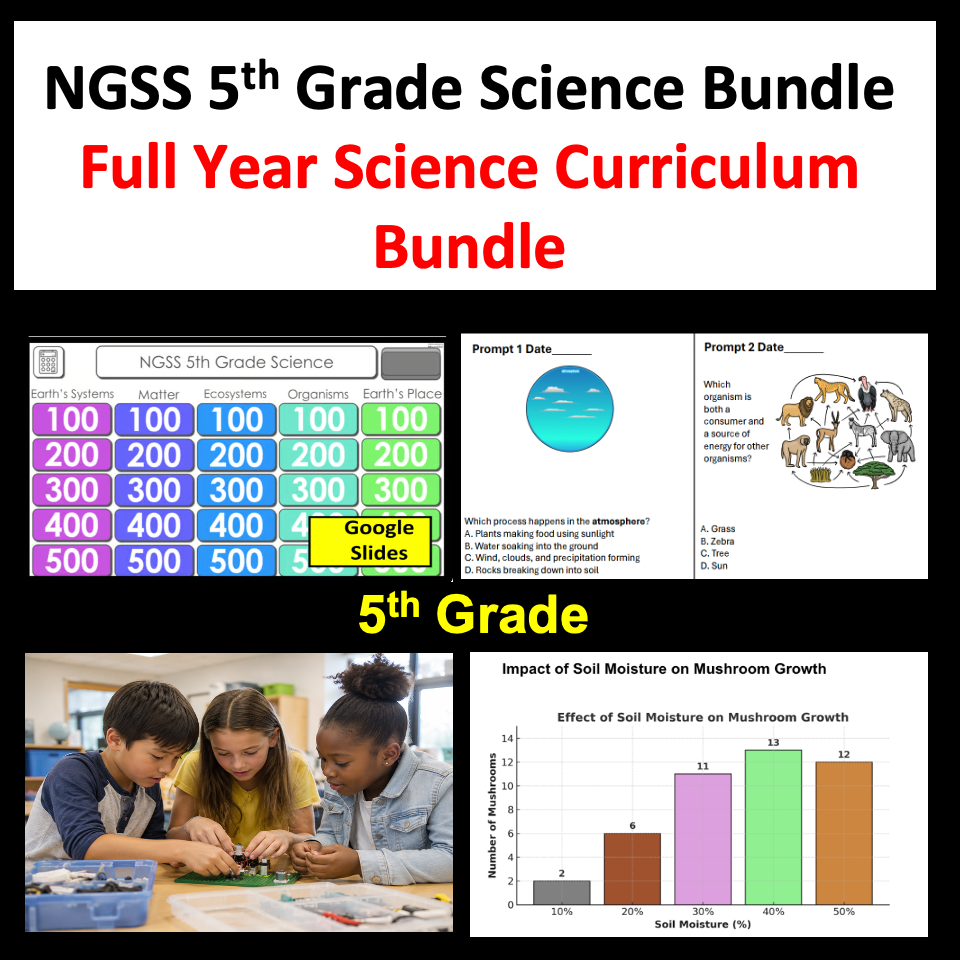
Benefits of the 5th Grade NGSS Science Curriculum Bundle
This bundle helps teachers:
- Save planning time
- Teach the major 5th-grade NGSS standards
- Organize a full year of science instruction
- Include hands-on learning
- Strengthen reading and writing in science
- Build graph-analysis skills
- Teach CER explanations
- Provide regular review
- Assess student understanding
- Offer printable and digital options
- Keep students engaged with games and projects
- Adjust the instruction for different student needs
It gives teachers a flexible collection of resources for teaching, practicing, reviewing, and assessing fifth grade science.
Frequently Asked Questions
Is this a complete 5th-grade NGSS science curriculum?
It is a comprehensive collection of 44 resources designed to support a full year of fifth-grade NGSS instruction. It includes core units, labs, projects, guided notes, assessments, bell ringers, graphing activities, CER practice, review games, reading passages, and test-preparation resources.
Does this bundle include a pacing guide?
Yes. A teacher-friendly pacing guide organizes the core units and supplemental resources into a suggested sequence and includes active links to the resources.
Are digital resources included?
Yes. Many resources include Google Slides, Google Forms, or other digital components. File formats vary by product.
Are hands-on labs included?
Yes. The bundle includes hands-on investigations involving matter, mixtures, chemical reactions, gravity, plants, Earth’s systems, water distribution, and engineering design.
Does the bundle include assessments?
Yes. It includes quizzes, NGSS assessment questions, practice tests, graph-analysis practice, reading questions, and review resources.
Can I use the resources in a different order?
Yes. The pacing guide is a suggested sequence. Teachers can rearrange lessons and units to match their own curriculum maps and schedules.
Does the curriculum include science review games?
Yes. The bundle includes digital board games, cumulative review games, topic-specific games, and Grudgeball.
Is this only for test preparation?
No. Test preparation is only one part of the bundle. The main focus is yearlong science instruction through investigations, reading, modeling, graph analysis, explanation, engineering, review, and assessment.
A Note to 5th Grade Teachers
Teaching fifth-grade science is exciting, but planning an entire year of NGSS-aligned instruction can feel overwhelming.
You need lessons that are accurate, engaging, age-appropriate, and manageable within a busy elementary schedule.
This bundle was created to give teachers a flexible set of resources for teaching the major fifth-grade NGSS standards. You can use the suggested pacing guide or select the materials that fit your students, schedule, and district curriculum.
The goal is simple: spend less time searching for science materials and more time helping students investigate, analyze, discuss, explain, and think like scientists.
Explore the Complete 5th Grade NGSS Science Curriculum Bundle
Bring together science lessons, labs, guided notes, assessments, graphing practice, CER writing, bell ringers, projects, reading passages, review games, and test preparation in one organized resource collection.

Lynda R. Williams is an experienced science educator and curriculum creator who is passionate about making science engaging, understandable, and practical for both teachers and students. She taught science methods at the university level for nearly 20 years and has extensive experience helping educators use inquiry, data analysis, scientific practices, and hands-on learning in the classroom.
Through her Teachers Pay Teachers store, Lynda creates standards-aligned science resources for upper elementary and middle school classrooms. Her materials are designed to save teachers time in planning while helping students investigate phenomena, analyze evidence, read graphs, construct explanations, and think like scientists.
Lynda lives in Utah and enjoys beekeeping, gardening for pollinators, bird watching, and bringing real-world science into everyday life.