Getting students interested in science is not usually the difficult part. Fifth graders are naturally curious. They want to know why animals behave in unusual ways, how landforms develop, why water forms droplets, and what causes surprising events in the world around them.
The challenge is turning that natural curiosity into meaningful scientific thinking.
Teachers also face another challenge: time. Finding an interesting photo is easy. Finding a high-quality science phenomenon, checking the science behind it, developing useful questions, creating student pages, and preparing teacher notes can quickly turn one five-minute warm-up into an hour of planning.
Science phenomena bell ringers provide a simple way to build curiosity and important science skills without adding another complicated lesson to your day.
Looking for ready-to-use 5th-grade science phenomena?
You can see the complete Science Phenomena Bell Ringers resource here:
What Are Science Phenomena?
A science phenomenon is an event, object, pattern, or situation that students can observe and try to explain using science ideas.
A phenomenon does not need to be a dramatic volcanic eruption or a once-in-a-lifetime event. It can be something as familiar as water beading on a leaf, an animal displaying an unusual structure, rocks forming into unexpected shapes, or two materials behaving differently under the same conditions.
The most useful science phenomena make students pause and think:
What am I seeing?
Why is this happening?
What evidence supports my idea?
These questions move students beyond simply naming an object in a photograph. Instead, students begin making sense of what they observe.
That shift is important. Science is not just a collection of facts to memorize. Students need opportunities to observe patterns, ask questions, develop possible explanations, and use evidence to support their thinking.
What Are the Three Levels of Phenomena in Science Instruction?
Teachers can use phenomena at different levels of a science unit. An anchor phenomenon introduces the larger question for the unit, investigative phenomena help students explore smaller parts of that question, and everyday phenomena connect scientific ideas to familiar experiences.
| Level of Phenomenon | Purpose | When It Is Used | Example |
|---|---|---|---|
| Anchor phenomenon | Introduces a complex event or problem that students cannot fully explain at the beginning of the unit | At the beginning of a unit and revisited throughout instruction | Why are some areas of a city much hotter than nearby areas on the same day? |
| Investigative phenomenon | Helps students investigate one part of the anchor phenomenon and develop the science knowledge needed to explain it | During individual lessons, investigations, stations, or activities | How do different surfaces absorb and release heat? |
| Everyday phenomenon | Connects a science concept to a familiar event students may observe in daily life | During bell ringers, discussions, examples, reviews, or short activities | Why does a dark-colored playground slide become hotter than a light-colored surface? |
How Do the Three Levels of Phenomena Work Together?
The three levels of phenomena should build on one another.
The anchor phenomenon gives students a larger question to investigate. Investigative phenomena break that larger event into smaller, manageable questions that can be explored through labs, models, readings, data analysis, and discussion. Everyday phenomena help students connect the scientific concept to situations they already recognize.
For example, a unit about urban heat could begin with the anchor phenomenon of one neighborhood being significantly warmer than another. Students might then investigate how pavement, grass, water, and building materials absorb heat. Everyday examples, such as a hot car seat or a warm playground slide, help students connect those ideas to their own experiences.
When all three levels are used intentionally, phenomena become more than an attention-grabbing introduction. They provide a meaningful structure for students to ask questions, gather evidence, and develop increasingly complete scientific explanations.
Why Use Science Phenomena as Bell Ringers?
Teachers often introduce phenomena at the beginning of a full science unit. A puzzling event can generate questions that students investigate over several days or weeks.
However, science phenomena can also be used in shorter routines.
A five-minute photo prompt will not replace a complete investigation or unit-anchoring phenomenon. It can, however, help students repeatedly practice the thinking skills they need during larger science lessons.
A science phenomena bell ringer gives every student an accessible starting point. Students do not need to remember a vocabulary definition or complete a long reading passage before participating. They can begin with something they can see.
This is especially valuable at the beginning of the year, when students may have different levels of science background knowledge. It also works throughout the school year as students become more confident explaining their ideas.
Science Phenomena Help Students Slow Down and Observe
Many students want to jump immediately to an answer.
They may look at a photograph for two seconds and announce what they think it shows. Sometimes they are correct, but they often skip the evidence that led to their conclusion.
A consistent science phenomena routine teaches students to slow down.
Begin by asking students to record only what they can actually observe. They might notice colors, shapes, textures, positions, movement, patterns, or differences within the image.
For example:
“The animal has a large red structure near its neck” is an observation.
“The animal is trying to attract a mate” is an inference.
Both statements may be valuable, but they are not the same type of thinking.
Frequent practice with photographs gives fifth graders a concrete way to understand the difference between an observation and an inference.
Students Learn to Ask Better Science Questions
Teachers frequently hear questions such as:
“What is it?”
“What is the answer?”
“Are we supposed to know this?”
Science phenomena encourage students to ask questions that are more useful for investigation and explanation.
Instead of only asking for the object’s name, students may begin asking:
Why does this structure have that shape?
What caused the material to change?
How does this feature help the organism survive?
Why are these two areas different?
What might happen next?
Students do not need to produce a perfect testable question every time. The goal is to build the habit of questioning what they observe.
Over time, students become more comfortable admitting that they do not yet know the answer. That uncertainty is not a failure. It is often the beginning of scientific thinking.
Visible Evidence Gives Students Something Concrete to Discuss
“Use evidence” can feel abstract to fifth graders.
A photograph makes the concept more manageable because students can point to specific details.
A student might say:
“I think the animal is adapted for swimming because its feet are wide and its body is shaped in a way that could move through water.”
The student’s explanation may not be complete, but it connects an idea to visible evidence.
This routine prepares students for more advanced science writing, including claims, evidence, and reasoning. Before students can write a strong CER response, they need repeated practice recognizing evidence and explaining how it supports an idea.
Photo prompts offer a quick, low-pressure way to develop that skill.
What Makes a Good Science Phenomenon for 5th Grade?
Not every interesting picture creates a useful science discussion.
A strong 5th grade science phenomenon should be visually clear enough for students to notice details but puzzling enough to generate questions.
Look for images that:
• Show an event, interaction, structure, or pattern
• Connect to life, Earth, physical, or engineering science
• Allow more than one reasonable initial idea
• Include visible details students can use as evidence
• Encourage questions rather than reveal the answer immediately
• Are appropriate for the students’ age and background knowledge
The image should not require students to already know a specialized vocabulary word. Students should be able to begin by describing what they see.
The vocabulary and scientific explanation can come after students have had time to think.
A Simple 5th Grade Science Phenomena Routine
A phenomena bell ringer does not need to become a lengthy class discussion every day.
Try this simple routine:
First, display one image without revealing its title or explanation.
Give students quiet time to observe. Even one uninterrupted minute can improve the quality of their responses.
Next, have students record what they notice and what they wonder.
Then, ask students to develop a possible explanation and identify evidence from the image.
Finally, invite students to share with a partner or participate in a brief whole-class discussion.
The complete routine can take approximately five minutes, although you can extend it when a photograph connects naturally to your current unit.
Do Not Reveal the Answer Too Quickly
One of the most important parts of using science phenomena is resisting the urge to explain everything immediately.
Teachers know the science background. We naturally want to correct vocabulary, confirm the right answer, and make sure students leave with accurate information.
Accuracy matters, but timing matters too.
Allow students to observe, question, and develop ideas before giving them the scientific explanation. Students are more likely to care about new vocabulary when it helps answer a question they have already asked.
You can clarify misconceptions during the discussion without shutting down student thinking.
A useful response is:
“What evidence in the photograph led you to that idea?”
This keeps the conversation focused on reasoning rather than simply labeling answers right or wrong.
How Science Phenomena Solve Common Teacher Planning Problems
Using phenomena sounds simple until teachers begin trying to create everything themselves.
A teacher may need to:
Find an image with enough detail for observation
Confirm that the photograph shows what the source claims
Research the science background
Anticipate student questions and misconceptions
Create prompts and response pages
Prepare digital and printable formats
Decide how the phenomenon connects to science practices
That is a great deal of preparation for a short warm-up.
A ready-to-use resource removes those barriers. Teachers can project the image, distribute a response page or notebook prompt, and use prepared background notes to guide the conversation.
The goal is not to remove teacher decision-making. It is to give teachers a strong starting point so their limited planning time can be used where it matters most.
Flexible Ways to Use 5th Grade Science Phenomena
These prompts can be used in many parts of the school day.
Use them as:
• Morning science warm-ups
• Daily bell ringers
• Science notebook prompts
• Partner discussions
• Centers or stations
• Printable task cards
• Early finisher activities
• Introductions to new units
• Observation-versus-inference practice
• Evidence-based speaking or writing prompts
You might use one photograph each day for several weeks. You could also select prompts that connect to your current life science, Earth science, physical science, or engineering topic.
Some teachers may choose to revisit an image after completing a unit. Students can compare their original inference with the explanation they can now develop using new science knowledge.
What Is Included in the 5th Grade Science Phenomena Bell Ringers?
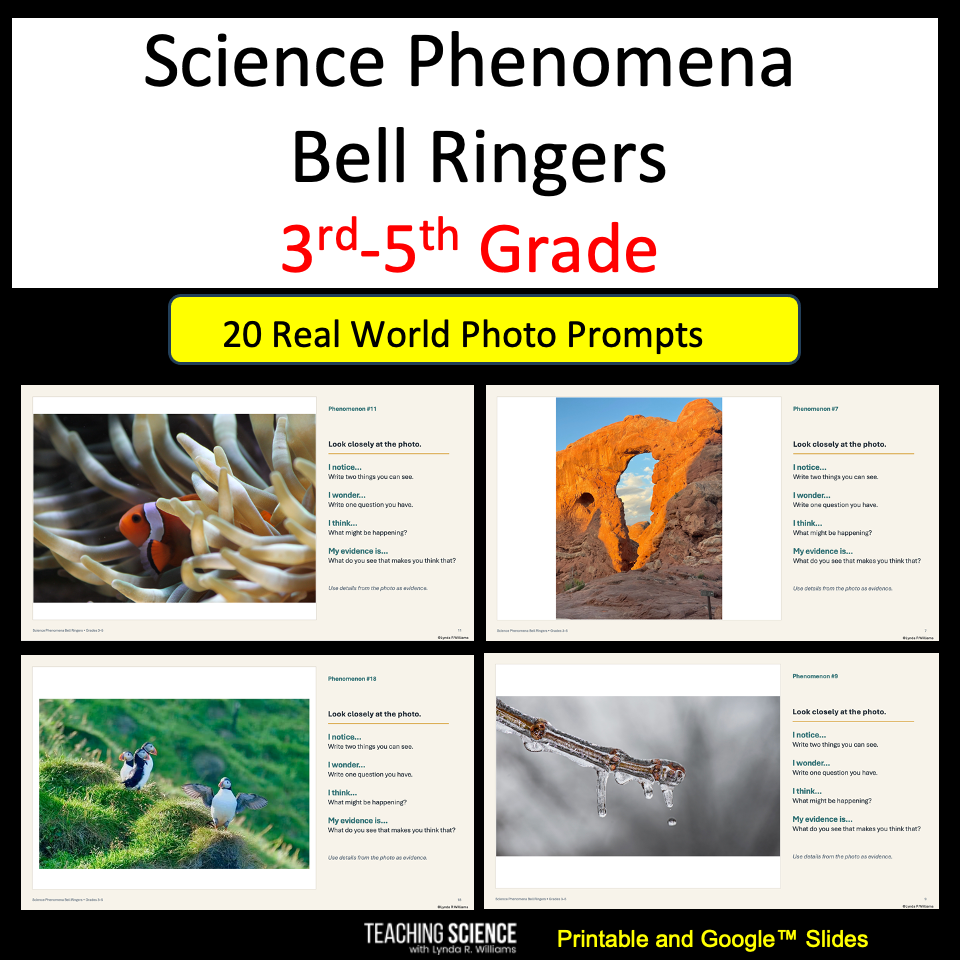
The Science Phenomena Bell Ringers resource includes 20 real-world science photo prompts.
Students practice noticing details, asking questions, developing possible explanations, and identifying evidence.
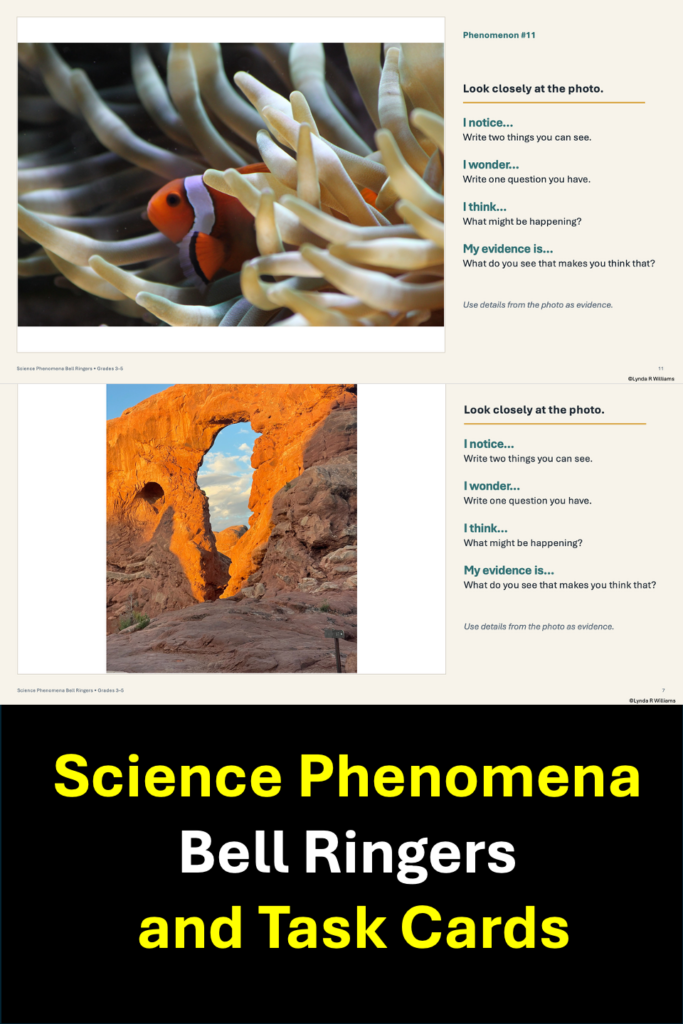
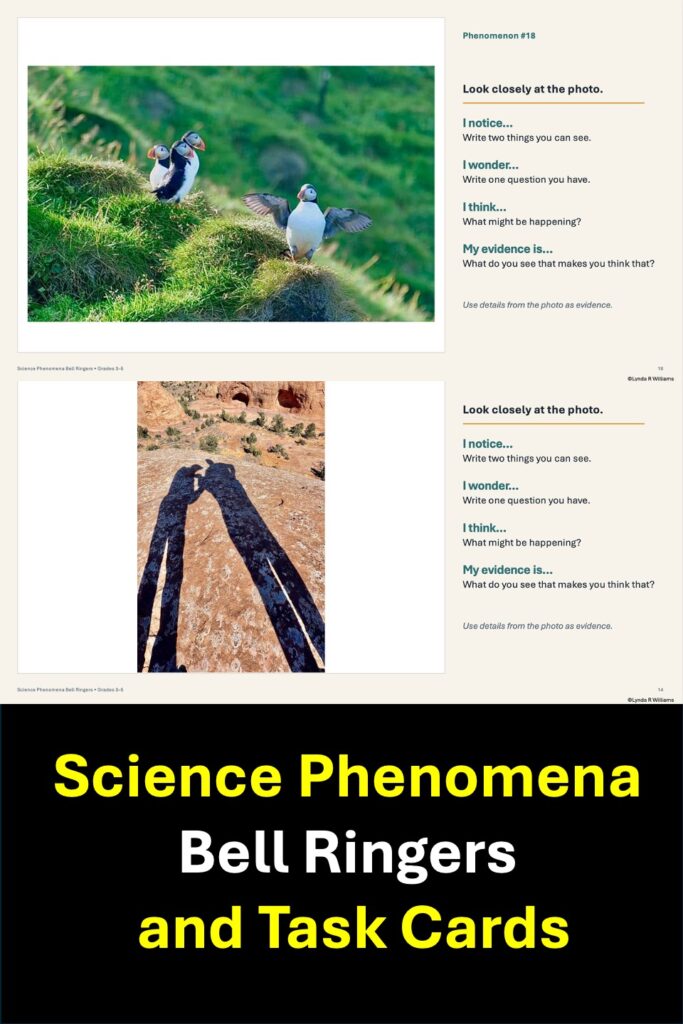
The resource includes projected images, printable task cards, student response options, and teacher support pages with science background information and possible student responses.
The title-free student images encourage students to think before vocabulary or context gives away the explanation.
This makes the routine easy to use at the beginning of the school year, but it is not limited to back-to-school instruction. The photographs cover a variety of science ideas and can be used throughout the year.
Build a Science Routine Students Can Use All Year
A strong science routine does not need to be complicated.
When students repeatedly observe, question, infer, and use evidence, those habits begin to transfer into investigations, readings, data analysis, models, and CER writing.
Science phenomena bell ringers create a predictable structure while keeping the content fresh. Students know what kind of thinking is expected, but each new photograph gives them something different to investigate.
Most importantly, the routine communicates an essential message:
You do not need to know the answer immediately to begin thinking like a scientist.
Explore the complete 5th Grade Science Phenomena Bell Ringers resource on TPT
Explore the Complete 5th Grade Science Phenomena Bell Ringers Resource here on My Website
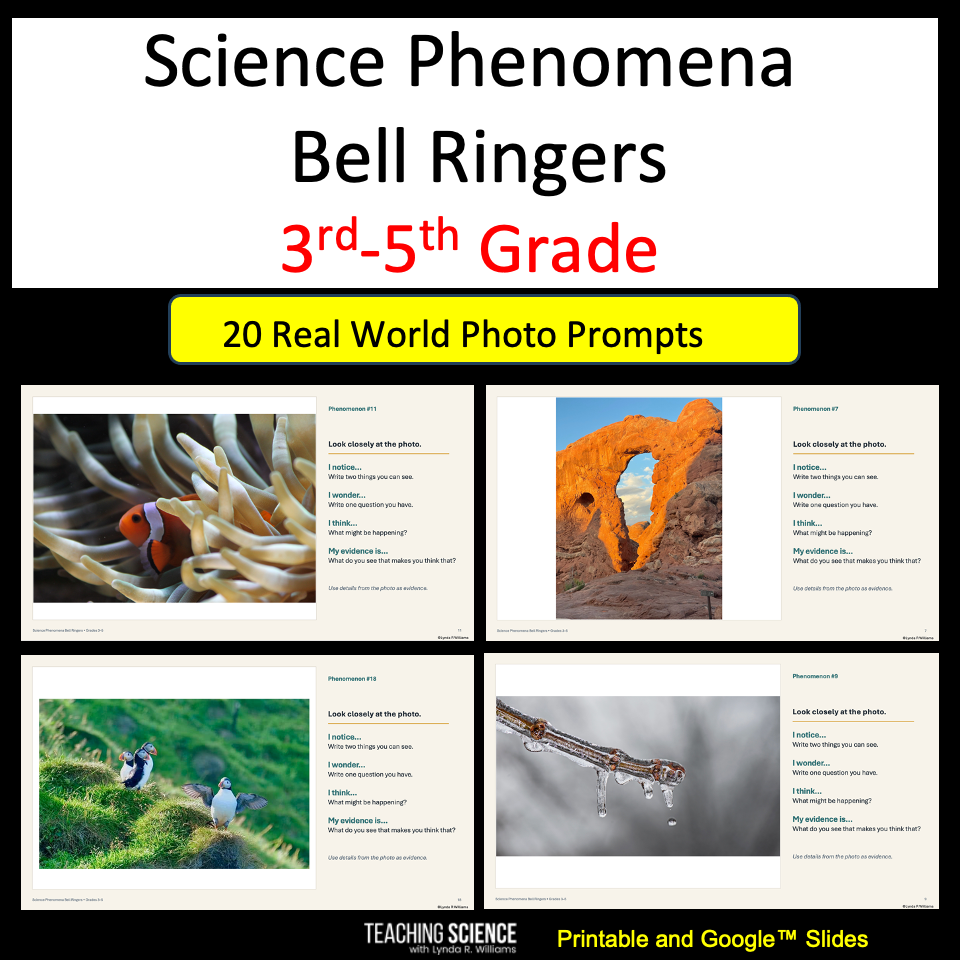
I also have science phenomena bell ringers and task cards for Middle School Science
About the Author
Lynda R. Williams is an experienced science and STEM educator with more than 34 years in education. She holds a K–12 teaching license and a master’s degree in Curriculum and Instruction. Lynda has taught elementary students and future educators in university Science Methods courses.
She creates practical, standards-based resources that help upper-elementary and middle school teachers make science instruction engaging, meaningful, and manageable. Her areas of expertise include science phenomena, graph and data analysis, STEM engineering, inquiry-based learning, Claim-Evidence-Reasoning, NGSS, and Utah SEEd standards.
Lynda has presented her research on interactive notebooks at professional conferences, received multiple awards for her work, and was honored with a Faculty Excellence Award from Utah Valley University.
Learn more about Lynda R. Williams and her experience in science and STEM education.