Middle school students are often eager to give an answer.
The challenge is getting them to slow down long enough to examine the evidence behind that answer.
A student may glance at an image and immediately identify an animal, landform, machine, or weather event. Naming what is pictured can be helpful, but it is only the beginning. Science students also need to ask what is happening, consider possible causes, and support their explanations with evidence.
Middle school science phenomena bell ringers provide a practical way to build those skills in just a few minutes at the beginning of class.
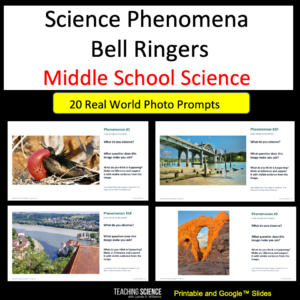
They also address a very real teacher problem: planning time. Finding a good phenomenon is only the first step. Teachers must also check the science, prepare questions, anticipate student responses, create student pages, and decide how to guide the discussion without giving away the explanation too soon.
Looking for a ready-to-use set of middle school science phenomena?
You can see the complete resource here:
What Are Science Phenomena?
Science phenomena are observable events or situations that students can investigate, explain, or make sense of using science ideas.
Phenomena can be large-scale events such as lightning, plate movement, or erosion. They can also be everyday events that become puzzling when students stop and examine them carefully.
Why do droplets form rounded beads on certain leaves?
How can rock layers become folded?
Why can one organism safely live among another organism’s stinging structures?
Why do waters from different rivers remain visibly separate where they meet?
A strong phenomenon creates a need to figure something out.
Instead of beginning a lesson with a definition, teachers begin with something students can observe. Vocabulary and scientific ideas are then introduced as tools for explaining the event.
Why Use Science Phenomena as Bell Ringers?
Anchoring phenomena are often used to launch an entire instructional unit. Students return to the same event as they investigate questions and develop a more complete explanation.
A short phenomenon bell ringer serves a different purpose.
It does not replace a full anchoring phenomenon, laboratory investigation, or coherent unit storyline. Instead, it gives students repeated practice with the thinking habits needed during those larger learning experiences.
In approximately five minutes, students can:
Observe an unfamiliar image
Ask a meaningful question
Make an inference
Support that inference with visible evidence
Listen to another student’s interpretation
Revise or clarify their own thinking
Because the routine is brief and predictable, it can be used regularly without taking over the entire class period.
What Are the Three Levels of Phenomena in Science Instruction?
Teachers can use phenomena at different levels of a science unit. An anchor phenomenon introduces the larger question for the unit, investigative phenomena help students explore smaller parts of that question, and everyday phenomena connect scientific ideas to familiar experiences.
| Level of Phenomenon | Purpose | When It Is Used | Example |
|---|---|---|---|
| Anchor phenomenon | Introduces a complex event or problem that students cannot fully explain at the beginning of the unit | At the beginning of a unit and revisited throughout instruction | Why are some areas of a city much hotter than nearby areas on the same day? |
| Investigative phenomenon | Helps students investigate one part of the anchor phenomenon and develop the science knowledge needed to explain it | During individual lessons, investigations, stations, or activities | How do different surfaces absorb and release heat? |
| Everyday phenomenon | Connects a science concept to a familiar event students may observe in daily life | During bell ringers, discussions, examples, reviews, or short activities | Why does a dark-colored playground slide become hotter than a light-colored surface? |
How Do the Three Levels of Phenomena Work Together?
The three levels of phenomena should build on one another.
The anchor phenomenon gives students a larger question to investigate. Investigative phenomena break that larger event into smaller, manageable questions that can be explored through labs, models, readings, data analysis, and discussion. Everyday phenomena help students connect the scientific concept to situations they already recognize.
For example, a unit about urban heat could begin with the anchor phenomenon of one neighborhood being significantly warmer than another. Students might then investigate how pavement, grass, water, and building materials absorb heat. Everyday examples, such as a hot car seat or a warm playground slide, help students connect those ideas to their own experiences.
When all three levels are used intentionally, phenomena become more than an attention-grabbing introduction. They provide a meaningful structure for students to ask questions, gather evidence, and develop increasingly complete scientific explanations.
Middle School Students Need Practice Separating Observation from Inference
One of the most valuable skills students can develop is the ability to distinguish between what they see and what they think it means.
Consider these two statements:
“The metal has a rough, reddish-brown surface.”
“The metal reacted with oxygen and water to form rust.”
The first statement is an observation. It describes visible evidence.
The second statement is an inference or explanation based on that evidence and prior knowledge.
Students often combine the two without realizing it. When asked what they observe, they may immediately state a cause, identify an organism, or repeat a fact they remember.
Photo-based science phenomena make this distinction concrete.
Students can ask themselves:
Can I actually see this in the image?
Or am I using what I see to develop an explanation?
Both types of thinking matter. The goal is for students to recognize which one they are using.
A Consistent Three-Question Science Routine
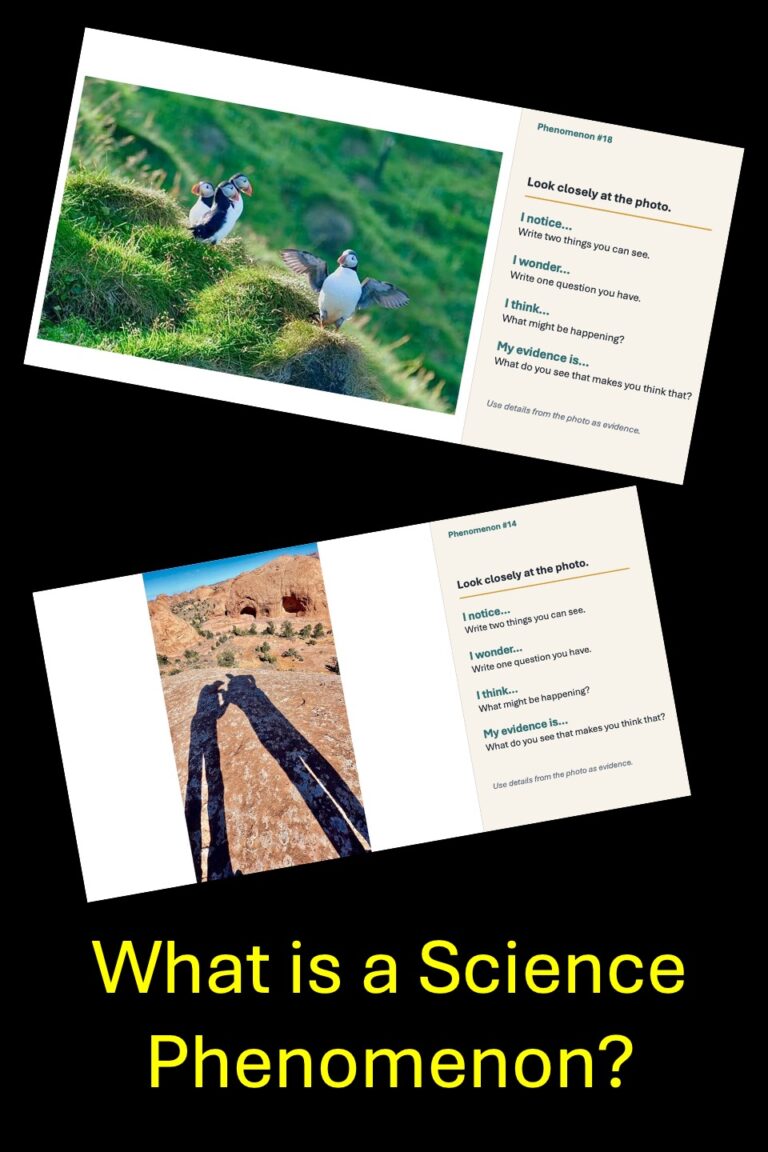
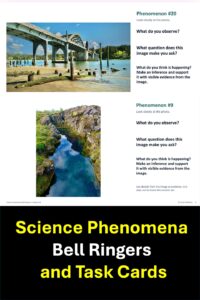
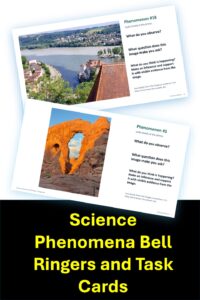
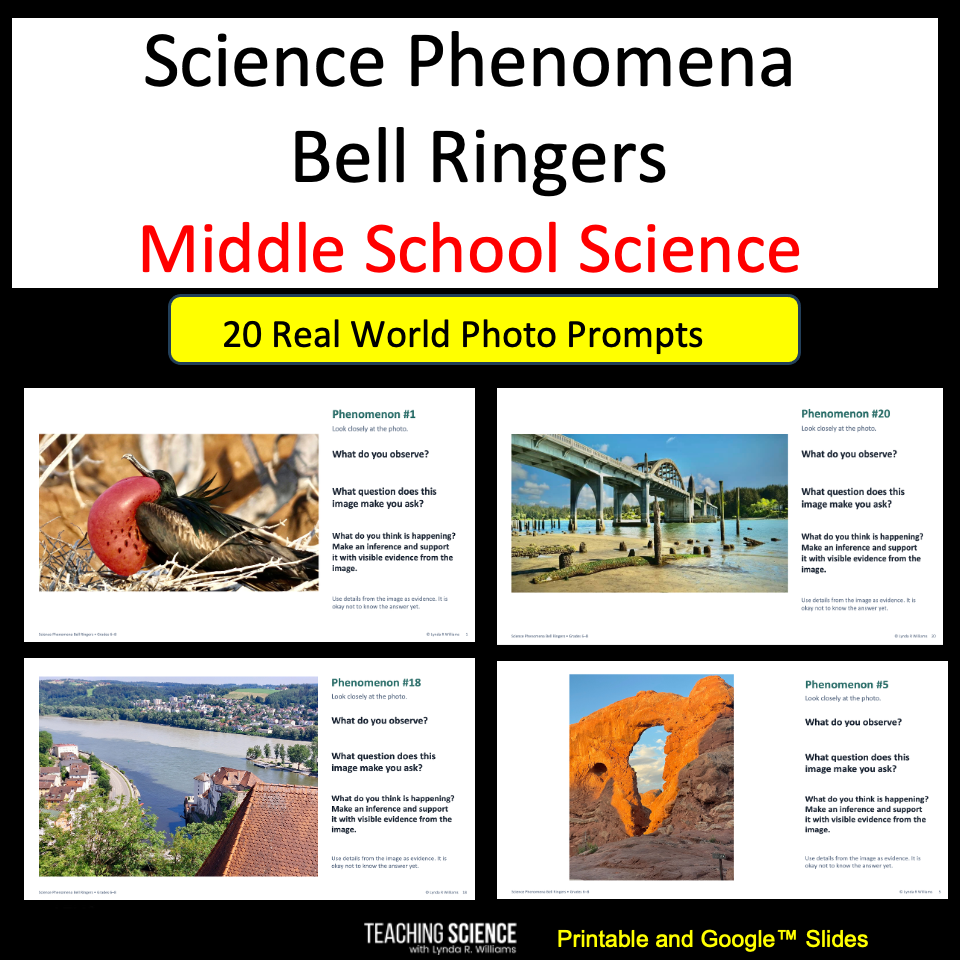
The Middle School Science Phenomena Bell Ringers use the same three questions with every photograph:
What do you observe?
What question does this image make you ask?
What do you think is happening? Make an inference and support it with visible evidence from the image.
Keeping the questions consistent reduces the time needed to explain directions. Students quickly learn what is expected, allowing more of the class period to be spent thinking and discussing.
The photographs change, but the thinking routine remains the same.
This consistency is especially useful during the first weeks of school. It helps teachers establish expectations for science discussion, notebook responses, evidence use, and respectful disagreement.
The routine remains valuable throughout the year as students apply it to increasingly complex science content.
Science Phenomena Create a Reason to Use Evidence
Middle school teachers frequently ask students to support a claim with evidence. However, students may treat evidence as an extra sentence added after the “real answer.”
Phenomena help students understand why evidence matters.
When several explanations are possible, students cannot rely only on confidence. They must point to details that make one explanation more reasonable than another.
For example, students examining horses rearing near a herd might suggest play, conflict, competition, or social communication.
The photograph alone may not prove one explanation. That is part of what makes the discussion useful.
Students can identify:
What evidence supports each possibility?
What information is missing?
What additional observation would help them decide?
This creates a more authentic discussion than a question with one obvious answer choice.
Good Science Phenomena Are More Than Interesting Pictures
An image can be beautiful, unusual, or dramatic without being instructionally useful.
A good middle school science phenomenon should provide enough visible information for students to begin reasoning.
Useful phenomena often include:
• A surprising structure or behavior
• A visible change or interaction
• A pattern students can describe
• Evidence of forces, energy, or movement
• A contrast between materials or environments
• A natural event that suggests an unseen cause
• A human-designed system solving a problem
The photograph should raise questions, but it should not be so confusing that students have no way to begin.
It should also connect to meaningful science ideas rather than functioning only as a guessing game.
Common Problems When Teachers Search for Phenomena
Teachers can find thousands of interesting photographs online, but creating a high-quality classroom prompt takes time.
Common challenges include:
Finding an image with enough detail for students to use as evidence
Locating a reliable explanation of what the image actually shows
Choosing phenomena appropriate for middle school
Connecting the image to life, Earth, physical, or engineering science
Writing prompts that encourage reasoning rather than recall
Predicting reasonable student questions and inferences
Avoiding photographs that reveal too much through captions or titles
Preparing both printable and digital options
Teachers may also worry about being asked a question they cannot answer immediately.
Detailed teacher notes help solve that problem. Teachers do not need a lecture script, but they benefit from having accurate background information, useful vocabulary, and possible discussion directions available before class begins.
Best Practices for Using Middle School Science Phenomena
Show the photograph before the title
A title can reveal the organism, process, or location before students have an opportunity to think.
Begin with a title-free image whenever possible. Add context and vocabulary after students respond.
Start with quiet observation
Give students a short period to examine the photograph before anyone speaks.
Once one student announces an interpretation, other students may stop looking and repeat the same idea. Quiet observation allows more students to form independent responses.
Ask for visible evidence
When a student offers an explanation, follow with:
“What do you see in the image that supports that idea?”
This keeps the conversation focused on reasoning.
Accept more than one reasonable initial inference
Students are developing possibilities, not always producing a final scientific explanation from one photograph.
Different ideas can be valuable when they are supported with evidence.
Identify what the photograph cannot tell us
A photograph is one source of evidence. It may not show what happened before the image was taken, what occurred afterward, the temperature, speed, chemical composition, or behavior over time.
Asking what additional data students would need strengthens their understanding of scientific evidence.
Introduce vocabulary after students think
Words such as mutualism, oxidation, divergent boundary, surface tension, or metamorphosis become more meaningful when they help explain something students have already observed.
Use Science Phenomena to Prepare Students for CER Writing
Students often struggle with CER because they are expected to produce a claim, select evidence, and explain their reasoning all at once.
Phenomena bell ringers break that process into a manageable routine.
Students first learn to observe accurately.
Then they make an inference.
Finally, they connect the inference to evidence.
The response does not need to become a complete CER paragraph every day. The bell ringer is practice for the thinking behind CER.
Teachers can occasionally extend one prompt by asking students to turn their inference into a claim and explain why the selected evidence supports it.
Flexible Ways to Use Middle School Science Phenomena
These prompts can be used as:
• Daily bell ringers
• Beginning-of-class warm-ups
• Science notebook entries
• Partner discussion prompts
• Printable task cards
• Centers or stations
• Gallery walks
• Early finisher activities
• Substitute teacher activities
• Introductions to life, Earth, physical, or engineering science
• Observation-versus-inference practice
• Evidence-based writing prompts
Use one phenomenon each day for 20 days, select one or two each week, or match individual photographs to upcoming units.
The task cards can also be placed around the room for students to rotate through several phenomena.
What Is Included in the Middle School Science Phenomena Resource?
The Middle School Science Phenomena Bell Ringers include 20 real-world science photographs across a range of topics.
Students explore animal behavior, adaptations, mutualism, forces and motion, surface tension, chemical change, weather, plate movement, rock formations, river systems, tides, engineering, and other science ideas.
The resource includes:
A projected slideshow
Printable half-page task cards
Full-page student response sheets
Quick-response options
A science thinking reminder
A final reflection page
Detailed teacher notes for each phenomenon
Possible student observations, questions, inferences, and evidence
Science background and optional vocabulary
Connections to Science and Engineering Practices and Crosscutting Concepts
The projected photographs and task cards remain title-free so students can observe before the explanation is revealed.
Reduce Preparation Without Reducing Scientific Thinking
Low prep should not mean low value.
A strong classroom routine can be simple for the teacher while still requiring meaningful thinking from students.
The preparation has already been completed, but students are still doing the intellectual work. They observe, ask questions, consider possibilities, use evidence, and listen to competing explanations.
That balance matters.
Teachers need resources that respect both instructional goals and limited planning time.
Build Curiosity One Photograph at a Time
Science phenomena remind students that science begins with the world around them.
A photograph can lead to a question. A question can lead to an inference. Evidence can strengthen, challenge, or change that inference.
When students practice this process regularly, they become less focused on guessing the teacher’s answer and more comfortable explaining how they reached their own ideas.
Explore the complete Middle School Science Phenomena Bell Ringers and Task Cards on TPT
Explore the complete Middle School Science Phenomena Bell Ringers and Task Cards Here on My Website
Want to learn more about using phenomena in the classroom?

About the Author
Lynda R. Williams is an experienced science and STEM educator with more than 34 years in education. She holds a K–12 teaching license and a master’s degree in Curriculum and Instruction. Lynda has taught elementary students and future educators in university Science Methods courses.
She creates practical, standards-based resources that help upper-elementary and middle school teachers make science instruction engaging, meaningful, and manageable. Her areas of expertise include science phenomena, graph and data analysis, STEM engineering, inquiry-based learning, Claim-Evidence-Reasoning, NGSS, and Utah SEEd standards.
Lynda has presented her research on interactive notebooks at professional conferences, received multiple awards for her work, and was honored with a Faculty Excellence Award from Utah Valley University.
Learn more about Lynda R. Williams and her experience in science and STEM education.