The beginning of the school year is often filled with procedures, supplies, schedules, curriculum maps, and standards. But before students can fully engage in academic learning, they need to understand what kind of classroom community they are entering. Build classroom community intentionally with these strategies.
For me, a strong classroom culture begins with five priorities:
- Kindness
- Respect
- Belonging
- Curiosity
- The freedom to make mistakes
These priorities are especially important in science classrooms, where students are regularly asked to share ideas, make predictions, analyze evidence, work with partners, and revise their thinking.
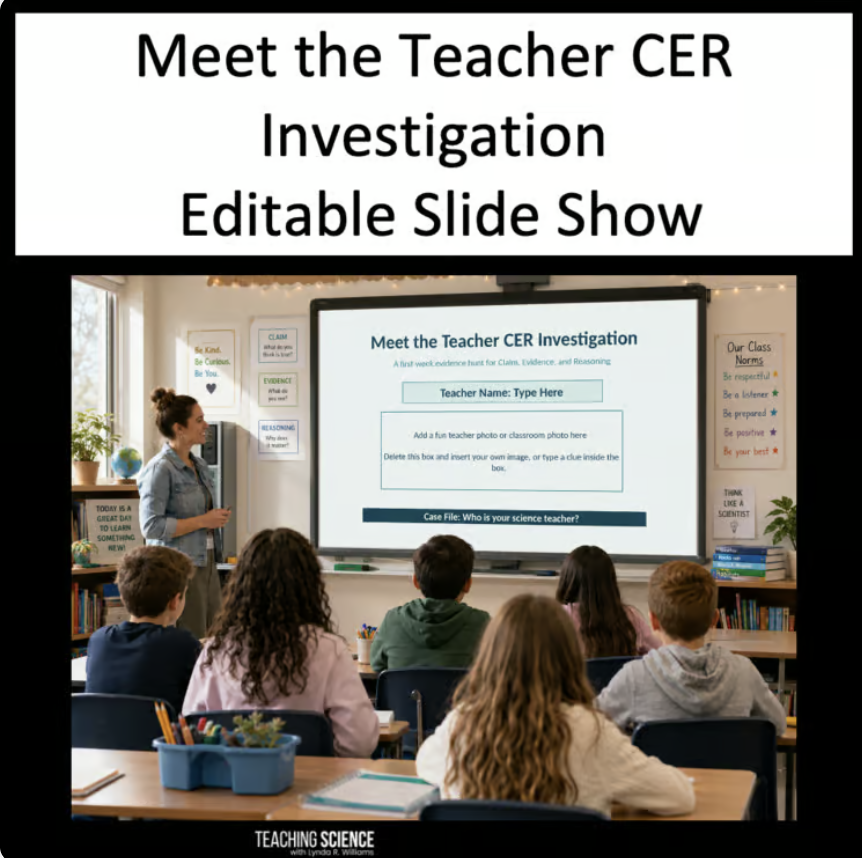
What Is Classroom Culture?
Classroom culture is the shared set of expectations, behaviors, relationships, and attitudes that shape how students interact, learn, and participate in the classroom.
A positive classroom culture helps students feel safe enough to ask questions, contribute ideas, disagree respectfully, make mistakes, and work with others.
Classroom culture is not something that is established with one lesson during the first week of school. It develops through the language teachers use, the routines students practice, and the behaviors that are consistently modeled and reinforced.
Watch: Cultivating Classroom Culture
Cultivating Classroom Culture: 5 Priorities for the Start of the School Year
In this video, I share practical examples of ways teachers can establish kindness, respect, belonging, curiosity, and a healthy attitude toward mistakes from the beginning of the school year.
5 Priorities for Building a Positive Classroom Culture
| Priority | What It Looks Like in the Classroom | A Simple Way to Teach It |
|---|---|---|
| Kindness | Students help, include, and encourage one another | Discuss specific examples of kind classroom behavior |
| Respect | Students listen and disagree appropriately | Teach sentence starters for respectful disagreement |
| Belonging | Students feel that they are valued members of the class | Frequently vary partners and groups |
| Curiosity | Students ask questions and wonder about the world | Use photographs, phenomena, graphs, and “What do you notice?” prompts |
| Mistakes | Students are willing to take academic risks | Analyze incorrect answers without embarrassment or blame |
1. Teach What Kindness Actually Looks Like
“Be kind” sounds simple, but students may have very different ideas about what kindness looks like in a classroom.
Instead of only telling students to be kind, give them concrete examples.
Kindness might look like:
- Inviting someone into a group.
- Helping a classmate find a material.
- Sharing supplies.
- Listening while another student is speaking.
- Encouraging someone who is struggling.
- Not laughing when someone gives an incorrect answer.
This is particularly important in science.
Students need to be willing to make predictions, explain their reasoning, and share ideas that may eventually turn out to be incorrect.
If students are worried that classmates will laugh at them, many will simply stop participating.
A kind classroom sends the message:
You can share your thinking here.
2. Teach Students How to Disagree Respectfully
Respect is another classroom expectation that often needs to be taught explicitly.
Students may know they are supposed to “respect others,” but they may not know how to respectfully disagree with someone.
That skill is especially valuable in science because students are frequently comparing evidence, defending claims, and discussing different interpretations of data.
Give students language they can actually use.
Instead of:
“That’s wrong.”
Students can say:
- “I got a different answer.”
- “I see it differently because…”
- “Can you explain your thinking?”
- “What evidence did you use?”
- “I agree with part of your idea, but…”
These sentence starters accomplish two things.
Students learn how to communicate respectfully, and they begin using the language of scientific discussion.

3. Create a Sense of Belonging
Students are much more likely to participate when they feel that they belong in the classroom.
One easy way to begin building belonging is to provide opportunities for students to interact with different classmates during low-risk activities.
During the first few weeks of school, try changing partners frequently.
Students might:
- Discuss a science photograph.
- Examine a simple graph.
- Make an observation.
- Compare two possible explanations.
- Share something they notice about a phenomenon.
These activities do not need to be complicated.
In fact, simple activities are often better early in the year because the academic task is not the only goal.
Students are also learning:
- How to talk with a partner.
- How to listen.
- How to take turns.
- How to work with someone who is not their closest friend.
- How to contribute to a group.
These routines will become increasingly valuable when students begin completing labs, investigations, stations, and other collaborative activities.
4. Make Curiosity Part of Your Classroom Culture
Curiosity is at the heart of science.
Unfortunately, students sometimes arrive in our classrooms believing that school is mostly about determining the answer the teacher wants.
We can begin changing that mindset by making questions just as valuable as answers.
Show students something interesting and give them time to wonder.
You might use:
- A photograph of an unusual natural phenomenon.
- An unexpected graph.
- An interesting animal adaptation.
- A mystery object.
- A short demonstration.
- A surprising data set.
Then ask questions such as:
What do you notice?
What do you wonder?
What questions do you have?
What might explain what you are seeing?
You do not always need to immediately provide the answer.
Allowing students to sit with a question for a while helps establish that science is about investigating the world rather than simply memorizing facts.
Start with this All About Me FREE Science Poster as a way to build Classroom Community.
5. Normalize Mistakes as Part of Learning
Students need to know very early in the school year that mistakes are expected.
This does not mean accuracy is unimportant.
It means that an incorrect answer is not something to be embarrassed about.
One strategy is to occasionally show students an incorrect response and analyze it together.
Ask:
What might this student have been thinking?
Which part of this answer makes sense?
Where did the reasoning begin to go in the wrong direction?
What evidence could help us revise this answer?
Notice how different those questions feel from simply saying:
“That answer is wrong.”
When students learn to analyze mistakes rather than fear them, they become more willing to take academic risks.
That matters in every subject, but it is especially important in science.
Scientists revise explanations when new evidence becomes available. Students should have opportunities to do the same.
What Should Teachers Prioritize During the First Week of School?
Teachers often wonder how quickly they should begin teaching academic content.
There is no need to choose between building classroom culture and teaching science.
You can do both at the same time.
A simple graph discussion can teach students how to:
- Take turns speaking.
- Disagree respectfully.
- Support an idea with evidence.
- Listen to another interpretation.
- Change their thinking.
- Work with a partner.
A science phenomenon can teach students how to:
- Ask questions.
- Share observations.
- Consider different explanations.
- Become comfortable saying, “I don’t know yet.”
The activity may be academic, but the routines and behaviors surrounding the activity are helping establish your classroom culture.
Classroom Culture Activities Do Not Need to Be Complicated
One of the best things about classroom culture activities is that they do not require elaborate preparation.
A single graph can lead to a valuable conversation.
For example, display a graph and ask:
Which claim does this graph support?
Have students select a claim and then explain what evidence in the graph supports their choice.
Before discussing the science answer, establish expectations for the conversation.
Students should listen to each other, explain their evidence, disagree respectfully, and be willing to revise an answer.
In just a few minutes, students are practicing science skills and classroom culture at the same time.
Why Classroom Culture Matters in Science
A strong science classroom requires more than knowing scientific facts.
Students need to be willing to:
- Ask questions.
- Share ideas.
- Interpret evidence.
- Work collaboratively.
- Defend a claim.
- Listen to another explanation.
- Revise their thinking.
Those behaviors are much easier to develop when students feel respected and included.
That is why classroom culture is not separate from science instruction.
It supports science instruction.
Frequently Asked Questions About Classroom Culture
What are the most important elements of a positive classroom culture?
A positive classroom culture includes kindness, mutual respect, belonging, curiosity, clear expectations, and an environment where students feel safe making mistakes and sharing ideas.
How do you build classroom culture at the beginning of the year?
Start by explicitly teaching what expected behaviors look and sound like. Give students opportunities to practice working with different classmates, asking questions, discussing ideas, and disagreeing respectfully.
How can teachers build classroom culture without losing instructional time?
Use academic activities to teach classroom expectations. A graph discussion, science phenomenon, partner observation, or short investigation can simultaneously teach academic skills and classroom routines.
Why is making mistakes important in a science classroom?
Mistakes allow students to examine their reasoning and revise their ideas based on evidence. This mirrors the process scientists use when developing and refining explanations.
How can teachers encourage curiosity?
Use photographs, demonstrations, graphs, objects, phenomena, and real-world observations. Ask students what they notice, what they wonder, and what questions they would like to investigate before giving them the explanation.
Try this Team Building Activity to build Classroom Community
Start With the Classroom You Want to Build
There will always be pressure at the beginning of the year to get started with curriculum.
But taking time to establish the way students will treat one another and approach learning is not wasted instructional time.
Teach kindness.
Model respect.
Create opportunities for students to belong.
Protect their curiosity.
And make it safe to be wrong.
When students feel comfortable asking questions, sharing ideas, disagreeing respectfully, and changing their thinking, you have created the conditions for meaningful science learning throughout the year.
What to teach the first month of school?
About Lynda R. Williams
Lynda R. Williams is a science educator with more than 34 years of experience in education. She holds a Master’s degree in Curriculum and Instruction and spent 20 years teaching Science Methods in university professional teacher education programs. Her work focuses on helping teachers make science instruction practical, engaging, and standards-aligned, with particular expertise in NGSS, Utah SEEd standards, interactive notebooks, and inquiry-based science learning. Through Teaching Science with Lynda R. Williams, she creates science resources for grades 3–8 designed to help teachers spend less time piecing together curriculum and more time helping students think, question, analyze evidence, and make sense of science.