Description
How can people protect wildlife while also protecting their homes, farms, and livelihoods?
In this Wildlife Management Project-Based Learning Unit, middle school students investigate conservation challenges in Botswana, Africa, where people and wildlife often depend on the same land and water resources.
Students examine three case studies involving elephants, lions, and human-wildlife conflicts. They analyze data, investigate different conservation strategies, and consider the needs of both wildlife and local communities.
The goal is to help students think like wildlife managers. They must identify problems, examine possible solutions, consider trade-offs, think about all sides of the issue, and use scientific evidence to develop a wildlife management proposal.
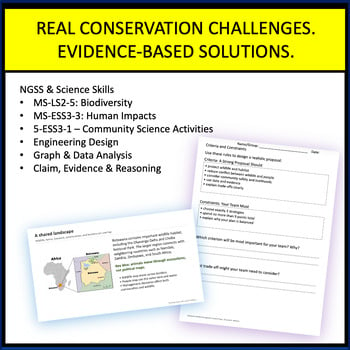
This project-based learning unit is designed for middle school ecosystems and environmental science and aligns with NGSS MS-LS2-5, MS-ESS3-3, and engineering design standards.
Three Wildlife Management Case Studies
Students investigate three conservation challenges using readings, photographs, video, and analysis questions.
Elephants on the Chobe River
Students watch an actual encounter between elephants and fishermen on the Chobe River along the Botswana-Namibia border. They examine the challenges that arise when people and elephants depend on the same water resources and consider ways to reduce conflict.
Lion Tracking and Livestock Protection
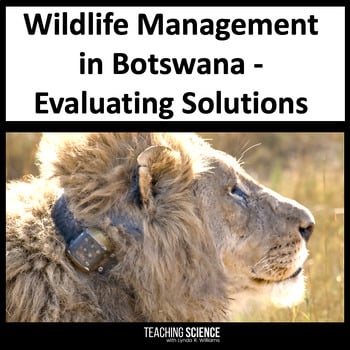
Students learn how tracking collars can help farmers monitor lion movements and protect their livestock. Using photographs of lions observed in Botswana, students examine the benefits and limitations of wildlife tracking as a management strategy.
Beehive Fences and Elephant Conservation
Students learn how beehive fences can help keep elephants away from agricultural areas. They examine this conservation strategy and consider its effectiveness for both farmers and elephants.
Students Investigate Problems and Evaluate Solutions
Students work through the conservation challenges before developing their own wildlife management plan.
Throughout the activities, students will:
- Investigate interactions between people and wildlife.
- Examine three wildlife management case studies.
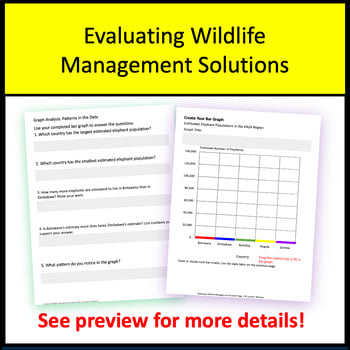
- Graph and analyze elephant population data.
- Explore carrying capacity and the challenges of maintaining healthy ecosystems.
- Investigate strategies for reducing human-wildlife conflicts.
- Consider different perspectives, including those of farmers, conservationists, and local communities.
- Compare management strategies using criteria and constraints.
- Evaluate the advantages, disadvantages, and trade-offs of possible solutions.
- Develop and present a wildlife management proposal.
- Write a Claim, Evidence, and Reasoning (CER) response to support their recommendations.
Students quickly discover that wildlife management decisions are complicated. A solution that benefits one group may create challenges for another. They must use the information they have collected to explain and defend their choices.
What’s Included?
The project is organized into eight activities, with teacher directions and student pages for each part.
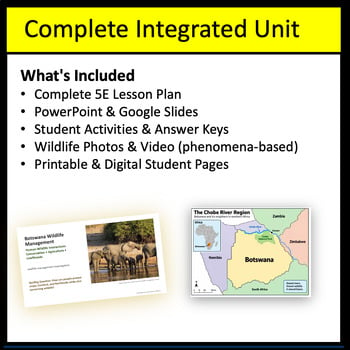
- Complete teacher lesson plans using the 5E instructional model
- Suggested pacing and teaching schedule (5-7 days)
- Introductory slideshow in PowerPoint and Google Slides
- Separate wildlife phenomenon slideshow
- Botswana wildlife photographs and video investigation (links to video)
- Student readings and case study analysis questions
- Elephant population data and graphing activity
- Graph analysis and carrying capacity questions
- Human-wildlife conflict and mitigation activities
- Beehive fence strategy evaluation
- Wildlife management strategies and decision matrix
- Criteria and constraints for comparing solutions
- Final wildlife management proposal and presentation
- Individual CER writing assessment
- CER rubric
- Teacher answer keys and sample responses
- Printable PDF student pages
- Digital, typable Google Slides student pages
NGSS Standards Alignment
This project gives students opportunities to apply their understanding of ecosystems, biodiversity, human impacts, and engineering design.
Aligns with the following Standards:
MS-LS2-5: Evaluate competing design solutions for maintaining biodiversity and ecosystem services.
MS-ESS3-3: Apply scientific principles to design methods for monitoring and minimizing human impacts on the environment.
MS-ETS1-2: Evaluate competing design solutions using criteria and constraints.
Additional Standards Connections
MS-LS2-4: Construct an argument supported by evidence about how changes to an ecosystem affect populations.
MS-ETS1-1: Define design problems with criteria and constraints.
5-ESS3-1: Explore how communities use science ideas to protect Earth’s resources and environment.
Students also practice several NGSS Science and Engineering Practices, including analyzing and interpreting data, engaging in argument from evidence, evaluating solutions, and communicating scientific information.
Why Botswana?
Botswana is home to one of the world’s largest African elephant populations, along with lions, hippos, and many other species. Some of these species are endangered worldwide. However, close proximity to human communities creates challenges.
The case studies, wildlife photographs, and observations from Botswana give students actual conservation problems to investigate. Real photographs by Brett R. Williams, used with permission.
This is not just a set of worksheets. This is a complete unit that encourages critical thinking and is grounded in Project-based learning.