

Description
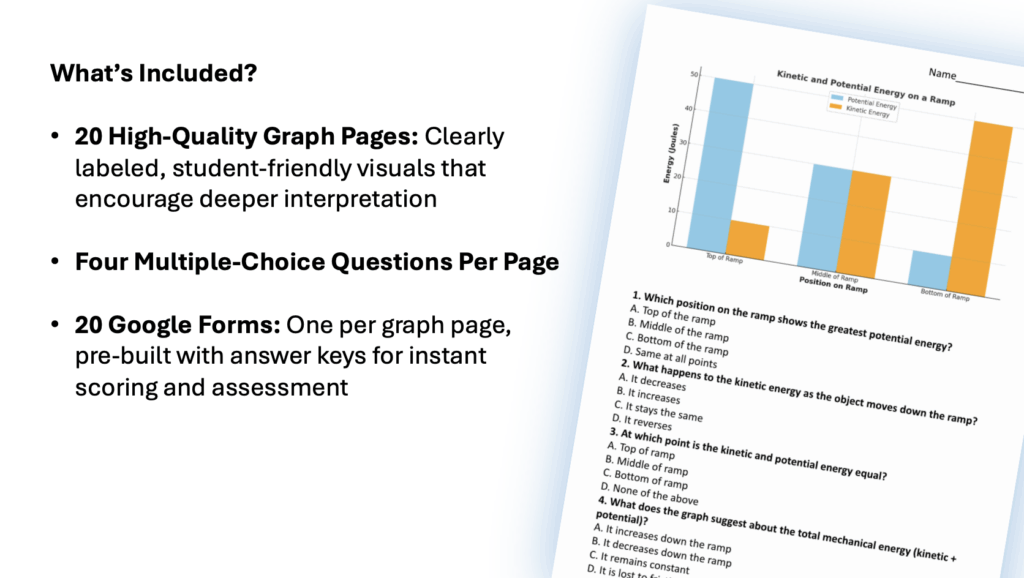
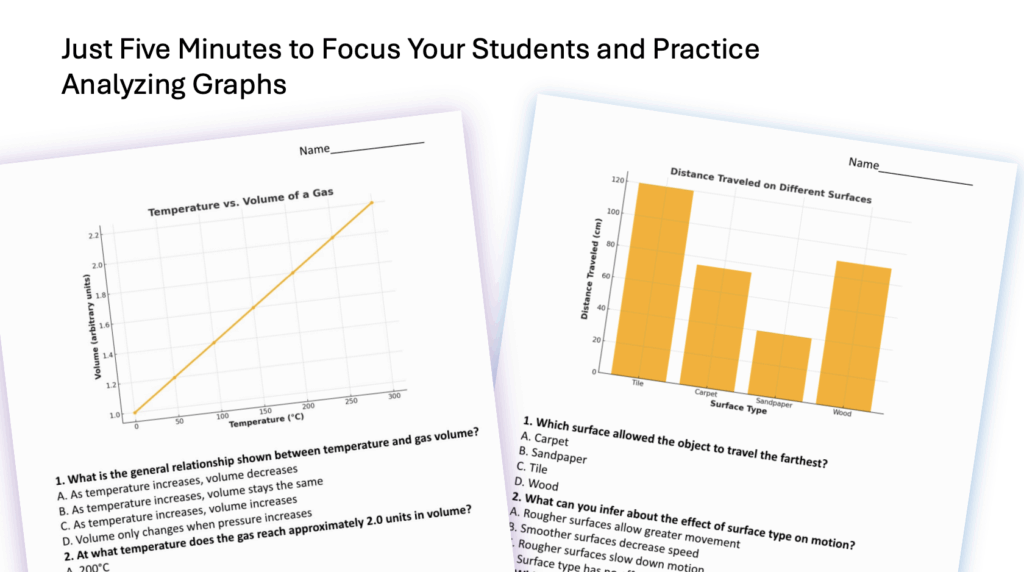
Are you looking for some daily graphs for science? Engage your middle school science students with 20 quick, data-driven bell ringers designed to build graph literacy and reinforce physical science concepts in just five minutes a day. Each page features a clear science graph accompanied by four multiple-choice questions that challenge students to interpret data, draw conclusions, and apply scientific reasoning. Included as a printable PDF and paired with 20 Google Form links, this resource frees you from the task of grading while providing instant feedback and progress monitoring. Perfect for bell work, warm-ups, early finishers, or remote assignments, these daily graphs require minimal prep and keep students thinking like scientists. Students will use the SEP Science and Engineering Practice of Analyzing and Interpreting Data.
What’s Included
- Printable PDF with 20 full-page graph analysis worksheets (8.5″×11″)
- 20 Google Form links (one per bell ringer) for self-grading, automatic scoring, and easy data tracking
- Four multiple-choice questions per graph, including at least one higher-order thinking question
- Diverse graph types covering key physical science topics (energy transfer, forces, motion, states of matter, chemical reactions, and more)
- Answer key for offline use or paper implementation
Why Teachers Love It
- 5-Minute Daily Graph Practice: Integrate seamlessly into your bell-ringer routine without sacrificing instructional time
- Zero Prep: Simply print and go—or share links for digital delivery
- Self-Grading: Google Forms provides instant feedback, freeing you from manual grading
- Data-Driven Insights: Monitor class and individual performance to inform reteaching and enrichment
- Flexible Use: Ideal for in-class warm-ups, remote learning, sub plans, or early finishers
- Standards-Aligned: Reinforces NGSS data analysis and core physical science concepts.
Graph Topics and Standards
•Mass Before and After a Chemical Reaction MS-PS1-1: Conservation of Mass
•Solubility vs. Temperature — MS-PS1-3: Chemical Properties of Matter
•Temperature Plateau During a Phase Change — MS-PS1-4: Energy Changes in Phase Transitions
•Force vs. Spring Stretch (Elastic Potential Energy) — MS-PS2-1: Forces and Motion
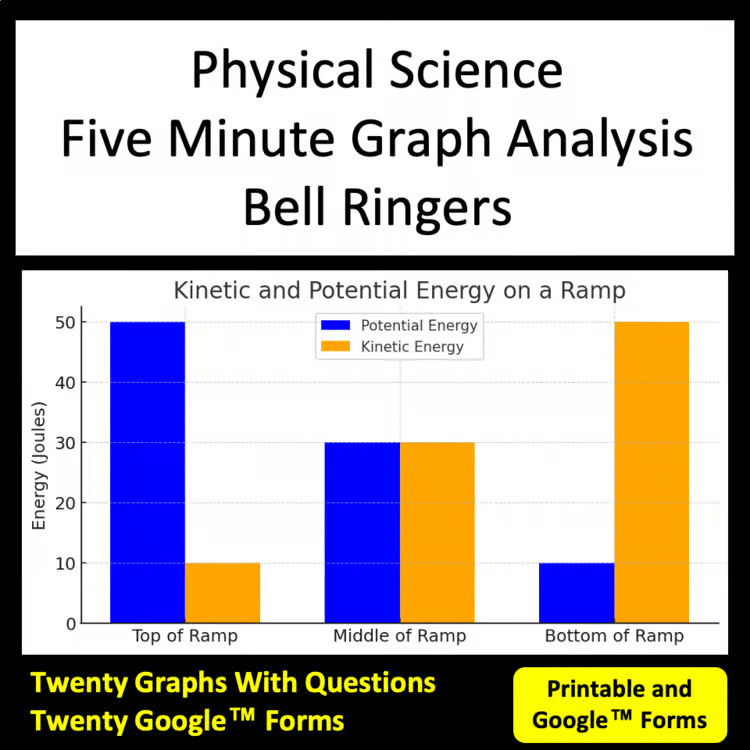
•Kinetic & Potential Energy on an Inclined Plane — MS-PS3-1: Energy Transfer
•Machine Efficiency (Energy Input vs. Useful Output) — MS-PS3-3: Energy Conversion Efficiency
•Effect of Surface Type on Motion (Friction) — MS-PS2-1: Forces and Motion
•Wavelength vs. Frequency of Sound Waves — MS-PS4-1: Wave Properties
•Signal Clarity: Analog vs. Digital — MS-PS4-3: Information Technologies
•Cooling Curve of a Pure Substance — MS-PS1-4: Energy Changes in Phase Transitions
•Voltage vs. Current (Ohm’s Law) — MS-PS2-3: Electromagnetic Forces
•Sound Intensity vs. Distance — MS-PS4-1: Wave Properties
•Mass vs. Acceleration Under a Constant Force — MS-PS2-1: Forces and Motion
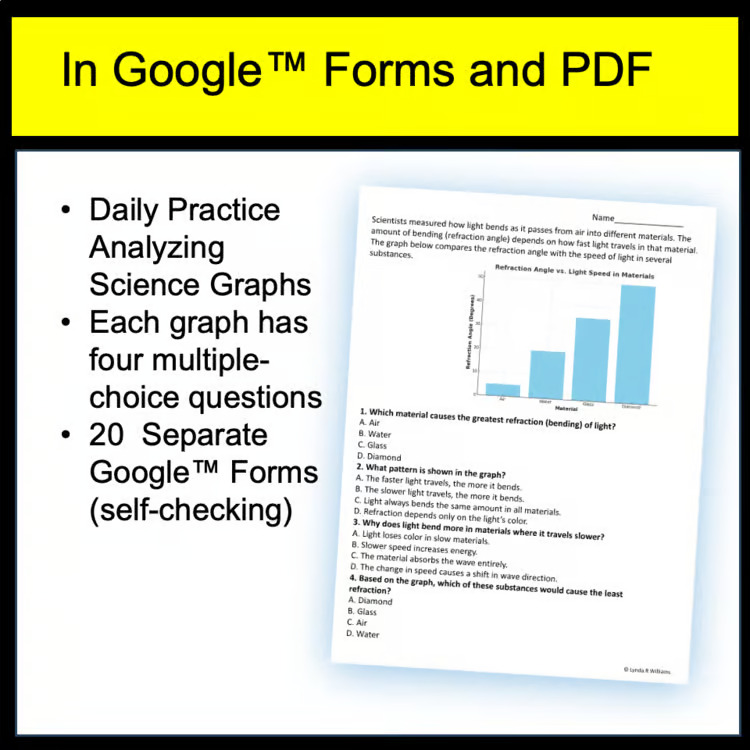
•Refraction Angle vs. Speed of Light in Materials — MS-PS4-2: Waves and Information
•Gas Volume vs. Temperature (Illustration of Gas Behavior) — HS-PS1-4*: Introduction to Gas Laws
•Electrical Conductivity of Various Materials — MS-PS4-1: Wave Properties (Charge Transport)
•Battery Types and Output Voltage — MS-PS3-2: Energy Conversion in Batteries
•Freezing Curve of Water — MS-PS1-4: Energy Changes in Phase Transitions
•Enzyme Reaction Rate vs. Temperature — MS-LS1-6*: Enzyme Function in Biological Systems
•Magnetic Attraction of Different Materials — MS-PS2-3: Electromagnetic Forces
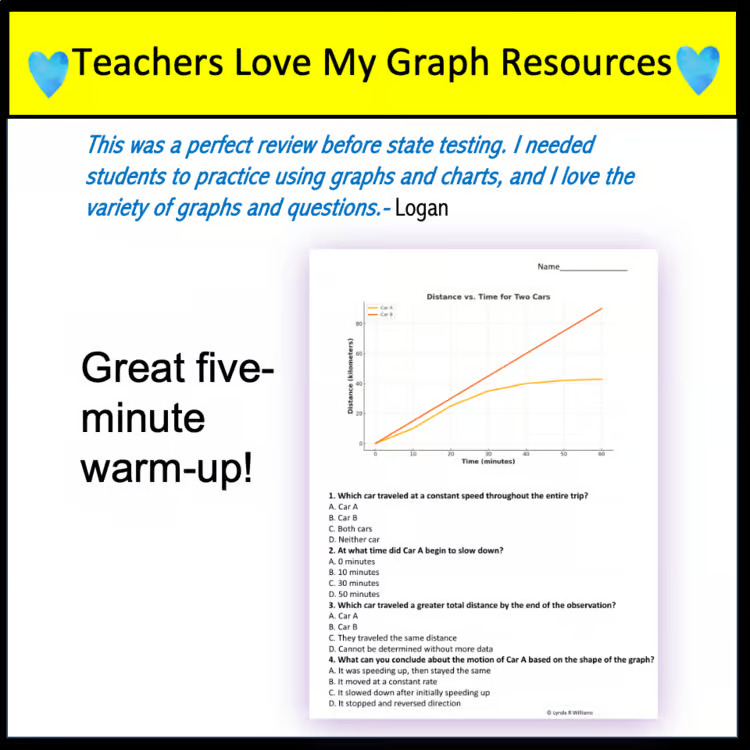
•Distance vs. Time for Two Cars (Constant vs. Changing) — MS-PS2-1: Forces and Motion
Get your Daily Graph Bell Ringers Today!
Check out my blog post on helping students master CER with graph based practice!