Helping 5th grade students learn to read, interpret, and analyze science graphs is an important part of building scientific thinking.
At this age, students are moving beyond simply finding a number on a graph. They need to compare data, recognize patterns, describe changes, draw conclusions, and use data as evidence to support scientific ideas.
For many students, graph analysis can feel challenging because they are using several skills at the same time. They must understand the graph, interpret the data, and connect what they see to the science concept they are learning.
The good news is that students do not need long graphing lessons every day. Short, consistent practice with 5th grade science graphs, bell ringers, CER activities, labs, and data-analysis tasks can help students become much more confident working with scientific data.
I create science graph and data-analysis resources specifically for 5th grade science teachers, including daily graph warm-ups, CER practice, NGSS-aligned activities, science test prep, and state-specific graph resources.
On This Page
- What graph analysis means in 5th grade science
- Why 5th graders struggle with science graphs
- Graph-analysis skills students need
- Types of graphs appropriate for 5th grade
- How to teach students to analyze a science graph
- Using graph data as evidence
- Graph analysis and CER
- Daily graph bell ringers
- Science test prep
- NGSS and graph analysis
- 5th grade science topics that work well with graphs
- 5th grade graph-analysis resources
- Frequently asked questions
What Is Graph Analysis in 5th Grade Science?
Graph analysis means using information displayed in a graph to answer questions, compare data, identify patterns, and draw conclusions.
In 5th grade science, students may analyze graphs related to:
- Plant growth
- Ecosystems
- Food webs
- Earth’s water
- Weather and climate
- Shadows and daylight
- Properties of matter
- Changes in matter
- Conservation of mass
- Energy
- Forces and motion
- Earth systems
- Human impact
A student who can read a graph may be able to answer:
Which plant grew the tallest?
A student who can analyze a graph should also be able to answer:
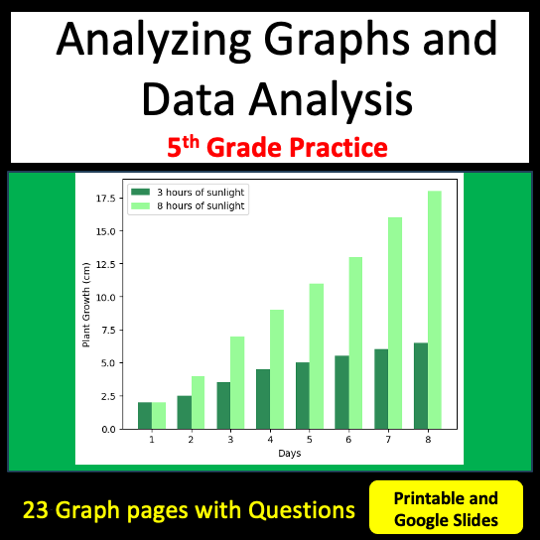
What pattern does the graph show about the amount of sunlight and plant growth?
That is an important shift.
Students are no longer simply locating information. They are beginning to use data to make sense of science.
Why Do 5th Grade Students Struggle With Science Graphs?
Science graphs require students to process several pieces of information at the same time.
Students may need to understand:
- The graph title
- The x-axis
- The y-axis
- Labels
- Units
- Scale
- A legend or key
- Individual data points
- Patterns in the data
- The science concept represented by the graph
A student may understand a science concept when it is explained in words but struggle when the same idea is shown as data.
For example, a student may know that plants need resources to grow. But when shown a graph comparing plant growth under different conditions, the student must determine:
What was changed?
What was measured?
Which plants grew more?
What pattern does the data show?
What conclusion is supported by the graph?
That additional layer of thinking is why repeated practice with science-specific graphs is so valuable.
What Graph Analysis Skills Should 5th Graders Learn?
Fifth grade students should gradually become comfortable with several important data-analysis skills.
Read the Graph Title
Students should first determine what the graph is about.
The title gives students an important clue about the data they are about to analyze.
Identify the X-Axis and Y-Axis
Students should learn to ask:
What does the x-axis show?
What does the y-axis show?
This simple routine helps students slow down and understand the graph before answering questions.
Read Labels, Units, and Scales
Students need practice recognizing units such as:
- Centimeters
- Grams
- Degrees Celsius
- Minutes
- Days
- Percentages
- Liters
- Number of organisms
Students should also pay close attention to the scale.
A graph may increase by 1, 2, 5, 10, 20, or another interval.
Skipping the scale is one of the easiest ways for students to misread a graph.
Compare Data
Students should practice making comparisons between:
- Two groups
- Two locations
- Two conditions
- Different time periods
- Several categories
Instead of writing:
Plant A grew more.
students can learn to use the data:
Plant A grew to 18 cm while Plant B grew to 11 cm.
Now the student is beginning to use quantitative evidence.
Identify Patterns
Students should begin looking at the graph as a whole rather than focusing only on one data point.
Useful questions include:
- What changed?
- What stayed the same?
- What increased?
- What decreased?
- Which group had the greatest value?
- What pattern do you notice?
- How are the two sets of data different?
Looking for patterns helps students move from graph reading to graph analysis.
Draw Conclusions From Data
Eventually, students should be able to answer:
What conclusion can you make from this graph?
A scientific conclusion should be supported by the data shown.
Students should learn that a good conclusion is not simply what they think might be true. It must be supported by evidence.
What Types of Graphs Should 5th Grade Science Students Understand?
For 5th grade science, I recommend focusing primarily on bar graphs, line graphs, and pie charts, along with simple data tables.
Bar Graphs
Bar graphs are useful for comparing categories or groups.
Students might compare:
- Plant growth under different conditions
- Amounts of water in different locations
- Number of organisms in different habitats
- Properties of materials
- Results from several experimental groups
Line Graphs
Line graphs are especially useful for showing change over time.
Students might analyze:
- Plant growth over several weeks
- Temperature changes throughout a day
- Shadow length over time
- Weather patterns
- Changes during an investigation
Pie Charts
Pie charts help students understand parts of a whole.
They work especially well with science topics such as:
- Distribution of Earth’s water
- Land and water
- Types of resources
- Composition of a total amount
Students can use pie charts to compare percentages and determine which portions are larger or smaller.
Data Tables
Students should also be comfortable reading simple scientific data tables.
Tables can be used for:
- Lab measurements
- Plant growth data
- Weather observations
- Mass measurements
- Experimental results
Students may also use a data table as the starting point for creating a graph.
| Graph or Data Display | Best Used For | Science Examples | Skills Students Practice |
|---|---|---|---|
| Bar Graph | Comparing categories or groups | Plant growth, habitats, materials, experimental conditions | Compare values, identify highest and lowest, calculate differences |
| Line Graph | Showing change over time | Temperature, shadow length, plant growth, weather observations | Identify trends, describe increases and decreases, interpret change over time |
| Pie Chart | Showing parts of a whole | Earth’s water, land use, natural resources | Compare percentages and understand part-to-whole relationships |
| Data Table | Organizing measurements and observations | Lab data, weather measurements, mass, plant growth | Locate data, compare values, recognize patterns, prepare data for graphing |
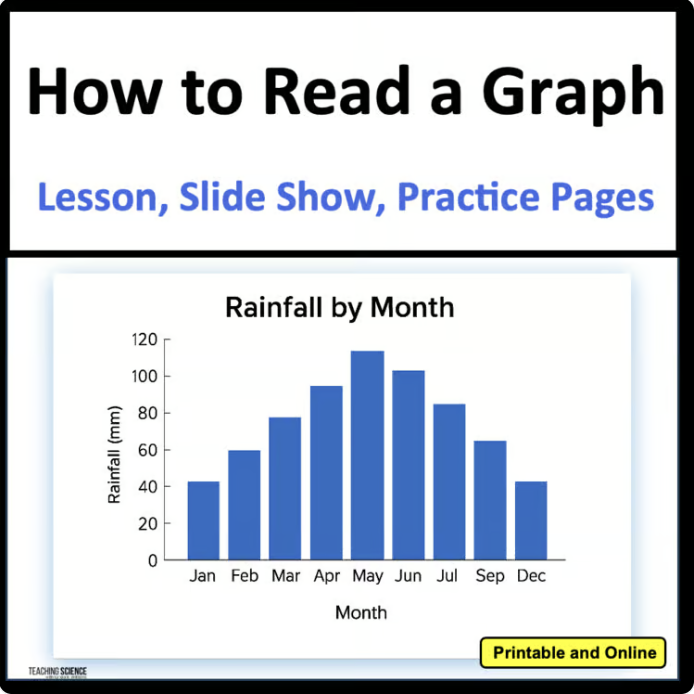
Read more about teaching students How to Read a Graph
How Do You Teach a 5th Grader to Analyze a Science Graph?
I recommend giving students a simple routine they can use every time they see a graph.
Step 1: Read the Title
Ask:
What is this graph about?
Step 2: Look at the X-Axis
Ask:
What information is shown along the bottom?
Step 3: Look at the Y-Axis
Ask:
What is being measured?
Step 4: Check the Units and Scale
Ask:
What units are being used?
How much does each interval represent?
Step 5: Look at the Data
Before answering questions, have students look at the graph as a whole.
Ask:
What do you notice?
Step 6: Compare the Data
Students should identify important differences or similarities.
Step 7: Look for a Pattern
Ask:
What does the data seem to show?
Step 8: Use the Data to Answer
Encourage students to refer to specific values from the graph whenever possible.
This helps students begin thinking about evidence.
Teach Students to Use Graph Data as Evidence
One of the most important transitions in 5th grade is helping students move from making observations to supporting ideas with evidence.
Instead of saying:
The plant with more sunlight grew better.
students can write:
The plant receiving 8 hours of sunlight grew 6 cm taller than the plant receiving 2 hours of sunlight.
Now the student is using specific data.
You can help students develop this habit by asking:
What number from the graph supports your answer?
What comparison provides evidence?
Which data point supports your conclusion?
This builds skills students will continue using in middle school science.
Using Graphs With CER in 5th Grade Science
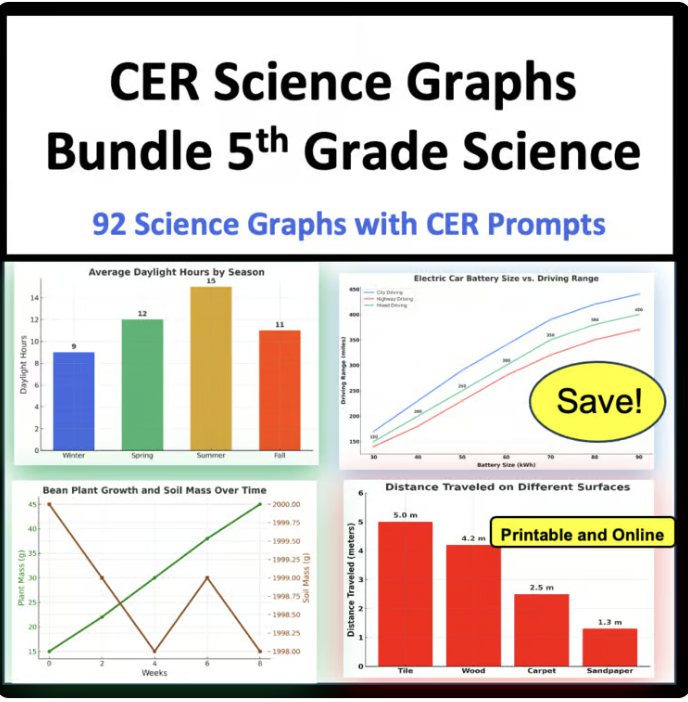
Science graphs are excellent for introducing and practicing Claim, Evidence, Reasoning, or CER.
Students can use a graph to answer a scientific question.
Claim
The student answers the question or states a conclusion.
Evidence
The student uses specific information from the graph.
Reasoning
The student explains how the evidence supports the claim using science ideas.
For example, students may analyze a graph comparing plant growth under different environmental conditions.
Their CER response might explain which condition resulted in the most growth and use specific measurements from the graph as evidence.
Graph-based CER activities are especially helpful because students do not have to invent evidence.
The evidence is right in front of them.
Explore 5th Grade Science CER Practice With Graphs and Data Analysis.
Make Graph Analysis Part of Your Daily Science Routine
Students do not need to complete a full graph-analysis lesson every day.
Short, repeated practice can make a big difference.
One easy way to provide this practice is with 5-minute science graph bell ringers.
Students analyze one graph and answer a few questions.
Over time, they practice:
- Reading axes
- Understanding scales
- Using units
- Comparing data
- Identifying patterns
- Drawing conclusions
- Using evidence
Because the graphs use science topics, students practice science content and data analysis at the same time.
Explore 5th Grade Science Graph Bell Ringers and Daily Warm-Ups.
Bell Ringers or Graph Analysis and CER Activities: Which Should I Use?
Teachers sometimes ask which type of graph resource is best.
Graph Bell Ringers are designed for short, ongoing practice. Students analyze one graph at a time and complete a few questions in approximately five minutes.
They work well for:
- Morning work
- Beginning-of-class routines
- Daily review
- Spiral practice
- Quick formative assessment
Graph Analysis and CER resources provide more focused practice with interpreting scientific data, explaining conclusions, and using evidence.
They work well for:
- Small-group instruction
- Science stations
- CER practice
- Review
- Test prep
- More in-depth data analysis
Use bell ringers for consistent daily practice and graph-analysis/CER resources when you want students to go deeper with the data.
Another Fun Way to Practice Graph Analysis: Crack the Code
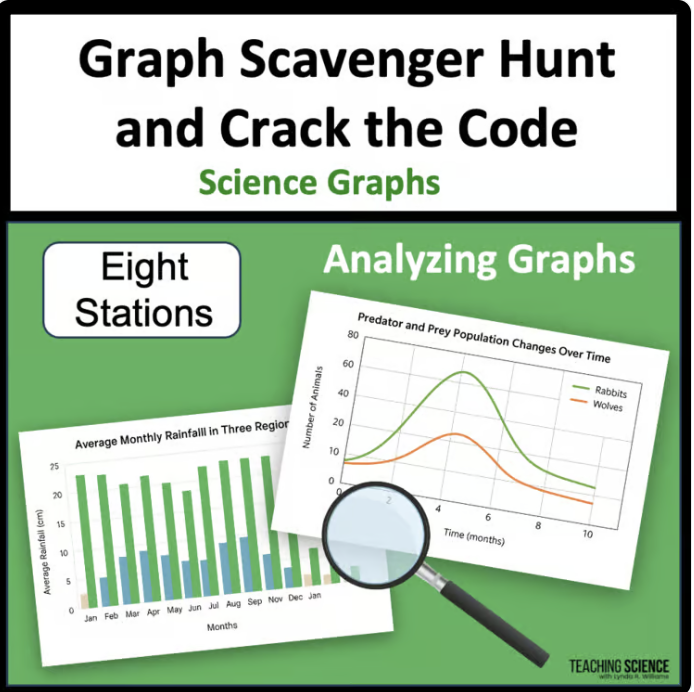
If you want students to practice graph analysis in a more interactive format, my Crack the Code science activities are another option.
Students rotate through science stations, analyze graphs or science information, answer questions, and receive code tokens after their answers are checked.
At the end of the activity, students use a Polybius square to decode a mystery word.
Crack the Code activities work especially well for:
- Science stations
- Small groups
- Review days
- Test prep
- Seasonal science activities
- Early finishers
- Standards-based practice
They give students another way to practice important science skills without every activity feeling like a traditional worksheet.
Explore 5th Grade Crack the Code Science Activities.
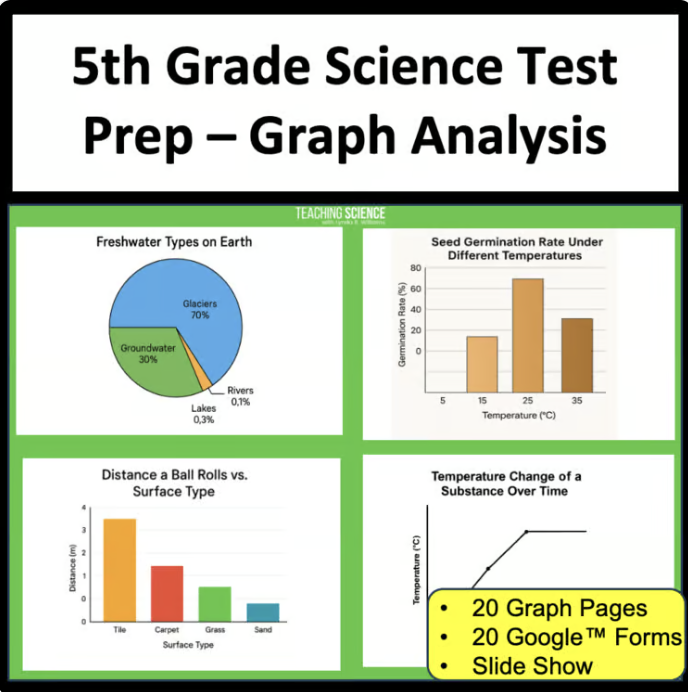
Graph Analysis and 5th Grade Science Test Prep
Science assessments often include graphs, tables, diagrams, and other data displays.
Students may be asked to:
- Read an unfamiliar graph
- Compare data
- Identify a pattern
- Determine which statement is supported by evidence
- Draw a conclusion
- Interpret results from an investigation
Graph analysis should not be something students encounter only during test-prep season.
Short graph practice throughout the year can help students become familiar with the process.
When students regularly work with science data, graph questions begin to feel like a normal part of science rather than a special test-taking skill.
Graph Analysis and the NGSS
Data analysis is an important part of the Next Generation Science Standards.
One of the NGSS Science and Engineering Practices is Analyzing and Interpreting Data.
In 5th grade science, students use observations, measurements, graphs, tables, and other evidence to make sense of scientific ideas.
Several 5th grade NGSS standards naturally lend themselves to graph and data analysis.
5-ESS1-2: Patterns in Shadows, Daylight, and the Sky
Students can analyze data showing patterns in:
- Shadow length
- Daylight hours
- Seasonal changes
- Observations of the Sun and stars
5-ESS2-2: Distribution of Earth’s Water
This standard specifically asks students to use graphical displays to describe the amounts and percentages of water found in different places on Earth.
Students may analyze data related to:
- Oceans
- Lakes
- Rivers
- Groundwater
- Glaciers
- Freshwater and saltwater
5-PS1-2: Conservation of Matter
Students can analyze mass measurements before and after physical or chemical changes to determine whether matter is conserved.
Graphs and data tables can help students compare measurements and look for patterns.
Life Science
Graphs can also be used to explore:
- Plant growth
- Plant needs
- Food webs
- Energy flow
- Ecosystems
- Matter moving through living systems
Using graphs within science content allows students to practice both science concepts and Science and Engineering Practices.
5th Grade Science Topics That Work Well With Graphs
Many 5th grade science concepts naturally lend themselves to graph and data analysis.
Earth and Space Science
- Earth’s water distribution
- Weather
- Climate
- Shadows
- Daylight patterns
- Earth systems
- Erosion
- Human impact
Life Science
- Plant growth
- Plant needs
- Ecosystems
- Food webs
- Energy flow
- Organism populations
- Environmental conditions
Physical Science
- Properties of matter
- Mass
- Conservation of matter
- Heating and cooling
- Force
- Motion
- Energy
Using graphs within these topics gives students a meaningful reason to interpret the data.
5th Grade Science Graph & Data Analysis Resources
I have created a growing collection of graph-analysis resources specifically for 5th grade science teachers.
5th Grade Science Graph Bell Ringers
Short graph warm-ups designed to give students consistent practice reading and analyzing scientific data.
Explore 5th Grade Science Graph Bell Ringers.
5th Grade Science CER Practice With Graphs
Students analyze science graphs, make claims, cite evidence, and explain their reasoning.
Explore 5th Grade Science CER Practice With Graphs and Data Analysis.
5th Grade Science Graph Analysis and Test Prep
Focused practice with the kinds of graphs and data questions students may encounter on science assessments.
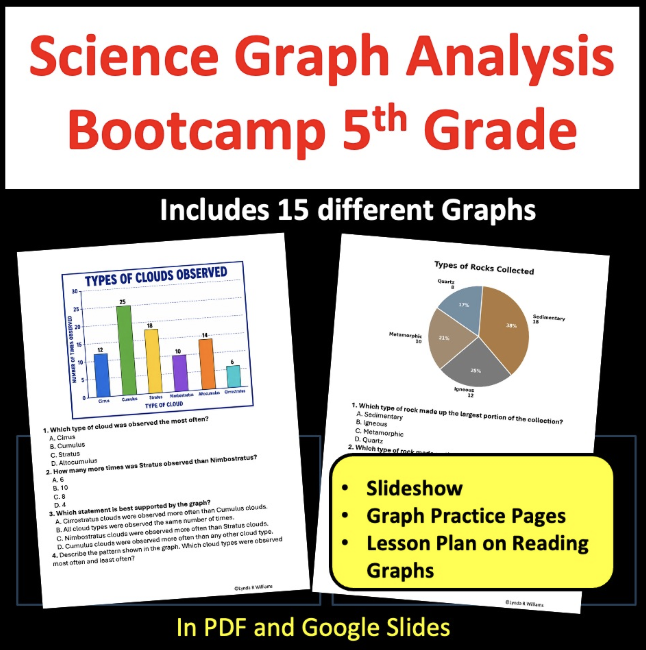
Explore 5th Grade Science Graph Analysis and Test Prep.
5th Grade NGSS Graph Resources
Graph-analysis practice connected to important 5th grade NGSS concepts and performance expectations.
Explore 5th Grade NGSS Science Resources.
State-Specific 5th Grade Science Graph Resources
I also create graph bell ringers and data-analysis resources aligned to individual state science standards.
These resources help teachers provide graph practice while reviewing science concepts students are expected to learn in their own state.
Explore State-Specific Science Resources.
Frequently Asked Questions About 5th Grade Science Graph Analysis
What graph skills should a 5th grader know?
Fifth graders should be able to read graph titles, axes, labels, units, and scales; compare data; identify patterns; and draw simple conclusions from scientific data.
What types of graphs should 5th graders understand?
In 5th grade science, students should primarily be comfortable interpreting bar graphs, line graphs, pie charts, and simple data tables.
How can I help my 5th graders get better at analyzing graphs?
Provide short, repeated graph-analysis practice throughout the year. Have students identify the title, axes, units, scale, and overall pattern before answering questions.
How often should students practice science graphs?
Even a few minutes of graph practice several times a week can provide meaningful repeated exposure. Bell ringers are an easy way to incorporate graph analysis without taking away from the main science lesson.
What is the difference between reading a graph and analyzing a graph?
Reading a graph means locating information.
Analyzing a graph means comparing data, identifying patterns, interpreting relationships, and drawing conclusions from the evidence.
How can I teach students to use graph data as evidence?
Ask students to support their answers with a number, measurement, comparison, or pattern from the graph.
Prompts such as “What data support your answer?” help students learn to cite evidence.
Can 5th graders use graphs with CER?
Yes. Graphs provide students with clear evidence they can use in Claim, Evidence, Reasoning responses. Students make a claim, cite specific graph data, and explain why the data support their conclusion.
Are graph-analysis activities useful for 5th grade science test prep?
Yes. Science assessments frequently include graphs, tables, models, and other data displays. Students who regularly work with these formats throughout the year are better prepared to interpret unfamiliar data during testing.
Should 5th graders create graphs as well as analyze them?
Yes. Both skills are useful.
Creating graphs helps students understand axes, scales, variables, labels, and how data are organized. Analyzing graphs gives students practice recognizing patterns, comparing evidence, and drawing scientific conclusions.
Help 5th Graders Become Confident With Science Data
Graph analysis is about much more than finding the right number.
Students use scientific data to identify patterns, compare evidence, answer questions, and develop explanations.
When students consistently practice these skills, they begin to approach graphs with a different question:
What does this data tell me about the science?
That is the kind of thinking we want students to develop.
By making graph analysis a regular part of 5th grade science instruction, teachers can help students become more confident with both science content and scientific evidence.
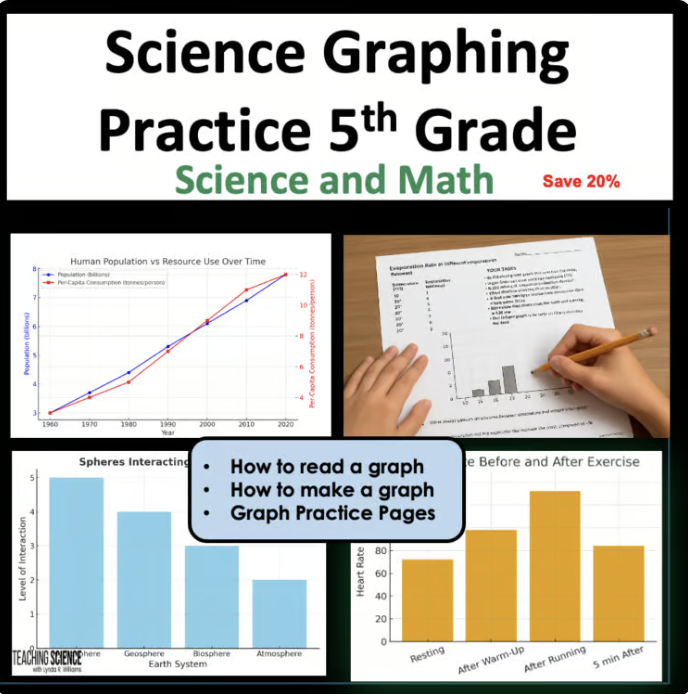
Explore 5th Grade Science Graph & Data Analysis Resources.
Teaching Middle School Science?
If you also teach grades 6–8, visit my Middle School Science Graph & Data Analysis guide for strategies, graph-analysis skills, CER ideas, bell ringers, and middle school science resources.
About Lynda R. Williams
Lynda R. Williams is a science educator, curriculum designer, and creator of Teaching Science with Lynda R. Williams. With more than 20 years of classroom experience, she specializes in practical, standards-aligned science resources for upper elementary and middle school teachers.
Her resources focus on helping students make sense of science through graph and data analysis, CER writing, phenomena-based instruction, 5E lessons, and hands-on STEM activities.
Lynda has also taught Science Methods at the university level and brings both classroom experience and curriculum expertise to the resources she creates.
Her goal is to help teachers save planning time while giving students meaningful opportunities to analyze evidence, think scientifically, and build confidence with challenging science concepts.