You know those back-to-school professional development days?
You are sitting in a meeting thinking about the bulletin boards that still need to be finished, the lab supplies that need to be organized, and the classroom that is nowhere near ready.
Then someone says:
“Everyone stand up! We are going to walk around the room and write our ideas on chart paper!”
So you grab a marker, move from poster to poster, and try to look enthusiastic while thinking:
I really just want to get back to my classroom.
Here is the thing.
Your students probably feel the same way about traditional back-to-school icebreakers.
They may not want to describe themselves as a sandwich, announce their favorite color, or share a random fun fact with a room full of people they just met.
Instead of giving students another meaningless icebreaker, begin the year with a science team-building activity that gets students moving, talking, problem-solving, and thinking like scientists.
What Is a Good First-Day Science Activity?
A good first-day science activity should help students feel comfortable while also introducing the skills and expectations they will use throughout the year.
The best first-day science activities include:
- Collaboration
- Communication
- Critical thinking
- Problem-solving
- Scientific reasoning
- Opportunities for students to explain their ideas
Students should leave the activity knowing a little more about their classmates and a little more about how science works.
That is exactly what my Science Team-Building Activity is designed to do.
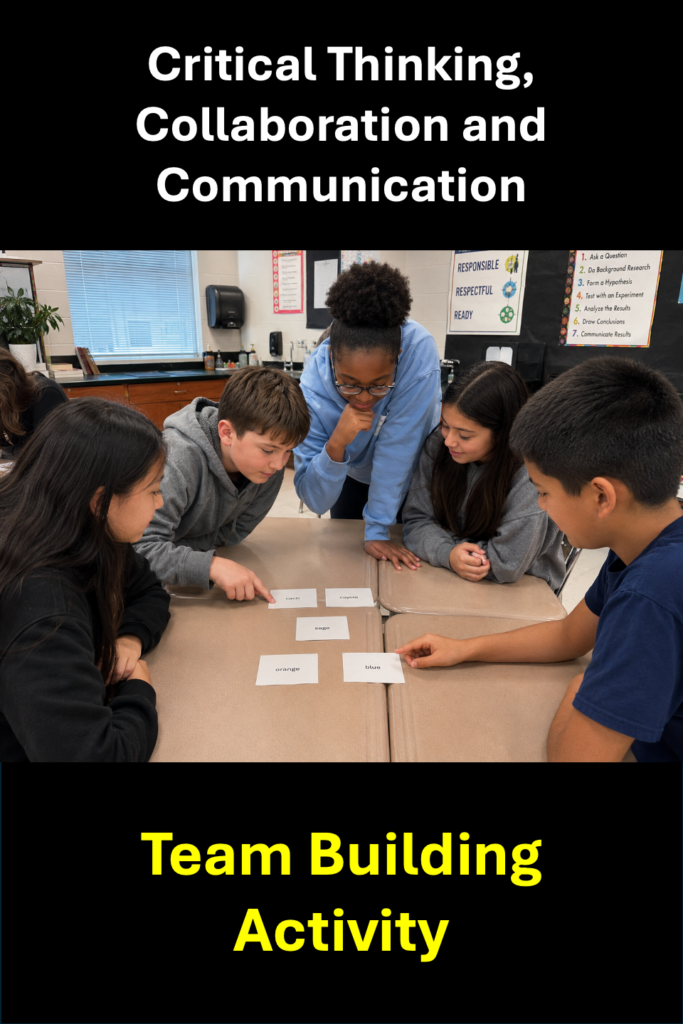
A Science Team-Building Activity With a Purpose
In this activity, each student receives a card with a word on it.
Students move around the classroom, talk to their classmates, and try to form groups of four related words.
There is just one catch.
You do not tell students what the categories are.
They must figure out how their cards might connect by asking questions, sharing information, and considering different possibilities.
For example:
- Is “orange” a fruit or a color?
- Is “marble” a rock or a round object?
- Does “sand” belong with colors or with the desert?
Some words could reasonably fit into more than one category.
This creates productive uncertainty and gives students something meaningful to discuss.
They cannot simply glance at their card and immediately know where to go. They must communicate with other students and gather more information before making a decision.
Why This Activity Feels Like Real Science
Science is not always about finding one immediate, obvious answer.
Scientists ask questions, collect information, compare ideas, develop explanations, and revise their thinking when new evidence becomes available.
Students use those same skills during this activity.
They may begin with one idea about where their card belongs. After speaking with their classmates, they may discover new information that changes their thinking.
Students learn that:
- There can be more than one reasonable explanation.
- New information can change an initial idea.
- Everyone may hold an important piece of information.
- Communication is necessary for solving complex problems.
- Models and explanations can be revised.
- Disagreement does not always mean someone is wrong.
That sounds a lot like science!
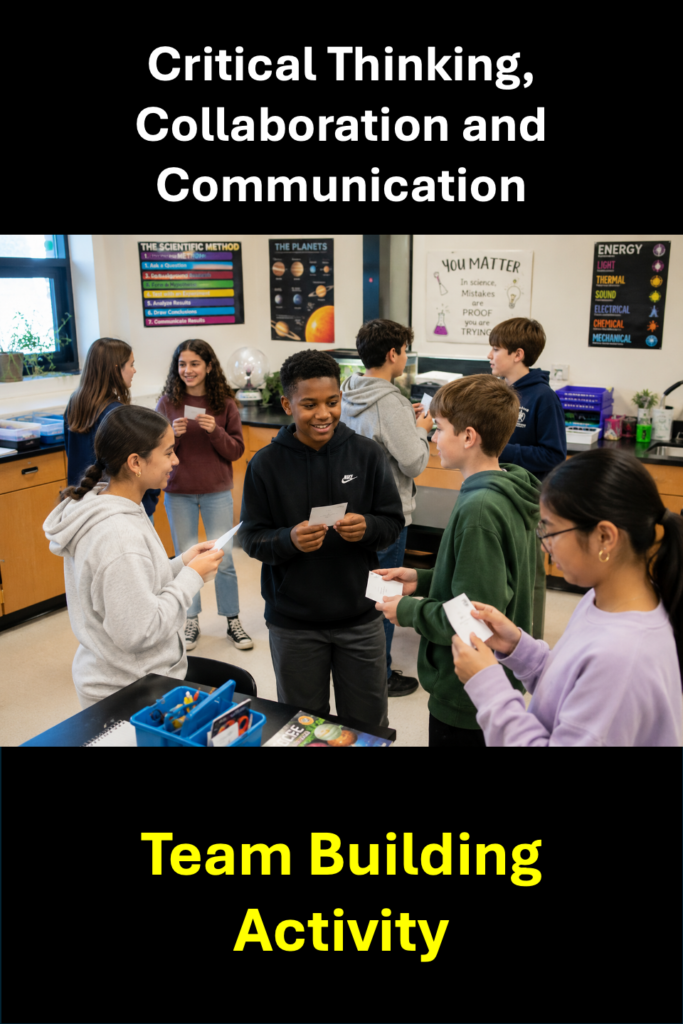
More Than a Middle School Science Icebreaker
This activity is fun and social, but it is not just an icebreaker.
It introduces foundational science and engineering practices that students will use throughout the school year.
Students Ask Questions
Students must ask one another about their cards and possible categories.
They cannot solve the task without gathering information.
Students Develop and Use Models
Each group of students creates a possible model for organizing the cards.
When a word does not fit, students may need to revise the model.
Students Analyze Information
Students compare words, identify relationships, and look for patterns.
They must decide which details are important and which connections make the most sense.
Students Construct Explanations
Students need to explain why their four cards belong together.
It is not enough to simply stand in a group. They must be able to defend their reasoning.
Students Communicate Ideas
The activity depends on discussion.
Students practice sharing ideas, listening to others, asking for clarification, and respectfully considering different explanations.
A Simple Way to Observe Your New Students
Teachers spend the first few weeks of school learning how students interact, communicate, and approach challenges.
This science team-building activity gives you valuable information from the very first day.
As students work, you can observe:
- Who naturally takes the lead
- Who listens carefully
- Who asks thoughtful questions
- Who encourages others to participate
- Who changes their mind when presented with new information
- Who is comfortable with uncertainty
- Who may need additional support joining a group
Because students are focused on solving the challenge, their interactions often feel more natural than they would during a formal introduction activity.
You begin learning about your students while they begin learning about one another.
Why Meaningful Team Building Matters in Science
Science classrooms depend on collaboration.
Students may work with partners during investigations, participate in laboratory groups, analyze data together, build models, discuss scientific explanations, and engage in engineering challenges.
Those experiences are more successful when students understand how to:
- Listen to one another
- Share materials and information
- Explain their thinking
- Ask productive questions
- Disagree respectfully
- Revise an idea
- Include everyone in the group
A meaningful first-day science activity helps establish these expectations before students begin their first lab or investigation.
It shows students that teamwork in science is not simply dividing up the work. It is using everyone’s ideas and information to build a stronger explanation.
How to Use This Activity on the First Week of School
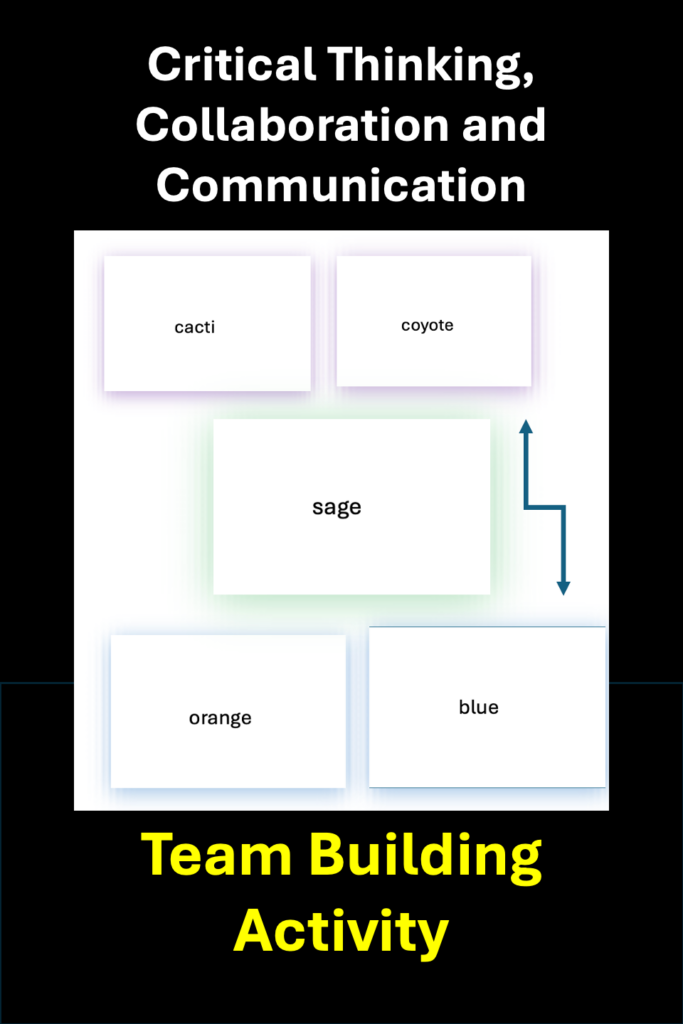
This activity requires very little preparation.
Before class:
- Print and prepare the word cards.
- Decide whether students will complete one round or several rounds.
- Review the possible categories and discussion questions.
- Leave enough open space for students to move around the room.
During the activity:
- Give each student one card.
- Explain that they must form a group of four related words.
- Do not reveal the categories.
- Encourage students to speak with multiple classmates.
- Ask each completed group to explain its reasoning.
- Discuss words that could fit into more than one category.
After the activity, bring the class together for a short reflection.
Ask students:
- What strategies helped you find your group?
- Did you change your mind at any point?
- What information helped you make your final decision?
- Were there multiple reasonable ways to group some words?
- How was this activity similar to the way scientists work?
These questions help students connect the team-building challenge to scientific thinking.
What Students Learn From This Back-to-School Science Activity
By the end of the activity, students have practiced much more than learning names.
They have practiced:
- Identifying patterns
- Classifying information
- Asking questions
- Considering multiple explanations
- Communicating clearly
- Listening to others
- Supporting an idea with reasoning
- Revising a model
- Working through uncertainty
These skills support future learning in laboratory investigations, CER writing, graph analysis, scientific modeling, and engineering design.
That makes this activity an effective bridge between building classroom community and beginning meaningful science instruction.
Use It With Upper Elementary or Middle School Science
This activity works especially well in upper elementary and middle school science classrooms.
It can be used during:
- The first day of school
- The first week of science
- A back-to-school orientation
- A classroom community lesson
- A science club meeting
- A new semester
- A schedule change
- A review of scientific practices
It can also be used later in the year when students need a reminder about collaboration, communication, or revising ideas.
Skip the Awkward Icebreaker
Students do not need another activity that asks them to perform, overshare, or announce an interesting fact on command.
They need an authentic reason to interact.
A good science team-building activity gives students something to talk about besides themselves. That can reduce some of the pressure students feel during the first days of school.
The conversation happens naturally because students are working toward a shared goal.
At the same time, you are establishing an important message about your classroom:
Science is active, collaborative, thoughtful, and open to new ideas.
That is a much more meaningful way to begin the year.
Get the Science Team-Building Activity
My Team-Building Activities for the First Day of School resource gives you a ready-to-use activity that builds classroom community while introducing important science skills.
Students move, communicate, classify, problem-solve, and explain their reasoning.
You can find the activity here:
Prepare Your First Month of Middle School Science
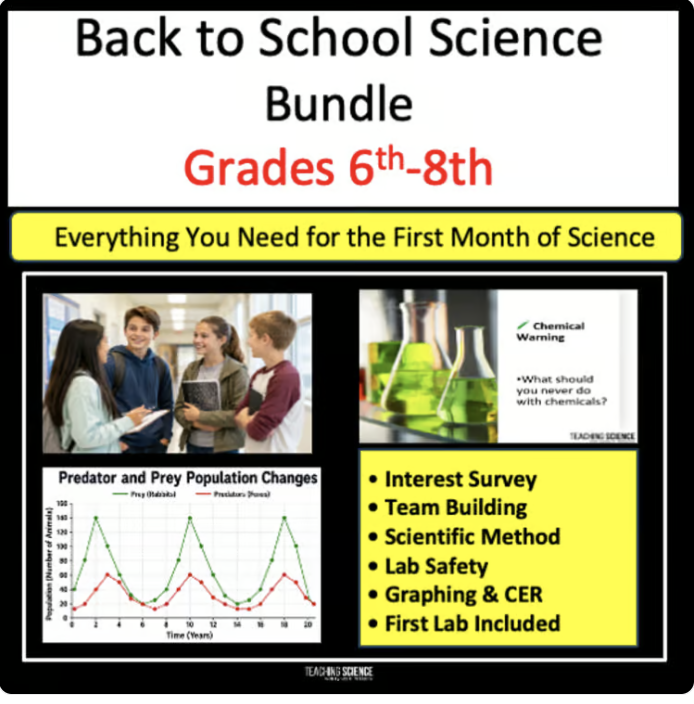
The team-building activity is also included in my Back-to-School Middle School Science Bundle.
The bundle includes meaningful, skill-based resources to help you launch your science classroom and establish strong foundations during the first month of school.
Activities address science classroom community, lab safety, the nature of science, scientific method and variables, graph analysis, CER writing, phenomena, and other essential beginning-of-year skills.
You can find the complete bundle here:
Instead of spending your final days of summer creating activities, you can begin the year with meaningful science lessons ready to use.
Frequently Asked Questions
What is a good first-day activity for middle school science?
A good first-day middle school science activity should encourage students to communicate, collaborate, solve problems, and explain their thinking. A science team-building classification activity introduces these skills while helping students become more comfortable with their classmates.
What can I do instead of a traditional classroom icebreaker?
Give students a shared challenge that provides a natural reason to talk. In a science team-building activity, students can classify words, identify patterns, gather information, and defend their reasoning instead of answering personal icebreaker questions.
How does team building support science learning?
Science students regularly work in laboratory groups, analyze evidence, build models, discuss explanations, and complete engineering challenges. Team-building activities help students practice the communication and collaboration skills needed for those experiences.
Can a first-day activity teach science skills?
Yes. A well-designed first-day science activity can introduce classification, pattern recognition, questioning, modeling, communication, collaboration, and evidence-based reasoning.
Is this activity only for the first day of school?
No. It can also be used during the first week, at the beginning of a new semester, after schedule changes, with science clubs, or whenever students need practice working collaboratively.
Start With Team Building That Matters
Your students may feel exactly the way you do during one of those back-to-school professional development activities involving chart paper and forced participation.
They want to know that the activity has a purpose.
Give them a reason to move, talk, think, and work together.
Skip the meaningless icebreaker and begin the year with a science team-building activity that helps students build relationships while practicing the skills they will use all year.
Need a Back to School Science Skills Bundle?
About Lynda R. Williams
Lynda R. Williams is an experienced science educator and curriculum designer with more than 20 years of experience teaching upper elementary and middle school science. She has also taught science methods courses at the university level, helping prepare future teachers to create engaging, inquiry-based science instruction.
Lynda specializes in NGSS-aligned curriculum, state science standards, graph and data analysis, CER writing, test preparation, phenomena-based learning, and hands-on STEM activities. Through her Teachers Pay Teachers store, Teaching Science with Lynda R. Williams, she creates practical, classroom-tested resources that help teachers save time while providing rigorous and engaging science instruction.
She holds a master’s degree in Curriculum and Instruction from California State University, Fullerton. Her goal is to make science easier to teach, more meaningful for students, and more manageable for busy teachers.