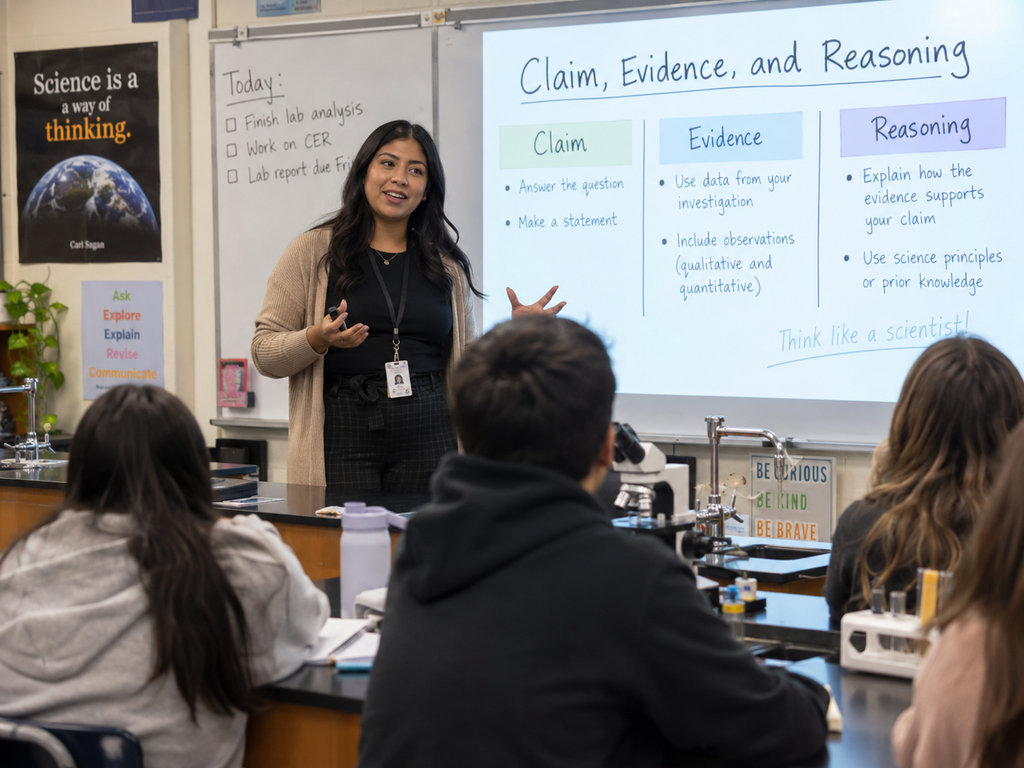
Learning how to teach CER in science can make a big difference in how well students explain their scientific thinking. CER stands for Claim, Evidence, and Reasoning, a framework that helps students answer science questions, support their conclusions with evidence, and explain why that evidence supports their claim.
Students may understand a science concept but still struggle to put their thinking into words. Teaching CER gives them a clear structure for organizing scientific explanations and can be used with labs, graph analysis, data interpretation, phenomena, bell ringers, and assessments.
What Is CER in Science?
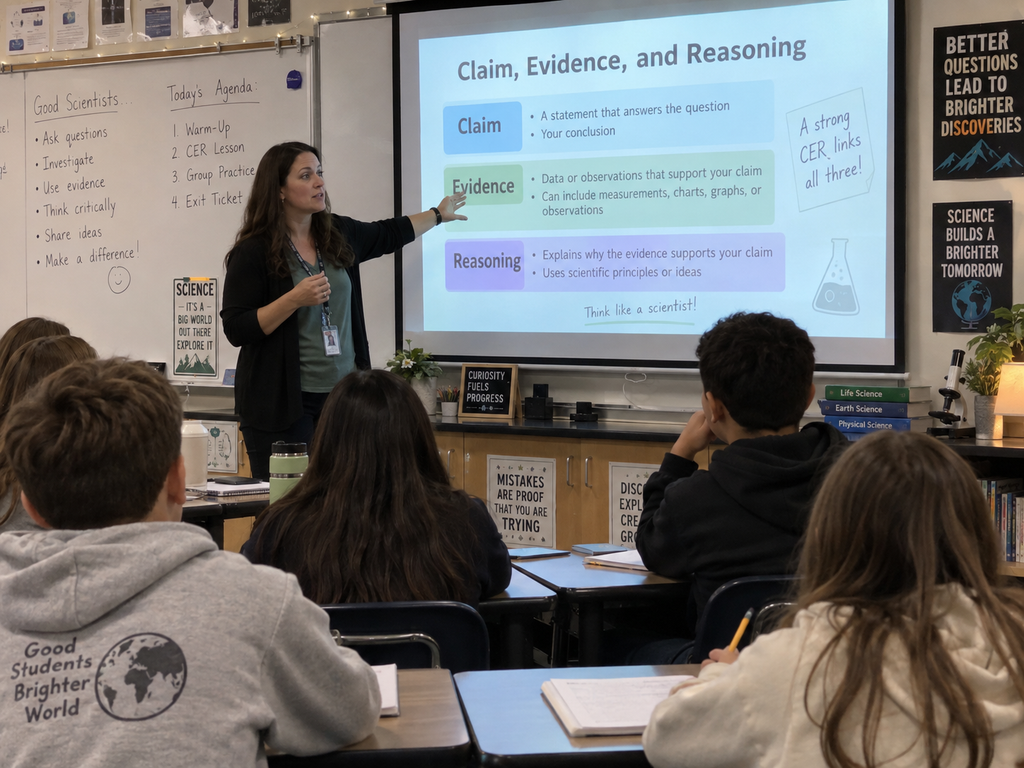
CER stands for Claim, Evidence, and Reasoning.
A CER response is a structured scientific explanation that includes:
| CER Component | What It Means | Question Students Should Ask |
|---|---|---|
| Claim | A statement that answers the scientific question | What is my answer? |
| Evidence | Scientific data, observations, or information that supports the claim | What information supports my answer? |
| Reasoning | An explanation of why the evidence supports the claim using scientific ideas | Why does this evidence prove or support my claim? |
How to Teach CER in Science Step by Step
Students are often more successful with CER when each part is introduced separately before they are expected to write a complete response.
Step 1: Start With the Claim
A claim is a statement that directly answers the question being investigated.
Students sometimes make their claim much more complicated than it needs to be. Teach them that the claim should usually be a clear, concise answer to the question.
For example:
Question: Which plant received the best conditions for growth?
Claim: Plant A had the best conditions for growth.
The student does not need to explain why yet. That comes later in the evidence and reasoning.
Questions Students Can Ask When Writing a Claim
- Did I answer the question?
- Is my claim clear?
- Did I choose one conclusion?
- Can my claim be supported with evidence?
A helpful rule for students is:
Claim = your answer.
Step 2: Teach Students to Choose Strong Evidence
Evidence is the information that supports the claim.
In science, evidence may come from:
- Data tables
- Graphs
- Measurements
- Experimental results
- Observations
- Scientific texts
- Models
- Research findings
Students frequently struggle with evidence because they either include too much information or choose information that does not actually support their claim.
Teach students to ask:
Does this piece of evidence help prove my claim?
For example:
Claim: Plant A had the best conditions for growth.
Evidence: Plant A grew 18 cm during the experiment, while Plant B grew 11 cm and Plant C grew 7 cm.
This is strong evidence because the data directly supports the claim.
Encourage Students to Use Specific Evidence
Compare these two examples:
Weak Evidence:
Plant A grew more.
Strong Evidence:
Plant A grew 18 cm, compared with 11 cm for Plant B and 7 cm for Plant C.
Specific numbers, observations, and results make scientific explanations much stronger.
Step 3: Spend Extra Time Teaching Reasoning
For many students, reasoning is the most difficult part of CER.
Students often repeat their evidence instead of explaining it.
Reasoning answers the question:
Why does this evidence support my claim?
Students should connect the evidence to a scientific principle, concept, relationship, or idea.
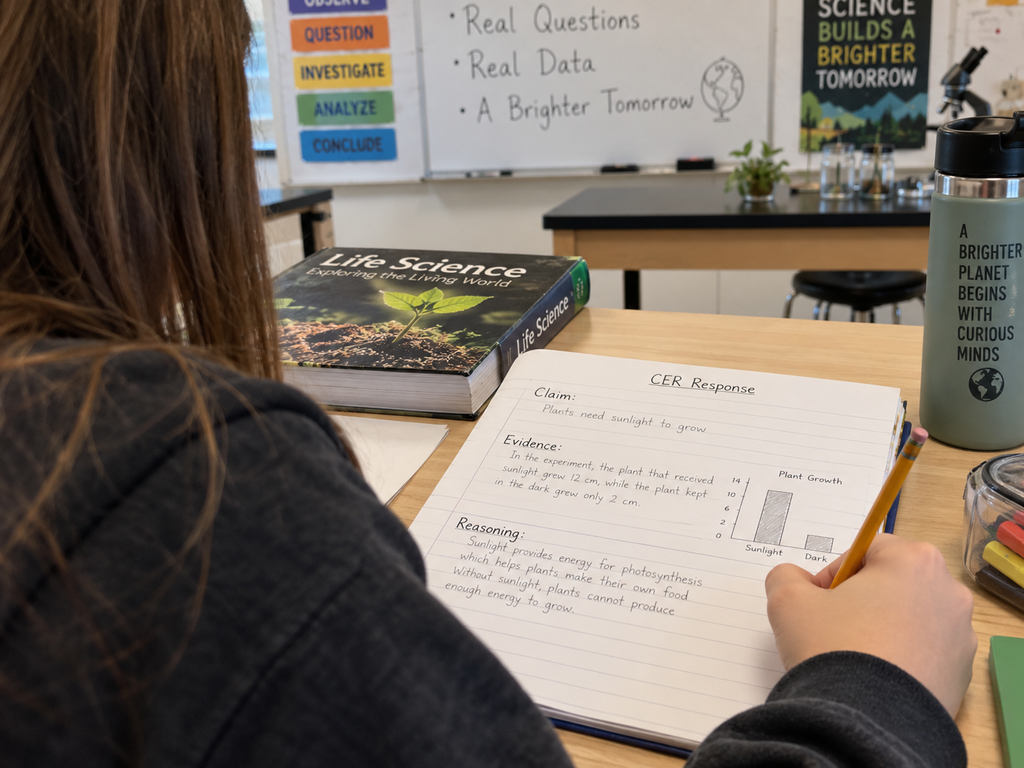
For example:
Claim: Plant A had the best conditions for growth.
Evidence: Plant A grew 18 cm, while Plant B grew 11 cm and Plant C grew 7 cm.
Reasoning: Greater plant growth indicates that the plant had more favorable conditions for carrying out the processes necessary for growth. Because Plant A had the greatest increase in height, the results support the conclusion that its growing conditions were the most favorable.
The reasoning connects the data to the science concept.
A helpful student reminder is:
Evidence tells WHAT happened. Reasoning explains WHY the evidence matters.
How to teach CER in science
CER Example for Science Students
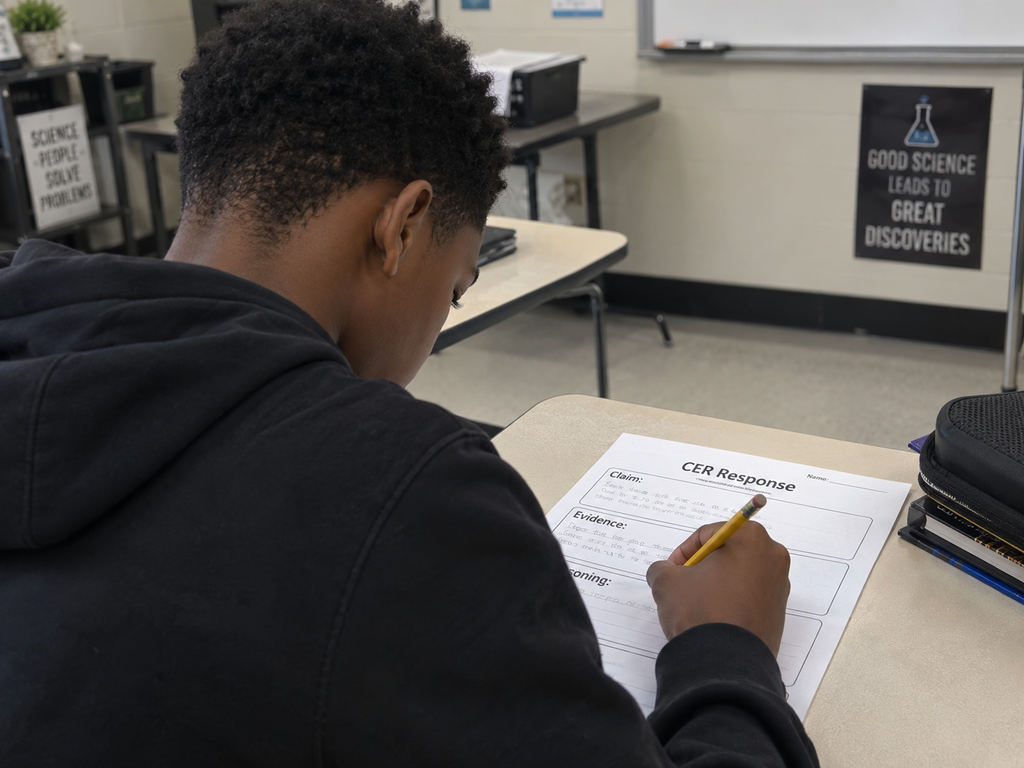
Here is a complete example students can use as a model.
Scientific Question
Which material was the best thermal insulator?
Claim
Material C was the best thermal insulator.
Evidence
The water surrounded by Material C decreased in temperature by only 3°C during the experiment. The water surrounded by Material A decreased by 8°C, and the water surrounded by Material B decreased by 6°C.
Reasoning
A good thermal insulator slows the transfer of thermal energy. Because the water surrounded by Material C experienced the smallest decrease in temperature, less thermal energy was transferred from the water to the surroundings. Therefore, the results support the claim that Material C was the best thermal insulator.
Notice that the reasoning does more than repeat the temperature changes. It explains the scientific relationship between thermal energy transfer and the experimental evidence.
Common CER Mistakes and How to Fix Them
Students tend to make several predictable mistakes when they first begin writing CER responses.
| Common Problem | What the Student Does | How to Help |
|---|---|---|
| Claim does not answer the question | Writes a general fact about the topic | Ask: “What exactly is the question asking?” |
| Evidence is too vague | Says “the graph shows” or “it was higher” | Require numbers, observations, or specific details |
| Evidence does not support the claim | Chooses interesting but irrelevant information | Ask: “Does this information help prove your claim?” |
| Reasoning repeats the evidence | Restates the numbers | Ask: “Why do those numbers matter?” |
| Reasoning lacks science content | Says “This proves my answer is correct” | Ask students to connect evidence to a science concept |
| Too much evidence | Copies an entire table or paragraph | Teach students to select the strongest evidence |
| Claim includes all three CER parts | Writes a long paragraph as the claim | Teach each CER component separately first |
The Difference Between Evidence and Reasoning
One of the most important CER lessons is helping students understand that evidence and reasoning are not the same thing.
Evidence
Evidence comes from the investigation, graph, data table, observation, or text.
Example:
The population decreased from 1,200 organisms to 700 organisms.
Reasoning
Reasoning explains why that information supports the claim.
Example:
A decrease in available food can limit the number of organisms an ecosystem can support. Therefore, the population decline is consistent with reduced resource availability.
A simple way to teach the difference is:
Evidence = What do you see?
Reasoning = What does it mean?
How to teach CER in Science: Use Graphs and Data to Practice CER
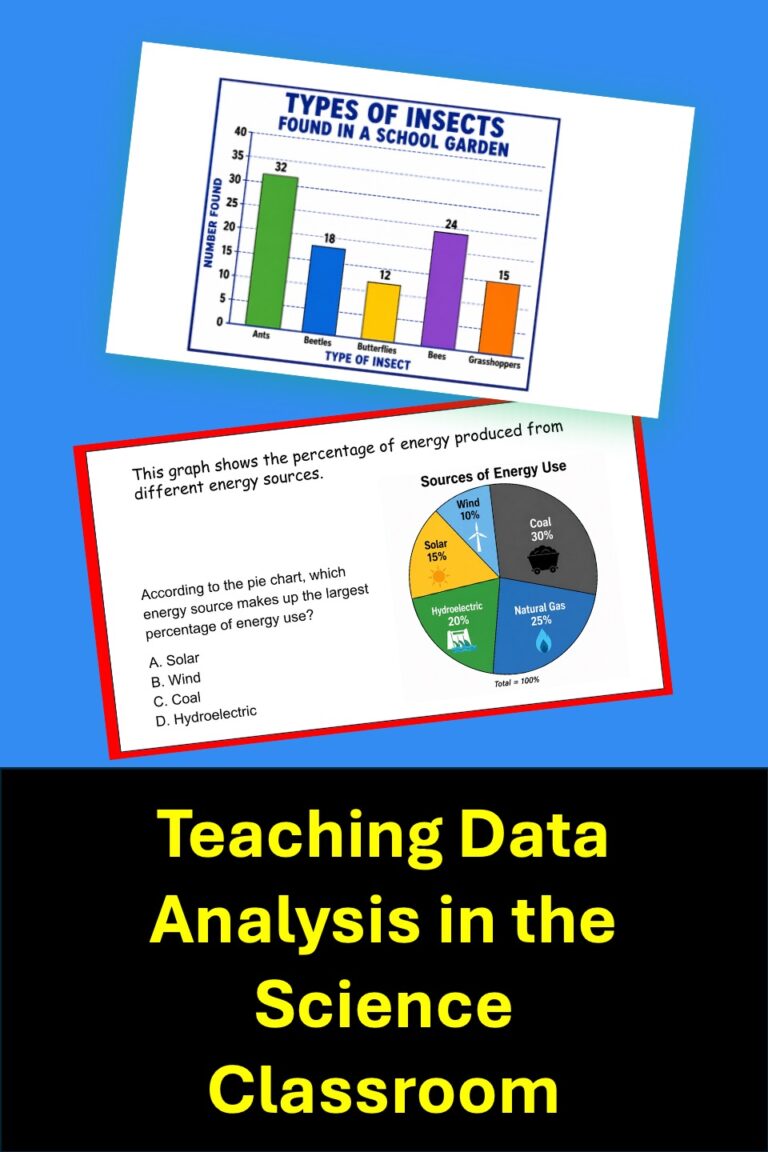
Graphs are especially effective for teaching CER because students have concrete evidence directly in front of them.
For example, give students a graph showing a rabbit population over several years and ask:
What happened to the rabbit population after the drought began?
Students might write:
Claim: The rabbit population decreased after the drought began.
Evidence: The population decreased from approximately 850 rabbits before the drought to about 500 rabbits two years later.
Reasoning: Drought can reduce the availability of water and plant food. When fewer resources are available, an ecosystem may support fewer rabbits, which explains the population decline shown in the graph.
This combines graph interpretation, data analysis, science content, and written scientific explanation in a single activity.
How to Teach CER in Science
Use Sentence Starters When Students Are Learning CER
Sentence starters can help students understand the structure of CER without giving them the answer.
Claim Sentence Starters
- My claim is that…
- The evidence suggests that…
- Based on the investigation, I conclude that…
Evidence Sentence Starters
- One piece of evidence is…
- The data show that…
- According to the graph…
- During the investigation…
- The results show…
Reasoning Sentence Starters
- This evidence supports my claim because…
- This is important because…
- Scientifically, this can be explained by…
- The relationship between ___ and ___ shows…
- Because we know that ___, the evidence suggests…
As students become more confident, gradually remove the sentence starters.
CER Should Not Be a Formula Students Simply Memorize
CER works best when students understand that it is a thinking process, not just a writing template.
Eventually, students should be able to recognize that strong scientific explanations naturally include:
- A conclusion
- Evidence supporting that conclusion
- An explanation connecting the two
Students may not always need to label the sections Claim, Evidence, and Reasoning. The long-term goal is for them to incorporate these elements naturally into scientific writing.
How to Scaffold CER for Struggling Students
How to teach CER in science: Students do not need to write a complete CER paragraph the first time they encounter the strategy.
Try gradually increasing the level of independence.
Beginning CER Practice
Give students the claim and ask them to identify the best evidence.
Next Step
Give students a claim and several possible pieces of evidence. Ask them to choose which evidence best supports the claim and explain why.
Developing Independence
Give students a graph or investigation and ask them to write the claim and evidence.
Complete CER
Ask students to independently write the claim, select appropriate evidence, and explain their reasoning.
This progression allows students to focus on one thinking skill at a time.
Teach Students to Evaluate CER Responses
One effective way to strengthen CER writing is to let students analyze examples.
Give students two responses and ask:
- Which claim answers the question more clearly?
- Which response uses stronger evidence?
- Is the evidence specific?
- Does the reasoning explain the science?
- Does the reasoning connect directly to the evidence?
- What could make the response stronger?
Evaluating someone else’s CER is often easier than evaluating their own. Once students recognize the components of a strong response, they can apply the same criteria to their writing.
How to teach CER in Science: A Simple CER Checklist for Students
Before submitting a CER response, students can ask:
Claim
- Did I answer the question?
- Is my answer clear?
Evidence
- Did I include evidence that supports my claim?
- Did I use specific data or observations?
- Did I include only relevant evidence?
Reasoning
- Did I explain why the evidence supports my claim?
- Did I use scientific ideas or concepts?
- Did I explain instead of simply repeating my evidence?
This short checklist can make a big difference in the quality of student responses.
How Often Should Students Practice CER?
CER should not be limited to major laboratory reports.
Students can practice CER in many parts of the science classroom, including:
- Bell ringers
- Graph analysis
- Laboratory investigations
- Exit tickets
- Science stations
- Phenomena-based lessons
- Data analysis activities
- Short constructed-response questions
- Review activities
- Assessments
Frequent, short CER practice can be more effective than asking students to complete an occasional lengthy scientific explanation.
When CER becomes part of the normal science routine, students begin to expect that scientific conclusions require evidence.
How to teach CER in Science: Why CER Is Important in Science
How to teach CER in science by using different strategies. Learning to write a CER helps students develop skills that extend far beyond one science assignment.
Students practice how to:
- Analyze evidence
- Interpret graphs and data
- Identify relevant information
- Develop scientific explanations
- Support conclusions
- Explain cause-and-effect relationships
- Communicate scientific thinking
- Distinguish observations from explanations
CER also helps shift classroom conversations away from simply asking:
“What is the answer?”
Instead, students begin asking:
“What evidence supports that answer?”
That is an important step toward authentic scientific thinking.
Frequently Asked Questions About How to Teach CER in Science
What does CER stand for in science?
CER stands for Claim, Evidence, and Reasoning. It is a framework used to help students construct scientific explanations based on evidence.
What is a claim in CER?
A claim is a clear statement that answers the scientific question or describes the conclusion reached from an investigation, graph, model, or set of data.
What counts as evidence in a CER?
Evidence can include data, measurements, observations, experimental results, information from a scientific text, or information shown in a graph, table, or model.
What is reasoning in CER?
Reasoning explains why the evidence supports the claim. Strong reasoning connects the evidence to relevant scientific concepts or principles.
What is the difference between evidence and reasoning?
Evidence describes the data or observations that support a claim. Reasoning explains what that evidence means and why it supports the claim.
Why is reasoning the hardest part of CER?
Students can often identify an answer and locate data, but reasoning requires them to connect that data to scientific knowledge. They must explain the relationship rather than simply report what they observed.
What grade levels can use CER?
CER can be adapted for upper elementary, middle school, and high school science. Younger students may begin with simple claims and observations, while older students can use multiple pieces of evidence and more sophisticated scientific reasoning.
Should students use more than one piece of evidence in a CER?
It depends on the question. Students should use enough relevant evidence to convincingly support their claim. For more complex questions, multiple pieces of evidence may be appropriate.
Can students use CER with graphs?
Yes. Graphs are excellent tools for CER practice because students can make a claim based on a pattern or relationship, cite specific data as evidence, and explain the scientific reason for the pattern.
Can CER be used as a science bell ringer?
Yes. Short CER questions work well as science bell ringers. Students can analyze a graph, data table, photograph, phenomenon, or short scenario and write a brief claim supported by evidence and reasoning.
How can teachers help students improve their CER writing?
Model strong responses, teach claim, evidence, and reasoning separately, provide sentence starters when needed, use frequent short practice, and allow students to evaluate example responses before writing independently.
How to Use Graphs as Evidence in a CER Response
Final Thoughts: Build CER Into Your Science Routine
Teaching students to write a strong Claim, Evidence, and Reasoning statement takes practice.
The biggest mistake is expecting students to master all three components immediately.
Start small.
Teach students to make a clear claim.
Then teach them to find strong, specific evidence.
Finally, spend plenty of time helping them understand how reasoning connects scientific evidence to a scientific idea.
With regular practice, students begin to understand that science is not simply about finding the right answer. Science is about making a conclusion, supporting it with evidence, and explaining why that evidence matters.
Read more about How to Write a CER
That is the real power of CER.
Lynda R. Williams is an experienced science educator and curriculum designer with more than 20 years of classroom experience helping students think, write, and communicate like scientists. She has extensive expertise in teaching CER (Claim, Evidence, and Reasoning) and creating resources that help students move beyond simple answers to evidence-based scientific explanations. Through her work in upper elementary and middle school science, as well as university-level science methods courses, Lynda has helped teachers make CER practical, accessible, and meaningful through engaging lessons, graph and data analysis, and scaffolded writing activities aligned to today’s science standards.