Utah SEEd Standards are Utah’s state science standards for kindergarten through high school. SEEd stands for Science with Engineering Education.
The Utah SEEd Standards are designed to help students do more than memorize scientific facts. Students use scientific knowledge to investigate phenomena, analyze data, create models, construct explanations, support claims with evidence, and design solutions to problems.
Although Utah SEEd shares many features with the Next Generation Science Standards, the two are not exactly the same. Utah educators used ideas from the national Framework for K–12 Science Education and the NGSS to create standards specifically for Utah students and teachers.
Watch: What Are the Utah SEEd Standards?
In this short video, I explain what Utah SEEd means, how the standards are organized, and what makes them different from a traditional science curriculum.
What Does Utah SEEd Stand For?
SEEd stands for Science with Engineering Education.
The name reflects the important role of engineering in science instruction. Engineering is not treated as a separate activity that teachers add after the science lesson. Students use both science and engineering to understand problems, test ideas, evaluate evidence, and develop possible solutions.
For example, students might:
- Design a solution that reduces erosion
- Compare materials for insulating a container
- Develop a model of an ecosystem
- Analyze data about weather patterns
- Test a structure to determine how well it withstands a force
- Evaluate ways to reduce human effects on the environment
Students are learning science content, but they are also learning how scientists and engineers approach questions and solve problems.
What Are the Three Dimensions of Utah SEEd?
Utah SEEd Standards use a three-dimensional approach to science instruction.
The three dimensions are:
- Disciplinary Core Ideas
- Science and Engineering Practices
- Crosscutting Concepts
Each Utah SEEd standard brings these dimensions together into one learning expectation. Students are not supposed to learn the three dimensions in isolation. They use them together to understand a scientific idea or explain a phenomenon.
| Dimension | Simple Definition | Classroom Example |
|---|---|---|
| Disciplinary Core Ideas, or DCIs | The science content students need to understand | Ecosystems, forces, matter, heredity, weather, energy, or Earth systems |
| Science and Engineering Practices, or SEPs | What students do as scientists and engineers | Analyze data, develop models, plan investigations, explain results, or design solutions |
| Crosscutting Concepts, or CCCs | Thinking tools that connect different areas of science | Patterns, cause and effect, systems, structure and function, or stability and change |
Disciplinary Core Ideas
Disciplinary Core Ideas are the important science concepts students learn.
These ideas come from four broad areas:
- Physical science
- Life science
- Earth and space science
- Engineering, technology, and applications of science
However, Utah SEEd instruction is not limited to delivering science content. Students must use that content to investigate, reason, explain, and solve problems.
Science and Engineering Practices
Science and Engineering Practices describe what students should be doing during science instruction.
Students may be asked to:
- Ask questions
- Define problems
- Develop and use models
- Plan and conduct investigations
- Analyze and interpret data
- Use mathematics and computational thinking
- Construct explanations
- Design solutions
- Argue from evidence
- Obtain, evaluate, and communicate information
These practices help move science instruction away from passive note-taking and toward active learning.
Crosscutting Concepts
Crosscutting Concepts are broad ideas that appear throughout every field of science.
The seven Crosscutting Concepts are:
- Patterns
- Cause and effect
- Scale, proportion, and quantity
- Systems and system models
- Energy and matter
- Structure and function
- Stability and change
For example, students might examine patterns in earthquake data, study cause-and-effect relationships in an ecosystem, or explore how the structure of a cell relates to its function.
Crosscutting Concepts help students connect what they learn in one science unit to ideas they encounter in another.
How Are Utah SEEd Standards Different From Traditional Science Standards?
Traditional science standards often focused heavily on what students needed to know. Teachers covered a list of topics, and students were frequently assessed on vocabulary, definitions, and factual recall.
Utah SEEd Standards still include important scientific content, but students must also demonstrate that they can use their knowledge.
| Traditional Science Instruction | Utah SEEd Instruction |
|---|---|
| Begins with facts or vocabulary | Often begins with a phenomenon, question, or problem |
| Focuses primarily on content knowledge | Combines content, practices, and scientific thinking |
| Students read or listen to learn information | Students investigate, model, analyze, explain, and communicate |
| Labs may confirm something already taught | Investigations help students develop scientific understanding |
| Questions often have one short correct answer | Students use evidence to explain and defend their thinking |
| Engineering may be an optional enrichment activity | Engineering is intentionally included in the standards |
| Topics may be taught as separate facts | Students connect ideas through Crosscutting Concepts |
This does not mean that vocabulary, reading, or direct instruction should disappear from the science classroom. Students still need clear instruction and strong background knowledge.
The difference is that these tools support sense-making. Students use what they learn to explain something, analyze evidence, build a model, or solve a problem.

Are Utah SEEd Standards the Same as NGSS?
No. Utah SEEd Standards are not identical to the Next Generation Science Standards, but they are closely related.
Utah’s standards were created by Utah educators and scientists. The writers used several research-based sources, including the Framework for K–12 Science Education and the Next Generation Science Standards. The official Utah standards state that most Utah SEEd Standards are based on NGSS.
Utah then organized and adapted the standards to create its own grade-level expectations.
| Utah SEEd | NGSS |
|---|---|
| Adopted specifically for Utah schools | Developed for states to consider adopting |
| Written and organized for Utah students and educators | Provides national performance expectations |
| Uses three-dimensional science learning | Uses three-dimensional science learning |
| Includes Utah-specific grade and course organization | States may adopt or reorganize the standards |
| Uses Utah’s own standard numbers and strands | Uses NGSS performance expectation codes |
| May change the placement or emphasis of some concepts | Provides a broader national structure |
Because the two systems are closely connected, an NGSS resource may support a Utah standard. However, the label “NGSS aligned” does not automatically mean the resource fully covers Utah SEEd.
Teachers should still check:
- The grade level
- The Utah strand
- The specific Utah standard
- The Science and Engineering Practice
- The Crosscutting Concept
- Any emphasis statement
- Any required engineering component
A resource might cover the correct scientific topic but place it at a different grade level or use a different student expectation.

How Are the Utah SEEd Standards Organized?
Utah SEEd Standards are organized into strands.
A strand is a group of related standards built around an important area of learning. The introduction to each strand helps teachers understand how the standards connect and what students should understand by the end of the unit.
Each standard number identifies:
- The grade or course
- The strand
- The individual standard within the strand
For example, 6.3.2 refers to:
- Grade 6
- Strand 3
- Standard 2
This organization makes it easier for teachers to see where each standard belongs within the grade-level curriculum.
The standards also use formatting to show the three dimensions:
- The Science and Engineering Practice is bolded.
- The Crosscutting Concept is underlined.
- The science content is written in regular text.
- Specific engineering expectations are italicized.
- Emphasis statements identify required areas of focus.
- Example statements provide possible contexts but are not necessarily required.
This formatting helps teachers see what students should do, how students should think, and what science content they should use.
Are Utah Middle School Science Standards Integrated?
Yes. Utah’s middle school standards are integrated by grade level.
Students study concepts from physical science, life science, and Earth and space science during middle school rather than taking one completely separate discipline each year.
For example, a single middle school grade may include standards related to:
- Matter and energy
- Earth systems
- Ecosystems
- Forces and motion
- Cells and body systems
- Heredity and natural selection
- Waves and information transfer
The topics are placed into grade-level strands that are designed to build understanding over time. Utah currently provides separate standards for grades 6, 7, and 8.
This integrated organization is one reason Utah teachers should check the exact grade alignment of any science resource they purchase or use.
What Role Do Phenomena Play in Utah SEEd?
A science phenomenon is an observable event that students can investigate and explain.
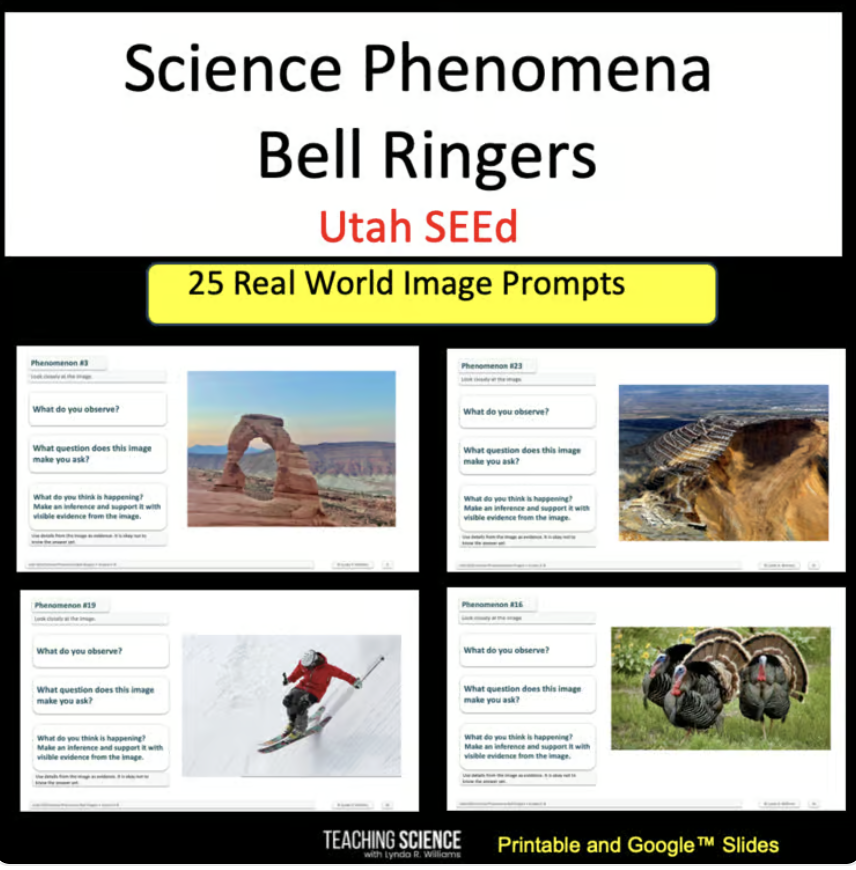
Phenomena give students a reason to learn the science content. Instead of beginning a unit by giving students all the information, a teacher might begin with:
- An unusual photograph
- A demonstration
- A short video
- A set of data
- A real-world event
- A puzzling observation
- A local environmental problem
Students make observations, ask questions, and develop initial explanations. As they gather evidence and learn new scientific ideas, they revise their thinking.
For example, students might investigate:
- Why a metal spoon feels colder than a wooden spoon
- Why Utah experiences temperature inversions
- Why some areas experience more erosion than others
- Why the Moon appears to change shape
- Why organisms in an ecosystem affect one another
- Why some materials heat or cool faster than others
Phenomena should not simply be entertaining hooks. They should provide a meaningful reason for students to use science content, practices, and Crosscutting Concepts.
What Does a Utah SEEd Classroom Look Like?
A Utah SEEd classroom does not have to be loud, complicated, or filled with expensive laboratory equipment.
It is a classroom in which students regularly make sense of science.
Students may:
- Observe a phenomenon
- Ask questions
- Discuss possible explanations
- Analyze graphs and data
- Read scientific information
- Develop or revise models
- Conduct an investigation
- Compare possible solutions
- Write a claim supported by evidence
- Explain their reasoning
- Communicate what they have learned
Teachers still provide instruction, clarify misconceptions, introduce vocabulary, model scientific thinking, and guide students toward accurate explanations.
The major shift is that students are active participants in developing understanding.
Why Is Utah SEEd Alignment Challenging for Teachers?
Finding resources for Utah SEEd can be challenging because many science materials are labeled only by topic or by a general NGSS code.
A lesson about ecosystems, for example, may contain good information but still fail to address the complete Utah standard.
True alignment requires teachers to consider:
- What students must know
- What students must do
- Which Crosscutting Concept students should use
- The expected level of rigor
- The grade-level placement
- Required emphasis statements
- Engineering expectations
- How the standard connects to the rest of the strand
Teachers should not have to piece together an entire curriculum from unrelated activities that happen to mention the correct topic.
Carefully aligned resources can help teachers create a more coherent learning experience while ensuring that students practice the skills identified in the standards.
Frequently Asked Questions About Utah SEEd Standards
What does SEEd mean in Utah science?
SEEd means Science with Engineering Education. The standards intentionally combine science content with scientific investigation, engineering design, and evidence-based reasoning.
Is Utah SEEd the same as Common Core?
No. Utah SEEd refers specifically to Utah’s science standards. However, science instruction can also reinforce literacy and mathematics skills, such as reading informational text, analyzing data, writing explanations, and using mathematical reasoning.
Is Utah SEEd the same as NGSS?
No. Utah SEEd is Utah’s own set of science standards. The standards are strongly influenced by NGSS and the Framework for K–12 Science Education, but they are organized and adopted specifically for Utah.
Do Utah SEEd Standards require hands-on learning?
The standards require students to engage in Science and Engineering Practices. Hands-on investigations can be an effective way to meet these expectations, but students can also analyze data, develop models, evaluate information, construct explanations, and design solutions.
Do teachers need to teach all three dimensions?
Yes. Each Utah SEEd standard combines a Disciplinary Core Idea, a Science and Engineering Practice, and a Crosscutting Concept. Students need opportunities to use all three dimensions together.
Can teachers use NGSS resources in Utah?
Yes, many NGSS resources can support Utah SEEd instruction. However, teachers should verify the grade placement, content expectation, practice, Crosscutting Concept, and emphasis of the Utah standard before assuming full alignment.
Are Utah SEEd Standards grade specific?
Yes. Utah provides grade-specific science standards for elementary and middle school, followed by course-specific standards in high school.
The Goal of Utah SEEd Science Instruction
The goal of Utah SEEd is not simply to cover more science topics.
The goal is to help students become scientifically literate thinkers who can:
- Ask meaningful questions
- Evaluate information
- Recognize patterns
- Analyze evidence
- Explain natural events
- Solve problems
- Communicate clearly
- Make informed decisions
When instruction is carefully aligned to Utah SEEd, students learn that science is not only a collection of facts. Science is a way of investigating questions, making sense of the natural world, and developing solutions that can improve people’s lives.
For teachers, understanding the structure of Utah SEEd is the first step toward creating lessons that are rigorous, engaging, and truly aligned to the standards.
About Lynda R. Williams
Lynda R. Williams is a science and STEM education expert with more than 34 years of teaching and curriculum design experience. She holds a master’s degree in Curriculum and Instruction, has taught both elementary science and university-level science methods courses, and has worked extensively with the Utah SEEd Standards.
Lynda specializes in creating engaging, teacher-friendly science resources that are carefully aligned to Utah’s grade-specific standards. Her lessons emphasize three-dimensional learning, science and engineering practices, crosscutting concepts, phenomena, data analysis, and evidence-based reasoning. Through Teaching Science with Lynda R. Williams, she helps Utah teachers save planning time while providing rigorous, meaningful science instruction for their students.